



Where Every Rupee Goes: I Opened Pakistan's 2026-27 Budget So You Do Not Have To
One citizen reading the national accounts, line by line, in plain words
By Asad Baig • Written from outside Pakistan • June 2026 • Approx. 25-min read
Every year the government lays a budget before the National Assembly that runs to thousands of pages and many trillions of rupees. A few totals appear in the news, the talk shows argue over them for a week, and the document goes back on the shelf. Most of us never open it. Our days are spent earning a living for our families, and we have no time to read the budget line by line.
So I read it for you. I sat down with the official numbers for 2026 to 2027 and arranged them so that any one of us, with no training in economics, can follow where the money is raised and where it is spent. Every figure here is the government's own Budget Estimate, in billions of rupees. I have not invented a single number. I do not need to. The numbers are bad enough on their own.
This is the full breakdown. For what I feel about it, read my opinion piece, where is the plan. Here I will mostly show you the figures, and let them do the talking. But I am not going to pretend I have no view. I do. You will see it.
Where does Pakistan's 2026-27 budget money go?
Of every Rs 100 the federal government spends in 2026-27, about Rs 43 goes to interest on past debt, Rs 16 to defence, Rs 14 to grants and cash support including BISP, and roughly Rs 5 each to pensions, subsidies, running the government and development. The total budget is Rs 18,771 billion. After interest and defence are paid, every other line, your child's school, your mother's hospital, the road to your town, is fighting over the few rupees that are left.
That one sentence is the whole budget in your hand. Now let me open it properly.
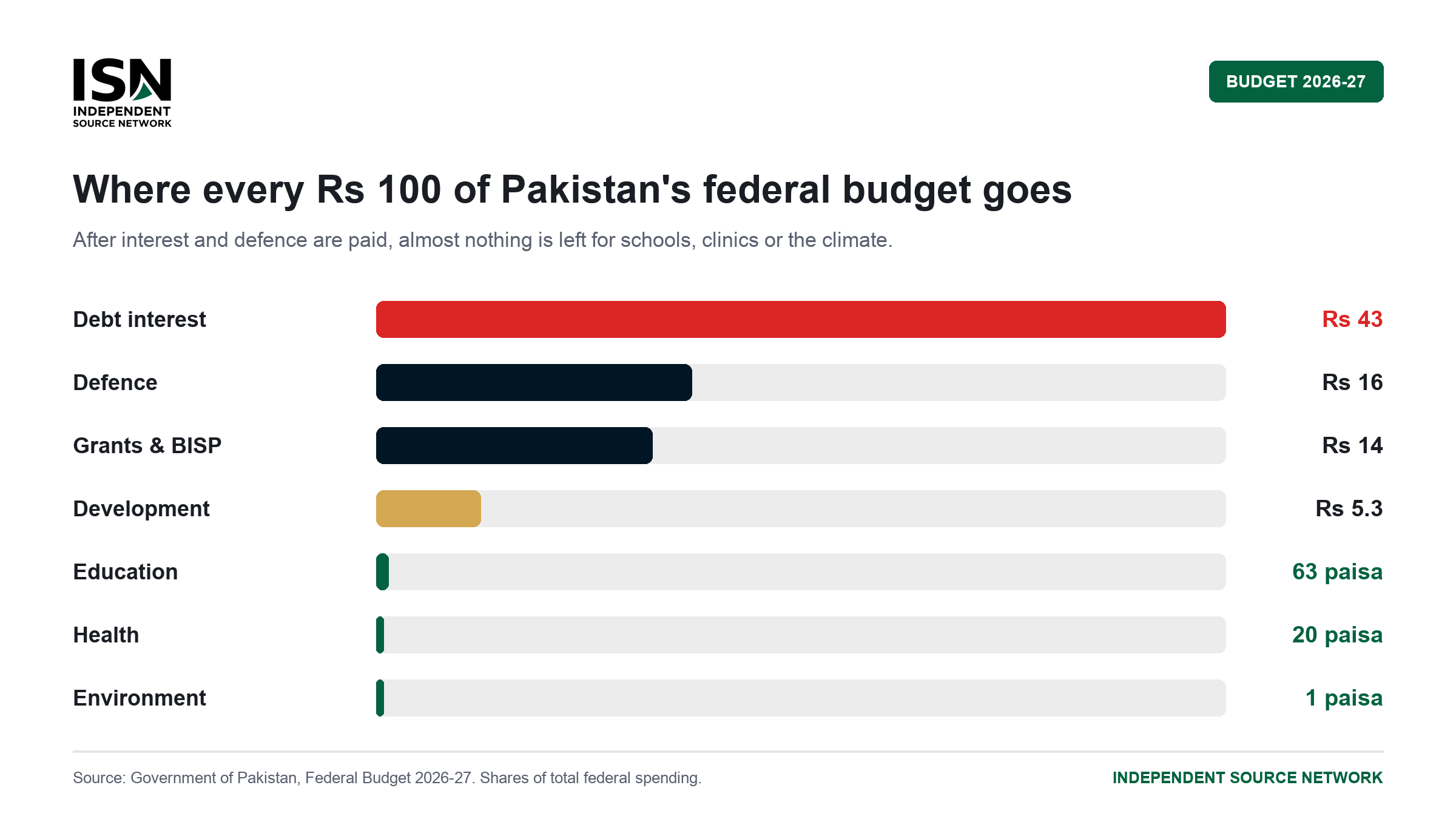
Where every Rs 100 of the federal budget goes.
The shape of it
Begin with one figure. For 2026 to 2027 the government intends to spend Rs 18,771 billion. That number is too large to feel, so I will do what the budget itself does and shrink it to a single Rs 100 note. Every department draws its share from that note.
Against last year the budget grew by about 6.8 percent, from Rs 17,573 billion to Rs 18,771 billion. Do not be fooled by the growth. Prices rose over the same year, so much of that increase is just inflation, not more spending on you. The economy as a whole, the nominal gross domestic product, is put at roughly Rs 143,604 billion.
| Indicator | FY 2025-26 | FY 2026-27 | Change |
|---|---|---|---|
| Total budget outlay | 17,573 | 18,771 | +6.8% |
| Gross revenue receipts | 19,278 | 20,600 | +6.9% |
| Federal Board of Revenue tax target | 14,131 | 15,264 | +8.0% |
| Transfer to the provinces | 8,206 | 8,848 | +7.8% |
| Net revenue retained by the centre | 11,072 | 11,751 | +6.1% |
| Current expenditure | 16,286 | 17,495 | +7.4% |
| Development and net lending | 1,287 | 1,276 | -0.9% |
| Federal budget deficit | 6,501 | 7,020 | +8.0% |
| Overall fiscal deficit (percent of GDP) | 3.9% | 3.6% | -0.3 |
| Nominal gross domestic product | 129,567 | 143,604 | +10.8% |
Figures in billions of rupees, except the deficit ratio.
Two lines in that table decide almost everything else. The first is the money that goes to the provinces. Of the roughly Rs 20,600 billion the federation collects, about Rs 8,848 billion passes straight to the four provinces under the constitutional formula, which leaves the centre with around Rs 11,751 billion of its own. The second is the gap between that and what the centre actually spends. The government plans to spend far more than it keeps, and it fills the difference by borrowing. Hold those two facts. Everything else grows out of them.
How they raise the money from you
Before the budget is divided, it has to be collected, and it is collected mostly from you. The government raises money in two ways. The larger part is taxes. The smaller part, called non-tax revenue, is levies, the profits of state bodies, fees and dividends.
Taxes carry most of the weight. The Federal Board of Revenue is told to collect Rs 15,264 billion this year, about 8 percent more than last year. And here is the part that matters for an ordinary family. Taxes come in two kinds. Direct taxes, mainly income tax, are paid out of what people and companies earn. Indirect taxes, sales tax, excise, customs, are hidden inside the price of goods, so they fall on everyone who buys, rich or poor, the same.
| Revenue source | FY 2025-26 | FY 2026-27 | Change |
|---|---|---|---|
| Income tax (direct) | 6,811 | 7,481 | +9.8% |
| Sales tax (indirect) | 4,753 | 4,927 | +3.7% |
| Customs duty (indirect) | 1,588 | 1,651 | +4.0% |
| Federal excise duty (indirect) | 888 | 1,073 | +20.8% |
| Petroleum levy (non-tax) | 1,468 | 1,676 | +14.2% |
| State Bank profit (non-tax) | 2,400 | 1,436 | -40.2% |
| Carbon levy (new this year) | 0 | 50 | new |
Figures in billions of rupees.
Look at the petroleum levy. A charge on every litre of fuel, expected to bring Rs 1,676 billion, more than customs duty brings in. And unlike most taxes, it is not shared with the provinces, so the centre keeps all of it. The excise duty jumps by a fifth. A new carbon levy appears for the first time. And the State Bank's profit falls by about 40 percent, which is part of why they lean harder on your fuel and your shopping this year.
What I mean to say is this. The weight of raising this money sits more on what you buy than on what the richest earn. That is not the choice of one year. It is how this country has always raised its revenue. I explain it in full in how Pakistan raises its money.
The first division: where every Rs 100 goes
Once the money is collected and the provinces take their share, where does the federal government's own spending go? There are two honest ways to cut it, and each answers a slightly different question.
The first sorts the spending by the kind of payment it is, interest, running costs, grants. These add up cleanly to the whole Rs 100.
| Where it goes | Per cent | Out of Rs 100 | Rs billion |
|---|---|---|---|
| Debt interest (mark-up) | 42.9% | Rs 42.90 | 8,054 |
| Defence | 16.0% | Rs 16.00 | 3,000 |
| Grants and transfers (incl. BISP) | 14.3% | Rs 14.30 | 2,680 |
| Pensions | 6.2% | Rs 6.20 | 1,169 |
| Subsidies | 5.8% | Rs 5.80 | 1,091 |
| Running of civil government | 5.7% | Rs 5.70 | 1,071 |
| Development programme (PSDP) | 5.3% | Rs 5.30 | 1,000 |
| Emergency and disaster | 2.3% | Rs 2.30 | 430 |
| Net lending | 1.5% | Rs 1.50 | 276 |
| Total | 100% | Rs 100 | 18,771 |
Shares are of total federal spending.
One line towers over everything. Almost 43 rupees in every 100 are spent on interest, the cost of money borrowed in years gone by. It builds no school, pays no doctor, opens no hospital. It is simply the price of old debt, and it is by far the biggest item in the whole budget. Read that line again. I want it to sit with you. I follow this number all the way down in the 43 percent, how debt interest eats the budget.
Defence comes next, at 16 rupees. After these two, everything falls away. The development programme, the money that actually builds the country, is about 5 rupees and 30 paisa. I break the payment-type view down further in where every hundred rupees goes.
The second division: by sector
The second way sorts the same money by sector, which is closer to how most of us picture a budget. Here one category, called general public service, acts like an umbrella and swallows both interest and pensions, so it looks enormous. The smaller lines under it are what you are really looking for.
| Sector | Per cent | Out of Rs 100 | Rs billion |
|---|---|---|---|
| General public service | 68.2% | Rs 68.20 | 12,800 |
| Defence | 16.0% | Rs 16.04 | 3,011 |
| Development and net lending | 6.8% | Rs 6.80 | 1,276 |
| Social protection (incl. BISP) | 4.6% | Rs 4.57 | 857 |
| Public order and safety | 2.1% | Rs 2.08 | 389 |
| Economic affairs | 1.3% | Rs 1.27 | 238 |
| Education | 0.6% | Rs 0.63 | 118 |
| Health | 0.2% | Rs 0.20 | 37 |
| Recreation, culture and religion | 0.13% | Rs 0.13 | 24 |
| Housing and community | 0.10% | Rs 0.10 | 19 |
| Environment | 0.01% | Rs 0.01 | 2.4 |
General public service is mostly debt interest and pensions, plus administration and aid. Figures in billions of rupees.
This table holds the plainest, hardest facts in the whole budget. Once you set aside the general public service umbrella, which is mostly interest and pensions under another name, the real sectors are tiny. Education, about 63 paisa in the hundred. Health, about 20 paisa. Culture, sport and religion together, about 13. And the environment, a single paisa.
Now, I have to be fair, and I will be. Part of this is accounting. Under the eighteenth amendment most schools and hospitals are paid for by the provinces, not the centre, so these federal lines understate what the country spends. I deal with that honestly in education, health and the smallest shares and in the 18th amendment, why these figures understate spending. But even after I allow for all of that, the distance between these sectors and the cost of debt and defence is the cruellest thing on the page.
One figure beside another
A number like Rs 118 billion for education means nothing until you put it next to something. So let me do only that. One line of the budget, beside another. The figures are exact. The arithmetic is simple. The feeling is yours.
| This... | ...beside this | The gap |
|---|---|---|
| Debt interest, 8,054 | Development, 1,000 | Interest is about 8 times development |
| Defence, 3,011 | Education, 118 | Defence is about 25 times education |
| Cash support, 845 | Education, 118 | Cash support is about 7 times education |
| Running of government, 1,071 | Development, 1,000 | The cost of running it exceeds what it builds |
| Defence, 3,011 | Health, 37 | Defence is about 80 times health |
| Social protection, 857 | Health and education, 155 | Over 5 times the two combined |
| Debt interest, 8,054 | Health, education, environment, 157 | About 50 times all three |
Figures in billions of rupees, all for the year 2026 to 2027.
Twenty-five rupees on the army for every one rupee on a child's school. Eighty rupees on defence for every one on a hospital. I am not telling you the army needs nothing. I am asking you to look at the ratio, and to feel it, because the people who wrote this budget are counting on you never seeing it laid out like this.
And look at one more. The cost of simply running the government, Rs 1,071 billion, is now larger than the entire development budget of Rs 1,000 billion. A state that spends more on keeping itself running than on everything it builds. I take that apart in the cost of governing.
This year against the last
A budget is easiest to judge against the one before it. Some lines rose this year. Some were cut. The direction tells you what they chose to protect, and what they let die quietly.
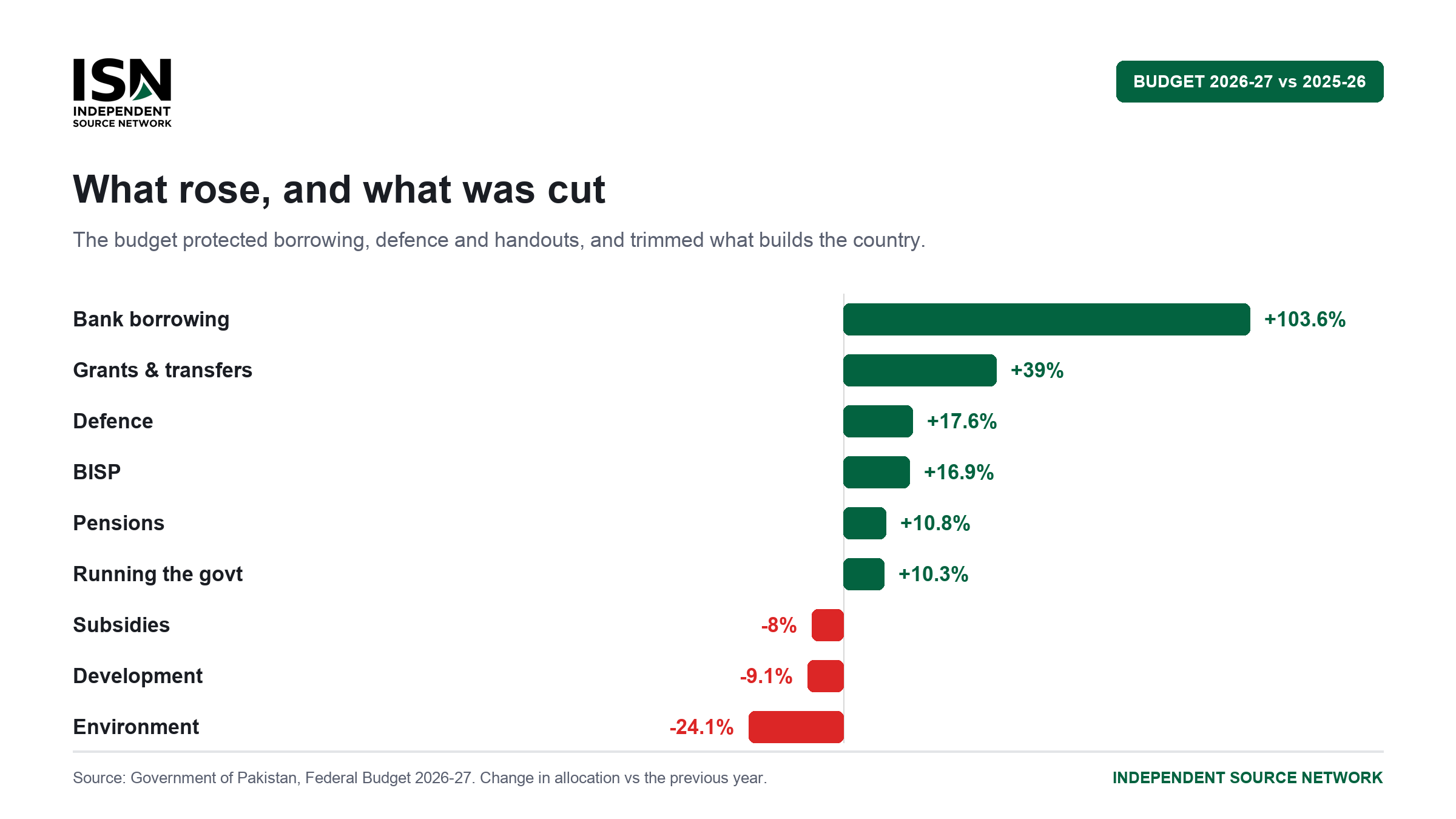
What rose, and what was cut. They protected borrowing, defence and handouts, and trimmed what builds the country.
| Item | FY 2025-26 | FY 2026-27 | Change |
|---|---|---|---|
| Bank borrowing | 1,971 | 4,012 | +103.6% |
| Federal education and training (dev.) | 18.6 | 36.3 | +95.4% |
| Grants and transfers | 1,928 | 2,680 | +39.0% |
| Federal excise duty | 888 | 1,073 | +20.8% |
| Defence affairs and services | 2,550 | 3,000 | +17.6% |
| Benazir Income Support Programme | 722.5 | 844.8 | +16.9% |
| Higher Education Commission (dev.) | 39.5 | 46.0 | +16.5% |
| Petroleum levy | 1,468 | 1,676 | +14.2% |
| Pensions | 1,055 | 1,169 | +10.8% |
| Running of civil government | 971 | 1,071 | +10.3% |
| Debt interest | 8,207 | 8,054 | -1.9% |
| Subsidies | 1,186 | 1,091 | -8.0% |
| Development programme (PSDP) | 1,100 | 1,000 | -9.1% |
| State Bank profit | 2,400 | 1,436 | -40.2% |
| Environment protection | 3.2 | 2.4 | -24.1% |
Figures in billions of rupees. (dev.) marks a development allocation.
Read down that table and the story tells itself. What grows fastest is borrowing and fixed obligations. Bank borrowing more than doubles. Grants and cash support rise. Defence and pensions grow faster than ordinary inflation. And what falls? Development, cut by about 9 percent. Subsidies, cut by 8. The environment, cut by a quarter. They protected what they pay out and what they owe. They cut what builds the country and what protects the land. I go through the whole comparison in this year against the last.
I will be fair here too, because I promised the numbers would talk. Some good things did rise. Federal education and training almost doubled. The Higher Education Commission rose by about a sixth. These are small in rupees but real. This is not a budget of total retreat. It is a budget that guards its debts and its handouts, and trims the future.
Where the borrowing comes in
One line in that table deserves its own paragraph. Bank borrowing more than doubled, from Rs 1,971 billion to Rs 4,012 billion. This is the clearest proof of the gap I told you to hold at the start.
The centre keeps about Rs 11,751 billion after paying the provinces. Its day-to-day spending alone is Rs 17,495 billion. The difference has to be borrowed, and more and more of it is borrowed from our own banks. That borrowing at home is what makes credit dear for every business that wants to grow, a thing I follow in why most of our interest is owed at home. It is also the same wound as the money that leaves the country, which I have written about in the capital that flies out of Pakistan every year.
How to read the budget yourself
You do not need the full documents to follow this. Three habits make the budget readable, and they are the habits I used here.
First, shrink every figure to the Rs 100 note. A number in the trillions means nothing to the eye. The same number as a share of 100 rupees can be held in your hand. When I say interest is Rs 42.90, I mean that out of every 100 rupees, almost 43 go to interest.
Second, always set this year beside last year. One figure tells you a department's size. The change from last year tells you the direction they chose. A line that rose 17 percent was protected. A line cut 9 percent was not.
Third, watch the words that hide things. General public service sounds like clerks and offices. It is mostly interest and pensions. Current expenditure sounds technical. It just means the day-to-day cost of the state, as opposed to development, which builds. Once you know what the umbrellas hide, the budget stops hiding from you.
And one habit for anyone who buys fuel. The petroleum levy, Rs 1,676 billion this year, is charged on every litre, and the centre keeps all of it. So part of what you pay at the pump is not the price of fuel at all. It is a federal charge that funds this budget directly, and it grew 14 percent this year. Reading the budget is partly a matter of finding your own bills inside it.
They write the budget so you will not read it. But you can. Shrink it to 100 rupees, set this year beside last, learn what the umbrellas hide, and find your own bills inside it. Then no one can tell you what is in it but you.
What could change, if they wanted it to
I will not only complain. Let me tell you what serious people, even the lenders, say could change, so you can judge the government against it.
The first is the tax net. We collect a low share of our economy in tax, and we lean on the taxes hidden in prices, which fall on everyone. Widening direct tax, bringing untaxed sectors in, and leaning less on the fuel levy, these are the reforms the lenders themselves ask for.
The second is the cost of debt. Because interest is the biggest line, and it tracks the rate at which the government borrows, lower inflation and a lower rate are the single strongest lever. It is slow work, and it needs a stability we keep losing.
The third is the balance between spending today and building for tomorrow. When they cut development to protect day-to-day spending, the things that grow the economy shrink, and next year is harder, not easier. Protecting development even in a tight year is what many economists beg for.
The fourth is plain honesty. Because the running of government and general public service appear as single huge blocks, you cannot see which ministries ate the increase. A full, line-by-line account would let you judge how much is unavoidable and how much is feeding itself. That is the least we should ask.
Everything in this budget grows from one fact. As long as interest takes more than two fifths of all spending, the room left for your children, your clinics, your clean air and your roads stays small. That is the whole story.
What the figures show
On one page, the budget for 2026 to 2027 has a clear shape, and it is the figures, not my anger, that draw it.
Of every hundred rupees the government spends, about 43 go to interest and 16 to defence. Together those two take almost three rupees in every five. Pensions, grants, subsidies and the cost of running the government eat most of what is left. What remains to build the future is about Rs 5.30, less than the cost of running the office that spends it. Education, health, culture and the environment together come to little more than a single rupee of the hundred.
Against last year, the budget guarded its debts and its handouts, and trimmed development, subsidies and the environment. The deficit narrows only a little, and mostly on paper, because the government runs a surplus on its day-to-day account and then borrows to pay the interest it already owes.
That is the arithmetic of the year, in the government's own numbers. I have not raised my voice in this piece. I did not need to. I only set their figures beside each other and let you see the shape they make. The anger, if you feel it, is your own, and it is honest. For what I believe we should do about it, read where is the plan.
Frequently asked questions
What is the total size of Pakistan's 2026-27 budget? The total federal budget outlay for 2026-27 is Rs 18,771 billion, up about 6.8 percent from Rs 17,573 billion last year. The economy as a whole, nominal GDP, is put at about Rs 143,604 billion.
Where does most of Pakistan's budget money go? The largest single item is debt interest at about Rs 8,054 billion, or 42.9 percent of all federal spending. Defence is second at about Rs 3,000 billion, or 16 percent. Together, interest and defence take close to three fifths of the budget.
How much does Pakistan transfer to the provinces? About Rs 8,848 billion of the roughly Rs 20,600 billion the federation collects passes to the four provinces under the constitutional formula, leaving the centre with about Rs 11,751 billion of its own.
How much is Pakistan's fiscal deficit in 2026-27? The federal budget deficit is about Rs 7,020 billion, roughly 3.6 percent of GDP, down from 3.9 percent last year. The government also runs a primary surplus, which is the balance before interest is counted.
What is the new carbon levy? A carbon levy appears for the first time in 2026-27 and is expected to raise about Rs 50 billion. It joins the petroleum levy, projected at Rs 1,676 billion, on the non-tax side of revenue.
How much does Pakistan spend on education and health? At the federal level, education gets about Rs 118 billion and health about Rs 37 billion, roughly 63 paisa and 20 paisa in every 100 rupees. Most school and hospital spending sits in the provincial budgets under the eighteenth amendment.
Did the budget really grow, or is it just inflation? Mostly inflation. The 6.8 percent rise in spending is close to the rate of inflation over the same year, so much of the increase is higher prices, not more real spending on you.
Why did bank borrowing double? Because the centre spends far more than it keeps after paying the provinces, and it fills the gap by borrowing, more and more of it from domestic banks. Bank borrowing rose from Rs 1,971 billion to Rs 4,012 billion.
Sources and notes
- Government of Pakistan, Federal Budget 2026-27: Budget in Brief, Annual Budget Statement, and Demands for Grants. All figures are Budget Estimates in billions of rupees, rounded for readability, so columns may not always sum exactly.
- Headline aggregates, revenue sources, spending heads and sector shares: Federal Budget 2026-27 documents.
- Provincial transfer and net federal revenue: National Finance Commission award framework as applied in the 2026-27 budget.
- This is my reading of the government's own published figures. The numbers are theirs. The view is mine, and where it is my view I have said so.
Related reading
- The opinion: where is the plan, a citizen's view of the budget
- The 43 percent: how debt interest eats Pakistan's budget
- Education, health and the smallest shares of Pakistan's budget
- BISP, subsidies and the politics of cash support
- Cluster explainers: how Pakistan raises its money, where every hundred rupees goes, the budget by sector, this year against the last


 ISN MEDIA