



Where Every Hundred Rupees Goes: Pakistan's Budget by Payment Type
The 2026-27 federal budget reduced to a single Rs 100 note
By the ISN Media desk • June 2026 • Approx. 7-min read
A budget in the trillions is hard to picture, so this explainer reduces Pakistan's 2026-27 federal spending to a single Rs 100 note and shows what each department draws from it. The figures are Budget Estimates from the Government of Pakistan, sorted by the kind of payment each represents. For the full guide, see Pakistan's federal budget 2026-27, where every rupee goes.
Where does every 100 rupees of Pakistan's budget go?
Of every Rs 100 the federal government spends in 2026-27, about Rs 43 goes to interest on past debt, Rs 16 to defence, Rs 14 to grants and cash support including BISP, and roughly Rs 5 each to pensions, subsidies, running the government and development. The total budget is Rs 18,771 billion. After interest and defence, every other line competes for the rupees that remain.
That single sentence is the whole budget in miniature. The table sets it out in full.
The full breakdown
This division sorts spending by the kind of payment it represents. The shares add up cleanly to the whole Rs 100.
| Where it goes | Per cent | Out of Rs 100 | Rs billion |
|---|---|---|---|
| Debt interest (mark-up) | 42.9% | Rs 42.90 | 8,054 |
| Defence | 16.0% | Rs 16.00 | 3,000 |
| Grants and transfers (incl. BISP) | 14.3% | Rs 14.30 | 2,680 |
| Pensions | 6.2% | Rs 6.20 | 1,169 |
| Subsidies | 5.8% | Rs 5.80 | 1,091 |
| Running of civil government | 5.7% | Rs 5.70 | 1,071 |
| Development programme (PSDP) | 5.3% | Rs 5.30 | 1,000 |
| Emergency and disaster | 2.3% | Rs 2.30 | 430 |
| Net lending | 1.5% | Rs 1.50 | 276 |
| Total | 100% | Rs 100 | 18,771 |
Shares are of total federal spending.
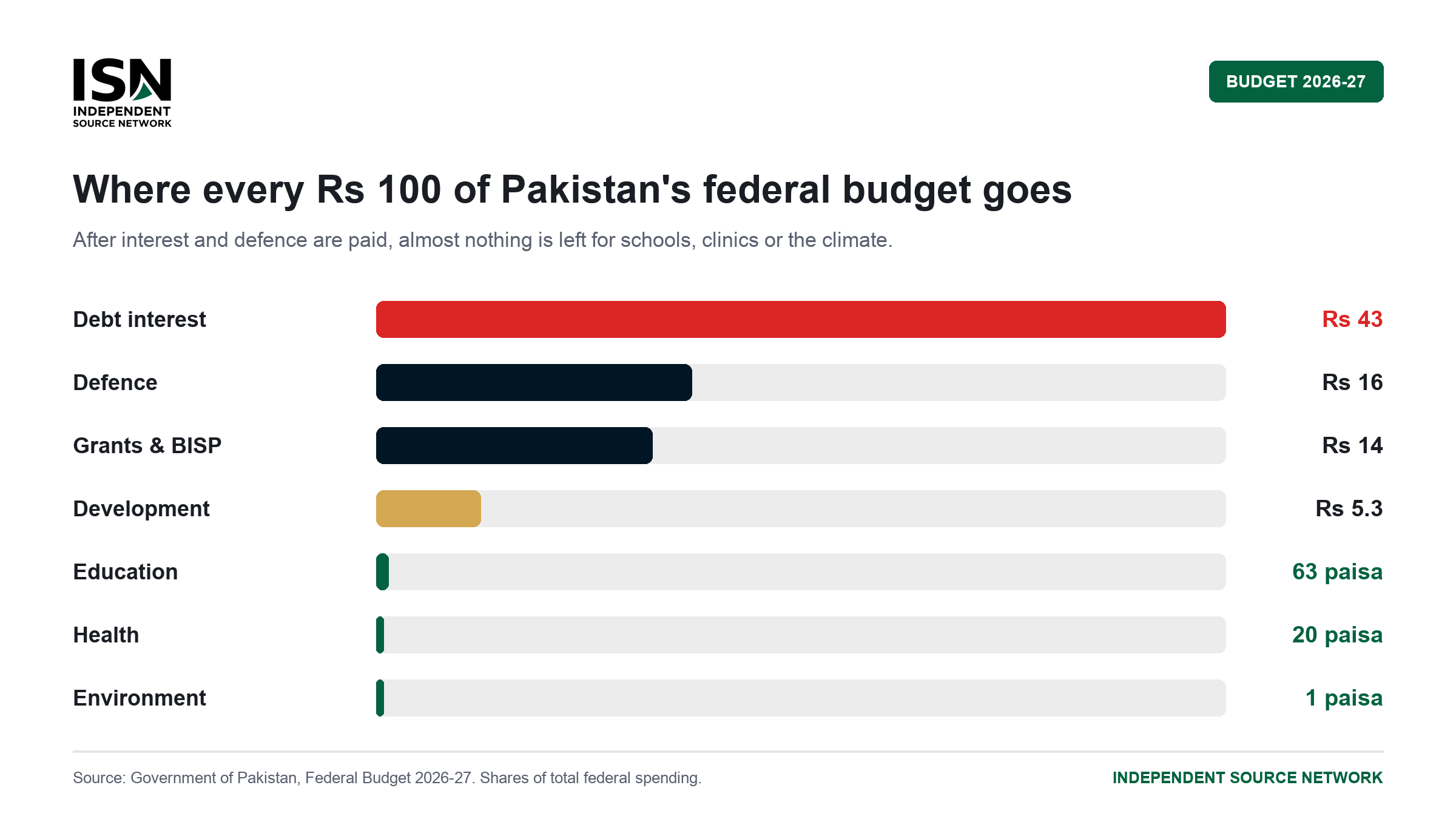
Where every Rs 100 of the federal budget goes.
The line that dominates
One line stands far above the rest. Almost 43 rupees in every 100 are spent on interest, the cost of money borrowed in earlier years. It pays for no project, no salary and no service. It is simply the price of past debt, and by a wide margin it is the largest item in the budget. We follow this figure in the 43 percent, how debt interest consumes the budget.
Defence follows at 16 rupees. After these two the amounts fall away sharply. Pensions, subsidies and the cost of running the government each take roughly 6 rupees. The development programme, which builds new roads, dams, schools and hospitals, accounts for only about Rs 5.30, less than the cost of running the administration itself.
What is left for everything else
Once interest, defence, pensions, grants, subsidies and administration are paid, the remainder for development and the social sectors is small. Education, health, the environment and culture, at the federal level, together come to little more than a single rupee of the hundred. Part of this is an accounting effect of the eighteenth amendment, under which most schools and hospitals are funded by the provinces, a point explained in education, health and the smallest shares. Even so, the distance between these sectors and the cost of debt and defence is the sharpest contrast in the budget.
Obligations versus services
A useful way to read the payment-type breakdown is to separate obligations from services. Interest, pensions and, to a degree, grants are obligations: amounts the state is committed to paying regardless of policy choices in a given year. Debt interest in particular cannot be reduced in a single budget, because it is the contractual cost of debt already borrowed. Together, interest and pensions alone account for close to Rs 49 of every Rs 100.
Services and investment, by contrast, are the discretionary part of the budget: development, and the spending that reaches citizens directly. Because the obligations are large and fixed, the discretionary room is narrow. This is the structural reason a government has limited freedom to shift money toward schools or hospitals in any single year without first addressing the obligations that dominate the total.
What the shares mean at household scale
Reducing the budget to Rs 100 makes the priorities legible. If a household earned Rs 100 and spent it the way the federal government does, it would pay Rs 43 in interest on past loans before anything else, then Rs 16 on security. It would spend about Rs 6 each on pensions, on subsidies and on simply running itself, and Rs 5.30 on anything new it wished to build. It would have about 63 paisa left for its children's education and 20 paisa for healthcare. Laid out this way, the budget is not a set of abstract trillions but a household stretched thin by debt, and that is precisely the point of the exercise.
Two ways to read the budget
The payment-type view in this article is one of two standard ways to divide the budget. The other sorts the same money by sector, where a large umbrella category called general public service absorbs interest and pensions. The two views answer slightly different questions; we set out the sector view in Pakistan's budget by sector 2026-27.
Why these proportions are hard to change
The payment-type breakdown also explains why a government cannot quickly redirect the budget toward services, however much it might wish to. The three largest claims are all difficult to move in the short term. Interest is contractual, fixed by debt already borrowed, and can only be eased over years through lower rates and a slower-growing debt stock. Defence is treated as a strategic commitment and is rarely reduced. Pensions are obligations earned by past service.
That leaves the genuinely flexible part of the budget, mainly development and subsidies, as the place where any year's adjustments fall, which is why those are the lines that move most from one budget to the next. The practical implication, widely noted by economists, is that the share reaching schools, clinics and new infrastructure cannot rise meaningfully until the debt burden that dominates the total is brought down. Reshuffling the smaller lines among themselves changes little. This is the structural case for treating the interest bill, examined in the 43 percent, as the central fact of the budget rather than one line among many.
Frequently asked questions
Where does most of Pakistan's budget go? The largest single item is debt interest at about Rs 8,054 billion, or 42.9 percent of all federal spending. Defence is second at Rs 3,000 billion, or 16 percent. Together they take close to three fifths of the budget.
How much of the budget is development spending? The development programme is about Rs 1,000 billion, or 5.3 percent of the budget, which is less than the cost of running the federal government (Rs 1,071 billion).
What share goes to debt interest? About 42.9 percent, or roughly Rs 43 of every Rs 100. It is the largest line in the budget, larger than defence and development combined.
Why is so little left for education and health? Because a few large, fixed claims, mainly interest, defence, pensions and grants, absorb most of the budget. The social sectors compete for the narrow band that remains, and most school and hospital funding is also provincial rather than federal.
What is the total size of the budget? The total federal outlay for 2026-27 is Rs 18,771 billion, up about 6.8 percent on the year.
Does debt interest count as a service in the budget? No. Interest is an obligation on debt already borrowed, not a service. It funds no project, salary or programme, which is why separating obligations from services is the clearest way to read the payment-type breakdown.
How much do interest and pensions take together? Together they account for close to Rs 49 of every Rs 100, since interest is about Rs 42.90 and pensions about Rs 6.20. These are largely fixed obligations, which is why the discretionary room in the budget is narrow.
Sources and notes
- Government of Pakistan, Federal Budget 2026-27: Budget in Brief and major spending heads. All figures are Budget Estimates in billions of rupees, rounded for readability, so the share column may not sum exactly.


 ISN MEDIA