



Why Is Pakistan's Debt Mostly Domestic?
Most of the interest bill is owed at home, and that changes the problem
By the ISN Media desk • June 2026 • Approx. 5-min read
This is a short, factual answer about why most of Pakistan's interest is owed at home rather than abroad. The figures are Budget Estimates from the Government of Pakistan, in billions of rupees. For the full analysis, see domestic vs foreign debt.
Why is Pakistan's debt mostly domestic?
Pakistan's interest is mostly domestic because the government finances most of its deficit by borrowing from its own banking system rather than from abroad. Of the roughly Rs 8,054 billion interest bill in 2026-27, about Rs 6,983 billion is interest on domestic debt and only about Rs 1,071 billion is on foreign debt. The government raises domestic debt by selling treasury bills, bonds and Islamic instruments to commercial banks, which hold them as safe, interest-bearing assets.
How the domestic debt is raised
The government borrows at home through three main instruments: treasury bills, which are short-term; Pakistan Investment Bonds, which are longer-dated; and Islamic instruments called sukuk. The buyers are largely commercial banks, for which government paper is an attractive, low-risk way to earn a return. This makes it relatively easy for the government to keep selling domestic debt, which is one reason the domestic portion has grown.
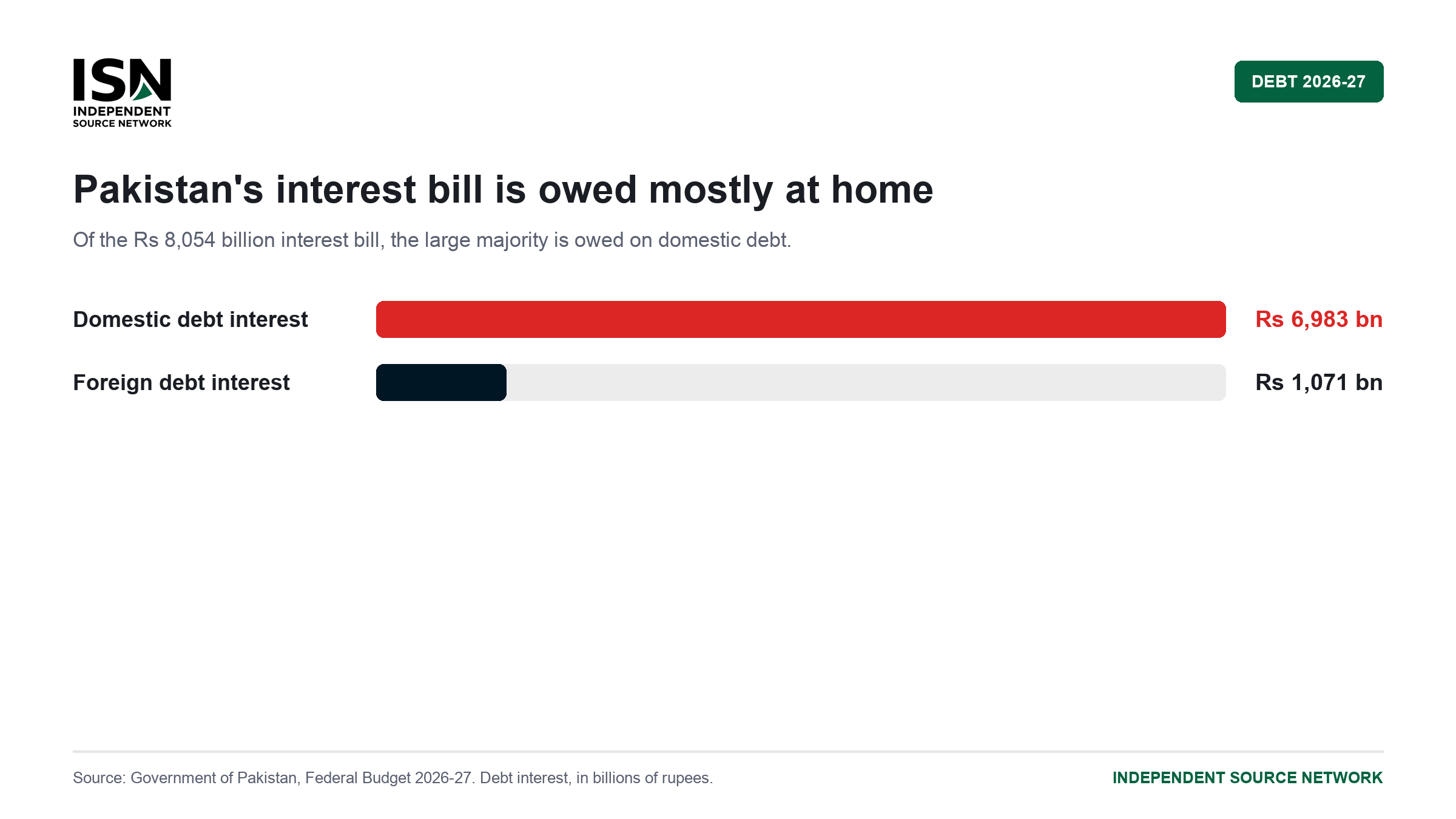
The interest bill, split between domestic and foreign debt.
Why it changes the problem
A debt owed at home poses different risks from one owed abroad. Foreign debt must be serviced in foreign currency, so it depends on reserves and the exchange rate, and a currency depreciation makes it more expensive. Domestic debt is owed in rupees, so it avoids that currency risk. But it carries its own cost: heavy government borrowing at home competes with private borrowers for credit, an effect called crowding out, which can raise interest rates and squeeze lending to businesses.
Why it matters for the economy
Because the debt is mostly domestic, the central problem is not mainly a shortage of dollars but the high rate at which the government borrows from its own banks. This links the budget directly to monetary policy: when the central bank raises rates to control inflation, it also raises the government's cost of refinancing its short-term domestic debt, enlarging the interest bill. The effect on private credit is examined in bank borrowing doubled.
Frequently asked questions
Why is Pakistan's debt mostly domestic? Because the government finances most of its deficit by borrowing from its own banking system, selling treasury bills, bonds and Islamic instruments to commercial banks, rather than borrowing abroad.
How much of the interest is domestic versus foreign? About Rs 6,983 billion is interest on domestic debt and about Rs 1,071 billion on foreign debt, out of a total of about Rs 8,054 billion.
Is domestic debt safer than foreign debt? It avoids currency risk, since it is owed in rupees, but it carries its own cost: it crowds out credit for private business and links the budget closely to interest rates.
How does the government borrow at home? Through treasury bills (short-term), Pakistan Investment Bonds (longer-term) and Islamic instruments called sukuk, bought largely by commercial banks.
What is crowding out? When heavy government borrowing absorbs credit and raises its cost for private businesses and households, so the state's borrowing comes partly at the expense of private investment.
Why does the domestic debt keep growing? Because each year's deficit is financed largely at home, and government paper is attractive to banks, so the stock of domestic debt, and the interest on it, tends to ratchet up unless rates fall or the surplus grows.
Sources and notes
- Government of Pakistan, Federal Budget 2026-27: domestic and foreign interest figures are Budget Estimates in billions of rupees, rounded for readability.


 ISN MEDIA