



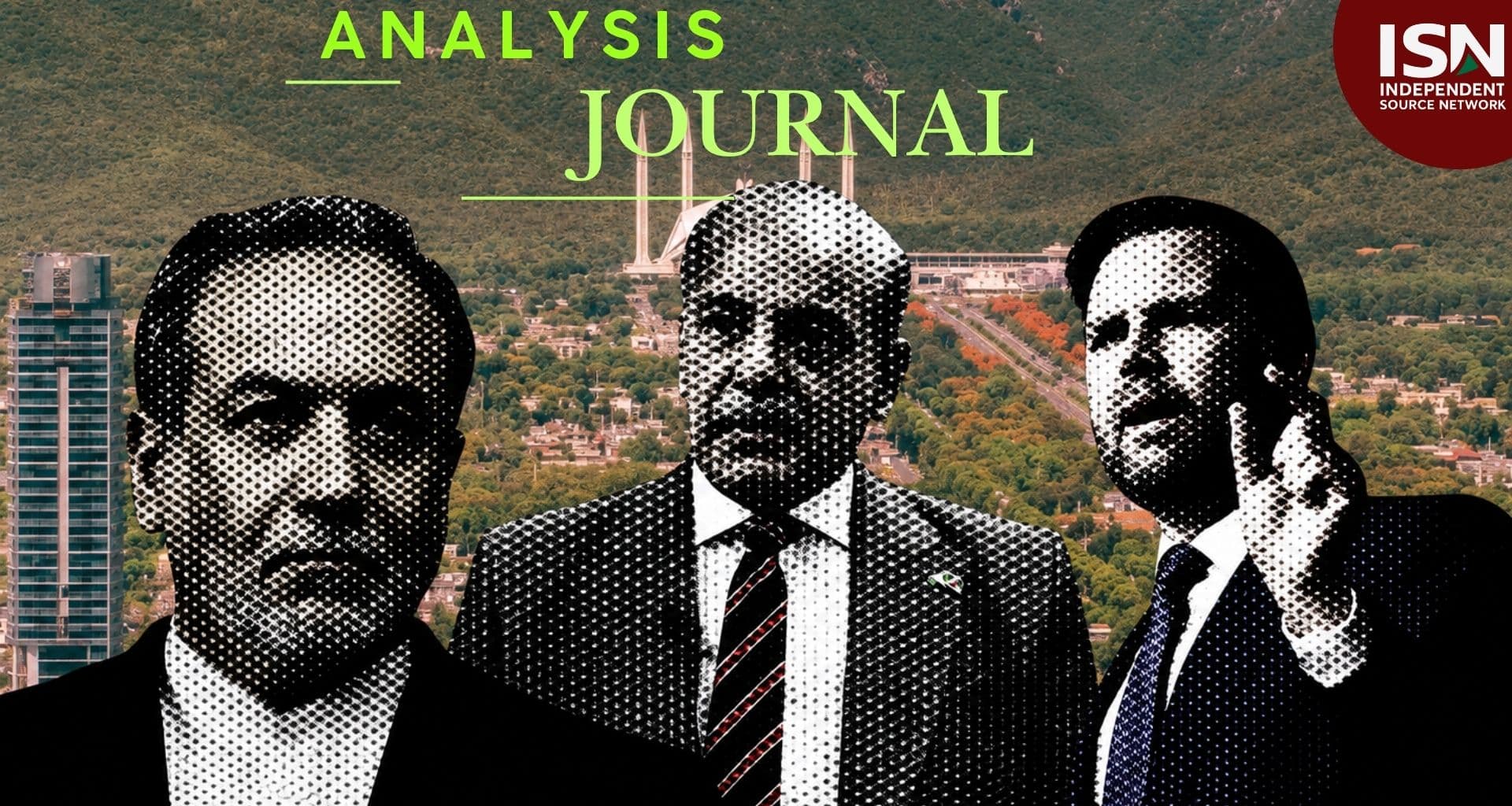
Pakistan's Finest Hour, Trump's Long Game
Why Washington keeps stalling on Iran, what cards Islamabad is actually holding, and how India ended up watching from the cheap seats
Analysis — June 2026
On a rain-soaked Wednesday evening in Islamabad — June 4, 2026 — Acting US Ambassador Natalie Baker stood at the largest Independence Day reception the American Embassy has ever hosted in Pakistan, and called Islamabad's role in this year's US–Iran talks "Pakistan's finest hour of modern history." Prime Minister Shehbaz Sharif called Donald Trump "a man of peace." Forty-eight hours earlier, Trump himself had walked out of the White House Situation Room without making a "final determination" on a deal his own envoys say has been effectively "closed" in Doha for over a week.
That gap — between Baker's flourish in Islamabad and Trump's silence in Washington — is the story of where the US-Iran-Pakistan triangle actually stands. The negotiation everyone insists is almost there hasn't closed in nearly four months. The ceasefire has been extended, extended again, and quietly extended once more. The naval blockade is still in place. The Strait of Hormuz has been effectively shut for over three months. And Pakistan — the country diplomats spent the better part of two decades writing off as "isolated" — is the one country both Tehran and Washington still pick up the phone for.
This is a story about leverage: who has it, who's pretending to have it, and who lost it without noticing.
What Pakistan Actually Did
To understand the present moment, rewind to the war. On February 28, 2026, the US and Israel launched the joint strikes that opened the second Iran war. Pakistan immediately did something unusual for a frontline Muslim state with a 900-kilometer Iranian border: it stayed officially neutral, condemned strikes on both sides, and offered to mediate.
For six weeks the offer sat there. Then, on April 8 — after Trump issued an ultimatum threatening Iran's energy infrastructure and "civilization-ending" strikes — it was Sharif who announced the conditional two-week ceasefire to the world, not Witkoff, not Rubio, not Trump. Pakistan had relayed Washington's 15-point plan to Tehran and carried Iran's counter-proposal back. It had bridged the gap when no one else could.
Three days later, on April 11, a 300-person US delegation led by Vice President JD Vance, special envoy Steve Witkoff, and Jared Kushner flew into Islamabad to negotiate with Iran's parliamentary speaker Mohammad Bagher Ghalibaf and Foreign Minister Abbas Araghchi inside the Serena Hotel. The talks ran 21 hours and collapsed. Two days after that, the US Navy began the blockade of Iranian ports that remains in force today.
But the more interesting fact is what happened next: Iran kept coming back to Pakistan. Araghchi visited Islamabad again in late April, met Field Marshal Asim Munir, and left after speaking only to Pakistanis. Iran's ambassador in Islamabad, Reza Amiri Moghadam, said publicly that Tehran would "do talks in Pakistan and nowhere else, because we trust Pakistan." On May 22, Munir himself flew to Tehran. The mediator wasn't replaced. The talks themselves stalled — the mediator didn't.
Why Washington Is Buying Time
Trump has set hard deadlines on an Iran deal in March, April, May, and now June. Each one has slipped. Each time he has dialed back from the brink, extended a pause, "paused the pause," or — as on June 1 — declared the whole process "boring" and walked off.
This isn't disorganization. It's a strategy with five components, and once you see them they explain almost every move:
1. Time is the blockade
The longer the war stays frozen, the more economic pain the US naval cordon inflicts on Iran. CSIS now describes the standoff bluntly as "a war of endurance, not firepower" in which Iran is "betting it can outlast US political will" — a bet Tehran is losing. Twenty percent of the world's seaborne oil normally flows through Hormuz; Iran's economy depends on its own share of those exports. The longer Washington stalls, the deeper Tehran sinks.
2. Maximum concessions, asymmetric clock
Trump's stated demands keep expanding: no enrichment, removal of all enriched material, unrestricted Hormuz transit with no Iranian tolls, US-IAEA destruction of uranium stockpiles. Iran's red lines — $12 billion in frozen assets, an end to the blockade, Lebanon inclusion — keep getting waved off. Every extension teaches Iranian negotiators that the asking price isn't a ceiling. It's a floor.
3. Splitting Iran from itself
Iran's leadership is publicly divided. Hardliners around the IRGC and Fars News reject the emerging memorandum; pragmatists around Araghchi and Larijani want it signed. Every delay forces that internal fight to play out a little louder. By the time a deal is on the table, US negotiators want the Iranian side too internally exhausted to walk away.
4. Military buildup, diplomatically priced
While the State Department speaks of "slight progress" — Rubio's exact words after the May meeting in Sweden — the Pentagon is openly developing options for what Axios described as a "final blow," including ground forces. A second aircraft carrier and strike group have moved into theater. Time at the table is buying the option on the table.
5. Domestic theatre
Trump's negotiation style is performance: deadlines, walk-outs, "they have to call me," Truth Social ultimatums followed by "great progress" posts. Each cycle generates the political win he wants — looking tough, looking close to a deal, looking like the indispensable closer — without requiring the deal to actually close. A senior Arab mediator told NBC last week that the framework was "already closed in Doha three days ago; now everyone is playing a game of chicken and egg."
The point isn't that Trump doesn't want a deal. It's that he gets more from approaching a deal than from signing one — and Iran, the side under blockade, doesn't.
Pakistan's Cards: Six That Actually Matter
Pakistan's mediator role didn't fall from the sky. It came from a hand Islamabad has spent eighteen months learning to play.
1. Rare earths and critical minerals
In Trump's Oval Office in September 2025, Field Marshal Asim Munir handed the President a wooden box of rare-earth samples from Balochistan. By the time the April talks failed, Missouri-based US Strategic Metals had committed roughly $500 million to a processing partnership with Pakistan's military-owned Frontier Works Organisation. Pakistan's first shipment — antimony, copper concentrate, neodymium, praseodymium — has already left for the US. For an administration whose entire China policy is built around prying open non-Chinese supply chains, Pakistan is not "a Muslim-majority nuclear state next to Iran." It's a deposit.
2. Crypto and the Witkoff family
Probably the most underreported lever. World Liberty Financial — the crypto firm co-founded by Trump family members — signed a letter of intent with Pakistan's Crypto Council. Pakistan named Bilal Bin Saqib chairman of a brand-new Virtual Assets Regulatory Authority. Saqib has been photographed at Mar-a-Lago with Zachary Witkoff, WLF's CEO and son of Steve Witkoff — the President's Middle East envoy and the man personally negotiating with Iran. Pakistan revamped the Roosevelt Hotel in Manhattan in a deal Steve Witkoff brokered. The Trump administration's commercial and diplomatic interests in Pakistan now share the same family tree. That is not a coincidence. It is statecraft.
3. The only working line to Tehran
Pakistan's value as a mediator rests on a structural fact India cannot match: Islamabad has functioning relationships with both Washington and Tehran. It is a Sunni-majority nuclear power with a Shia minority, a long border with Iran, deep historical ties to the Gulf, and — crucially — does not recognize Israel. That last point is why Iran trusts it. No Arab Gulf state, no Turkey, and certainly not India can credibly say the same to both sides at once.
4. The Munir–Trump bond
Trump hosted Pakistan's army chief at the White House in June 2025 — the first time a US president has met a sitting Pakistani military chief without an accompanying civilian head of state. Munir was elevated to the newly constituted post of Chief of Defence Forces in December 2025, consolidating command of all three services for a five-year term. For Trump, who prefers strongman counterparties he can call directly, Munir is the ideal interlocutor: hard-power, decisive, personally accessible. Pakistan has, in effect, given Trump a single number to dial.
5. The Kissinger-1971 echo
Pakistan has played the back-channel role before — most famously, arranging Henry Kissinger's secret 1971 flight from Islamabad to Beijing, the trip that opened US-China relations. There is institutional muscle memory in Pakistan's foreign service for exactly this kind of quiet, sustained shuttle diplomacy. Iran's ambassador to China has even floated Pakistan as a potential international guarantor of any final settlement, alongside China, Turkey and Russia. That is an extraordinary upgrade for a country that, three years ago, was being publicly lectured by Joe Biden as "maybe one of the most dangerous nations in the world."
6. The nuclear and missile backstop
It rarely gets said out loud, but it matters. When Hegseth was asked at the Shangri-La Dialogue on May 30 whether Pakistan's missile program — and Tulsi Gabbard's earlier remarks about ICBM risks — was a threat to the US, he declined to label Pakistan a threat and put it on equal footing with India: "Both sides are going to see understandable threats coming from the other." That parity language is itself a card. India spent twenty years getting the US to "de-hyphenate" the relationship. In June 2026, the hyphen is back.
What Rubio, Hegseth and Baker Are Actually Telling Us
Read the three voices of US Pakistan policy in sequence and a coherent message emerges.
Marco Rubio, meeting Foreign Minister Ishaq Dar in Washington on May 29, thanked Pakistan for its "constructive role" in mediation and said Islamabad has been "instrumental in realizing President Trump's vision for the Middle East." On India's grievances about Pakistan, asked directly in Delhi a few days earlier, his answer was telling: yes, India raises terrorism concerns, but on Pakistan's mediation role "it never came up. I don't think they were complaining about that." Translation: India's grievance and Pakistan's diplomatic utility are separate files, and Washington is not letting one veto the other.
Pete Hegseth, at the Shangri-La Dialogue on May 30, said Washington and Islamabad were entering a "true friendship," singled out Sharif and Munir for praise, refused to call either Pakistan or India a US threat, and explicitly cited Trump's mediation in last year's India-Pakistan war as evidence of "improving relations." For the Defense Secretary of a country whose Indo-Pacific strategy was built around India as a counterweight to China, this is a significant rebalancing of public language.
Natalie Baker, the Chargé d'Affaires running the US Embassy in Islamabad, on June 4, declared the relationship "no longer viewed through outdated assumptions" but as a "true strategic partnership" grounded in "mutual respect and shared security goals." She credited Trump's "bold, results-oriented leadership," called Islamabad's hosting of the April talks Pakistan's "finest hour of modern history," and delivered the line that should make Delhi pay attention: "A strong Pakistan is good for America, and a strong America is good for Pakistan."
That is not the language of transactional cooperation. That is the language of a partnership being upgraded — under a Republican administration, no less, of the kind Pakistani strategists have historically been most pessimistic about.
India's Vanishing Act
The most awkward fact in this story, for Indian observers, is how little of it involves India.
India was not at the Islamabad Talks. India did not host any leg of US-Iran mediation. India did not relay the 15-point plan. India did not co-author the March 31 five-point peace initiative — China and Pakistan did. India's first public statement on the April 8 ceasefire pointedly omitted any mention of Pakistan. When the BBC asked whether India was being "sidelined," former Indian Foreign Secretary Nirupama Rao wrote on X that the war had "damaged India's interests in almost every practical sense" and "the deeper question is whether India is willing to say so with sufficient clarity." It hasn't.
How did this happen? Several reinforcing failures:
India cannot accept mediation. New Delhi's position — restated by PM Modi to Trump on a June 2025 phone call — is that India will never accept third-party mediation, especially on Pakistan. That makes structural sense for Kashmir but boxes India out of any role requiring it to be a mediator. Pakistan can host talks. India structurally cannot.
The May 2025 ceasefire reframed both countries. After Operation Sindoor, Pakistan loudly credited Trump for ending the war and nominated him for the Nobel Peace Prize. India denied any US role at all. Trump, who responds emotionally to credit, drew the obvious conclusion about who appreciates him more. Atlantic Council's Michael Kugelman put it bluntly: "India's strategy of undercutting and indeed isolating Pakistan, regionally and globally, has backfired in a big way."
The trade war wounded the relationship. Trump hit India with 50% tariffs in August 2025 over Russian oil purchases. The February 2026 interim framework dropped them to 18% — but only after India publicly agreed to stop buying Russian crude, a major sovereignty concession. By the time Modi appeared smiling alongside Xi and Putin at the Tianjin SCO summit in early 2026 — his first visit to China in seven years — the optics had hardened. Trump publicly warned New Delhi things were "getting late."
India had nothing to offer the Witkoff orbit. No crypto opening — the RBI is famously hostile. No rare-earths-on-the-table moment — India is itself a critical minerals importer. No willingness to revamp a Trump hotel. Foreign Policy framed the deeper point cleanly: India could not "reorganize its diplomacy around Trump's appetite for praise and visible personal credit. Pakistan could."
This does not mean India has lost long-term strategic value to the US. The Quad still exists. The Indo-Pacific math against China still favours a strong US-India relationship. Rubio's late-May trip to Delhi was a deliberate signal of intent to reset. But for this story — the central diplomatic drama of 2026 — India is not in the room. It is reading about the room.
The Risks Pakistan Cannot Afford to Ignore
This is not an Islamabad victory lap. The smart people in Pakistan know it. Five risks deserve naming honestly:
Personality dependence. Almost everything Pakistan has built rests on Trump, Munir, the Witkoff family, and the current Sharif government. None of those four are guaranteed for long. CSIS's recent assessment was explicit: "history suggests that periods of strategic cooperation do not always translate into long-term, stable partnerships."
Domestic legitimacy deficit. Munir's elevation to a constitutionally created super-post, the continued imprisonment of Imran Khan, the unresolved Baloch insurgency that produced last month's BLA attack in Quetta — these are internal fragilities sitting underneath the diplomatic glow. The Diplomat's framing is uncomfortable but accurate: Pakistan "is in trouble at home, basks in glory abroad." That equilibrium is precarious.
The Iran relationship is finite. If a deal closes, Pakistan's irreplaceability evaporates overnight. If a deal collapses into renewed conflict, Pakistan's neutrality becomes harder to maintain, especially with refugee flows from Sistan-Baluchestan. The current sweet spot — useful to both sides because nothing is resolved — is by design temporary.
Crypto and minerals are not free. Both carry tail risks. The IMF has historically been hostile to sovereign crypto experiments (El Salvador's experience is the cautionary tale). Rare-earths extraction in Balochistan requires infrastructure in territory contested by separatists. The US designation of the BLA as a terrorist organization in August was a goodwill move — but designation is not pacification.
The China factor. Pakistan remains structurally dependent on Beijing — CPEC, debt, defence supplies. The current US thaw doesn't change that, and Beijing knows it. Pakistan is playing both sides skilfully, but the moment either Washington or Beijing demands exclusivity, Islamabad's room to manoeuvre shrinks fast.
What to Watch Next
A few signposts for the weeks ahead:
Will the 60-day MOU get signed? The reported framework — Hormuz mines cleared in 30 days in exchange for blockade lifting, plus 60-day nuclear talks — was agreed in Doha. Whether Trump signs is the single biggest near-term variable. Polymarket prices the probability of a permanent deal by year-end still below 50%.
The Lebanon dimension. Iran insists any deal must cover Hezbollah and Lebanon. Israel's planned operations in Beirut on June 1 froze talks. If the Lebanon front re-escalates, the Iran track collapses with it.
A second Munir White House visit. Widely rumoured. It would signal Pakistan's status as a Trump-era anchor partner is locked in.
India's response. Will Delhi double down on "no mediation, no hyphenation," or will Rubio's outreach translate into a serious trade and tech reset? The next India-US summit will be telling.
Balochistan. Any major BLA attack on a critical-minerals site would simultaneously test the rare-earths deal, the US terrorist designation, and Pakistan's ability to deliver on what it has promised Washington.
The Bigger Story
Strip away the day-to-day theatre and a larger pattern is visible. The Trump administration is rebuilding US Middle East and South Asia policy around personalized, transactional, optics-driven relationships — and the countries that have learned to deliver in that idiom are winning the access game.
Pakistan has done so almost flawlessly: a wooden box of rare earths, a crypto MOU, a Nobel nomination, a White House welcome for the army chief, hosting a peace process at exactly the moment it could not be hosted anywhere else. None of these are major strategic concessions. All of them are highly visible, highly personal gestures pitched at exactly the right register.
India, structurally and ideologically, cannot play that game. China can — but it is the adversary. Europe will not. The Gulf states are deeply engaged but cannot mediate with Iran. That leaves a narrow, specific opening, and Pakistan has stepped through it.
The longer the US-Iran negotiation drags, the more useful Pakistan becomes — because every extra week is another week in which someone has to relay messages, host envoys, take Munir's call, and quietly tell Tehran that Washington is serious this time. America is buying time. Pakistan is selling it.
Whether this hour — finest, fragile, or fleeting — translates into anything durable is the question that will define Pakistan's next decade. But for the first time in a generation, Pakistan is no longer asking permission to be in the room. It owns the room.


 Yasir Rai