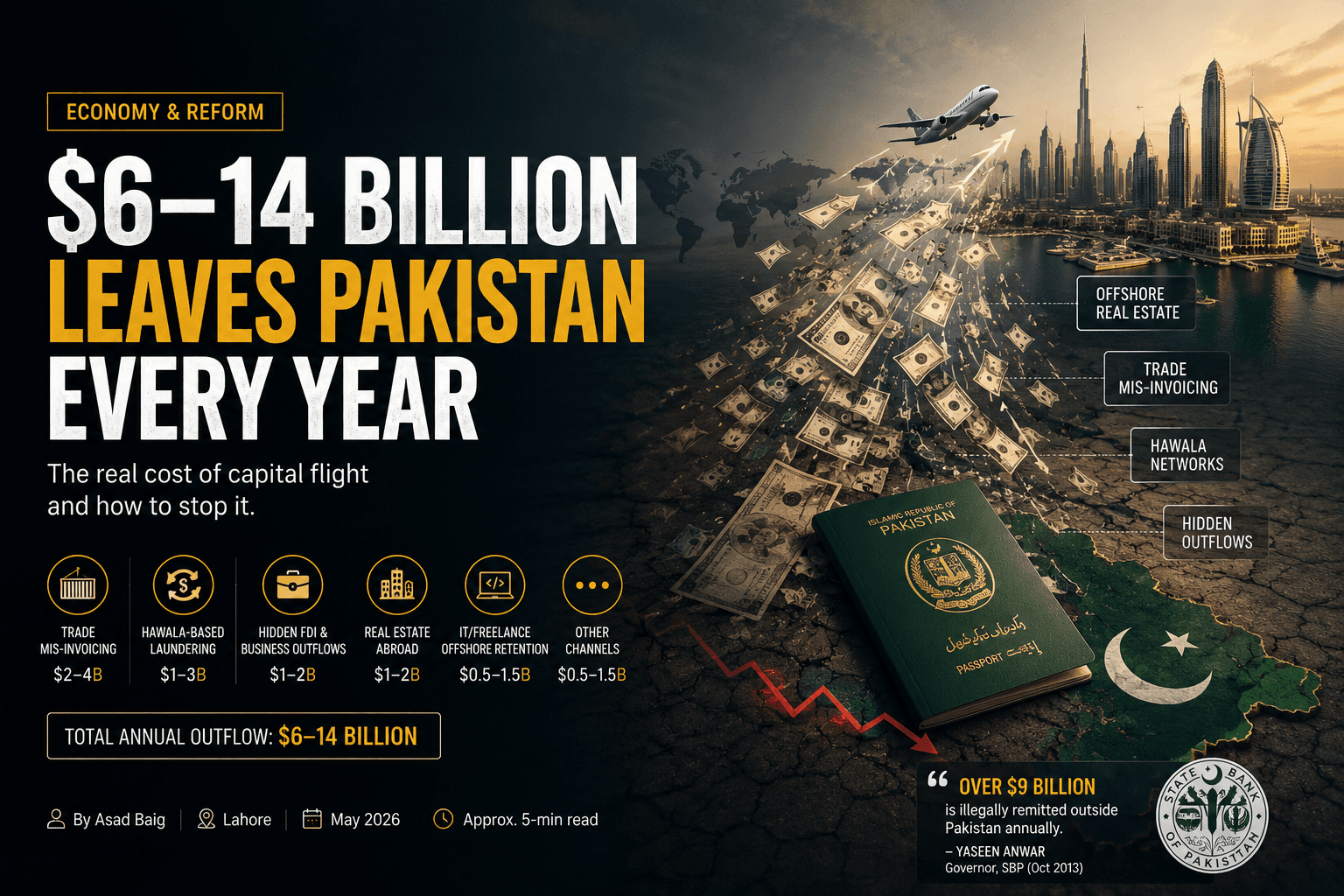
Approximately $6 to 14 billion per year across all channels, with $9 billion as the standard reference point
By Asad Baig · Lahore · May 2026 · Approx. 5-min read
The short answer
Pakistan's estimated annual capital flight is approximately $6 to 14 billion across all channels. The components: trade mis-invoicing ($2 to 4 billion), hawala-based laundering ($1 to 3 billion), hidden FDI and business outflows ($1 to 2 billion), real estate purchases abroad ($1 to 2 billion), IT and freelance offshore retention ($0.5 to 1.5 billion, largely defensive), and other channels ($0.5 to 1.5 billion). State Bank of Pakistan Governor Yaseen Anwar publicly stated in October 2013 that over $9 billion is illegally remitted outside Pakistan annually. This figure has become the standard reference point for capital flight estimates and sits comfortably within the $6 to 14 billion range.
This is a Tier 3 long-tail spoke under the $100 to 150 billion offshore wealth reality and parent pillar how Pakistan's FCY system costs the productive class $25 to 36 billion a year.
The channel breakdown
Pakistan Annual Capital Flight By Channel
Channel | Annual outflow |
|---|---|
Trade mis-invoicing | $2-4 billion |
Hawala-based laundering | $1-3 billion |
Hidden FDI/business outflows | $1-2 billion |
Real estate purchases abroad | $1-2 billion |
IT/freelance offshore retention (largely defensive) | $0.5-1.5 billion |
Other channels | $0.5-1.5 billion |
TOTAL ANNUAL OUTFLOW | $6-14 billion |
The largest single channel is trade mis-invoicing ($2 to 4 billion). Importers over-invoice imports and exporters under-invoice exports, with the difference parked offshore. The mechanism is operationally simple and difficult to detect because banks cannot verify actual goods values, customs only check physical goods, and there is no comprehensive global database of comparable prices.
The second-largest channel is hawala-based laundering ($1 to 3 billion). Despite formal channel growth post-9/11, hawala remains active for transactions where formal channels are inadequate or unwelcome.
The third and fourth channels (hidden FDI, real estate purchases) account for another $2 to 4 billion combined.
The $9 billion reference point
In October 2013, then-State Bank of Pakistan Governor Yaseen Anwar publicly stated that over $9 billion is illegally remitted outside Pakistan annually. This figure has become the standard reference point for capital flight estimates.
The figure is consistent with subsequent investigations:
OCCRP "Dubai Unlocked" investigation documenting $13 billion in Pakistani Dubai property
Atlas of Offshore World data on Pakistani offshore real estate
A.F. Ferguson submission to Pakistan's Supreme Court estimating $150 billion in UAE-held assets
The structural mismatch between Pakistani official remittance figures and documented diaspora income
Why IT/freelance offshore retention is "largely defensive"
The IT and freelance offshore retention figure of $0.5 to 1.5 billion annually is the smallest component of total outflows, and it is largely defensive. Pakistani IT exporters route earnings through Wyoming and UAE not because they are laundering money but because the formal Pakistani banking system does not serve their operational needs.
Reform that serves their needs would convert this defensive offshore migration into onshore retention, reducing rather than increasing total outflows. The Productive Capital Account proposal directly addresses this constituency. For the deeper analysis, see the Productive Capital Account: a reform proposal for Pakistan's FCY system.
Frequently asked questions
How much capital does Pakistan lose to capital flight annually? Approximately $6 to 14 billion across all channels. The estimate is based on multiple converging analyses: SBP Governor Yaseen Anwar's 2013 statement of "over $9 billion", subsequent OCCRP and Atlas of Offshore World investigations, and the channel-by-channel breakdown.
What is the largest channel of Pakistani capital flight? Trade mis-invoicing, at $2 to 4 billion annually. Importers over-invoice imports and exporters under-invoice exports, with the difference parked offshore. The mechanism is operationally simple and difficult to detect through banking compliance alone.
Did SBP Governor Yaseen Anwar really say $9 billion leaves Pakistan illegally? Yes. In October 2013, then-SBP Governor Yaseen Anwar publicly stated that over $9 billion is illegally remitted outside Pakistan annually. This statement has become the standard reference point for capital flight estimates.
Are Pakistani IT companies a major source of capital flight? The IT and freelance offshore retention is the smallest component (approximately $0.5 to 1.5 billion annually) and is largely defensive. Pakistani IT exporters route earnings offshore primarily because the formal Pakistani banking system does not serve their operational needs, not for tax avoidance or money laundering.
How does this compare to Pakistan's foreign reserves? Pakistan's foreign reserves of $21.79 billion (March 2026) are roughly equivalent to 1.5 to 3 years of estimated capital flight. The cumulative offshore wealth ($100-150 billion) is approximately 5 to 7 times the country's reserves, accumulated over multiple decades.
Does the FATF compliance regime stop Pakistani capital flight? Partially. FATF compliance reduces hawala flows somewhat and tightens KYC at account opening. The dominant channels (trade mis-invoicing, real estate purchases, hidden FDI) are addressed superficially. The flow continues through the largest channels.
Sources
Yaseen Anwar, Governor SBP, public statement on illegal remittances (October 2013)
OCCRP "Dubai Unlocked" investigation, May 2024
Atlas of Offshore World data on Pakistani offshore wealth
A.F. Ferguson submission to Pakistan Supreme Court (September 2018)
2018 tax compliance analysis on Section 111(4) whitewashing
Position Paper: The Foreign Currency Account Problem in Pakistan, May 2026


 ISN MEDIA