



Cash, Votes and Hunger: The Politics of Pakistan's Handouts
How much the state hands out, what it costs to run, and why I do not believe cash is a plan
By Asad Baig • Written from outside Pakistan • June 2026 • Approx. 24-min read
Cash support is one of the most visible parts of this budget, and one of the most defended. So let me lay out the figures honestly, for the Benazir Income Support Programme and the wider handouts, set the cost of running the government beside them, and then tell you what I believe. I will give the other side its say. I always do. But I will not hide my own view, because I have one, and it is strong.
For the full budget around these lines, read where every rupee goes. For the short, angry version of what follows, read where is the plan. Here I will take my time.
How much is BISP in the 2026-27 budget?
The Benazir Income Support Programme gets about Rs 844.8 billion in 2026-27, a rise of about 16.9 percent over last year, while total social protection comes to about Rs 857 billion. The wider grants and transfers head, which includes BISP, totals about Rs 2,680 billion, or 14.3 percent of the budget. So cash support is large, and growing fast, in the very same year that development, the money that builds the country, was cut.
That is the headline. Now let me open it, and the argument it always starts.
The 844-billion question
Start with the figure and its direction. BISP rose from about Rs 722.5 billion to about Rs 844.8 billion, a jump of about 17 percent, one of the larger rises anywhere in the budget. Total social protection rose by about the same, to roughly Rs 857 billion.
| Line | FY 2025-26 | FY 2026-27 | Change |
|---|---|---|---|
| Benazir Income Support Programme | 722.5 | 844.8 | +16.9% |
| Social protection (total) | 734.2 | 857.0 | +16.7% |
| Grants and transfers (incl. BISP) | 1,928 | 2,680 | +39.0% |
Figures in billions of rupees, FY2026-27 Budget Estimates.
Two things jump out. Cash support grew faster than inflation in a year when they cut development by about 9 percent. That alone tells you what this budget chose to protect. And the wider grants head grew by close to 39 percent, one of the biggest jumps in the whole budget, of which BISP is one part. I take the programme's size apart in BISP 2026-27, 844 billion rupees and a 16.9 percent rise.
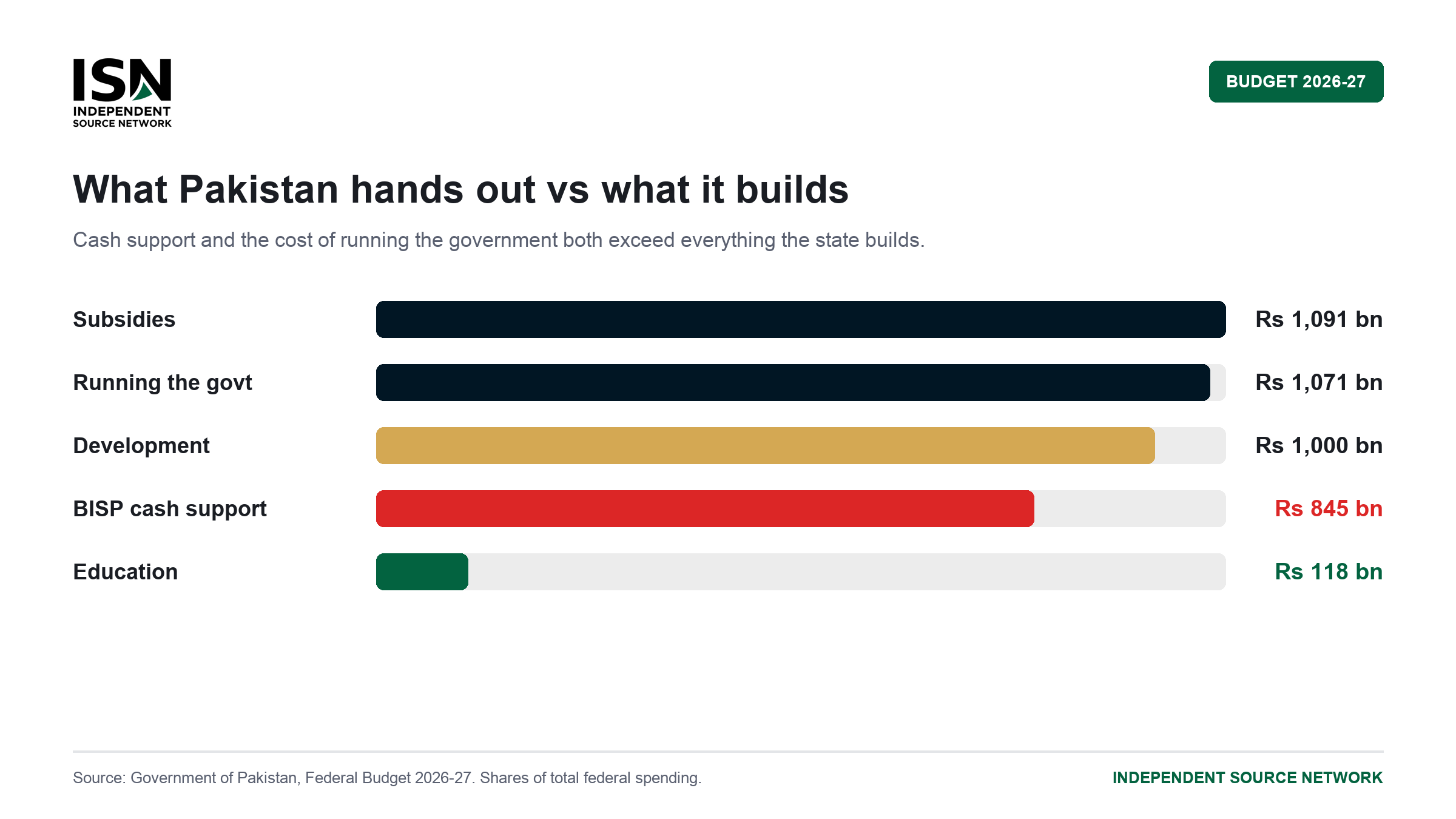
What Pakistan hands out, beside what it builds. Cash support and the cost of running the government both exceed development.
The wider handout: the 39 percent jump
BISP sits inside that larger head called grants and transfers, and that head grew even faster than the programme itself, from about Rs 1,928 billion to Rs 2,680 billion, close to 39 percent. I want you to see this, because it shows cash support is only one part of a much wider expansion of handouts.
Grants and transfers cover more than the safety net. The head includes grants to provinces and to state bodies, transfers tied to obligations, and other support, of which BISP is the most visible single piece. So do not read the whole Rs 2,680 billion as relief for the poor. The honest statement is that the targeted poverty payment, BISP at about Rs 845 billion, is a large and growing part of a still larger pile of transfers that grew faster than almost anything else, in a year when what builds the country was cut. That is the pattern of this whole budget, and it keeps repeating.
What BISP is, and how it grew
Let me be fair before I am hard, because the programme is not nothing. BISP is the country's largest safety net. It pays low-income families, found through a national means test, with a core cash transfer and conditional parts tied to children's schooling and health. It has grown across one government after another since 2008.
And part of the recent growth is not even a domestic choice. The lenders, the International Monetary Fund, have steadily pushed Pakistan to expand direct cash, on the argument that it reaches the poor more cleanly than broad subsidies, and cushions them against the very austerity the lenders demand. So the rise in BISP is, in part, the path Pakistan agreed with the fund, not only a local political decision. I say that plainly, because both the programme's friends and its critics tend to leave it out when it suits them.
How BISP finds the poor, and why that makes this hard
I have to give the programme its due, because the honest argument is harder than the lazy one. The recipients are not chosen by a local politician handing out favours. They are found through a national registry that scores households on a means test, which is meant to cut out exactly the patronage I am about to accuse it of.
The programme runs through several parts. The core is an unconditional payment, made to the woman of the house. Alongside it sit conditional payments, a stipend tied to children staying in school, and a nutrition part for mothers and small children. Paying the woman directly, and tying part of the money to school and health, are good design choices, and I will not pretend they are not.
This is the strongest thing that can be said for BISP, and I say it without flinching. A means-tested, biometric, woman-targeted transfer is a more honest instrument than the schemes it replaced, and the World Bank and others have praised it for exactly that. It is because the delivery is credible that the argument over its politics is genuinely difficult, and not a simple matter of theft. I deal with the size and growth in BISP 2026-27, 844 billion rupees.
Cash against education: the argument I keep having
Here is the comparison I make most, and the one at the heart of it. The handout gets about seven times what the federal education line gets.
| This... | ...beside this | The gap |
|---|---|---|
| Cash support, 845 | Education, 118 | About 7 times education |
| Social protection, 857 | Health and education, 155 | Over 5 times the two combined |
Figures in billions of rupees, FY2026-27 Budget Estimates.
The comparison is true, but I will be honest about its limit, because I want you to trust me when I am hard. It is not a straight swap. Most school funding is provincial, so money taken from federal cash support would not automatically become federal school money. And the handout carries an education part of its own, the payment tied to keeping children in school. The fair reading is that both lines are small against the budget, and both are crushed by the same giants, interest and defence. I weigh the two directly in cash support versus education.
But here is my view, and I will not soften it. If the choice were mine, I would take what goes into the handout and spend it on educating the very families who receive it, so their children inherit a skill instead of a queue. Feed a man for a day, or teach him a trade for life. We chose the day. We called it a programme.
Is it a plan, or a machine? What I believe
Now I leave the figures and tell you what I believe, and I will mark it clearly as my belief, so no one can pretend I dressed an opinion as a fact.
I believe cash support has become a political machine. Consider one thing. The province most tied to this programme's politics has not changed its government in a very long time. And I ask you honestly, a family that receives a payment every month, will it ever vote for the party that might end it? These may be called my claims, or my harsh opinions. But when a party will not let a cash programme end, and will not even let its name be changed, I do not call that only corruption. I call it a use of power. I make the full case in is BISP political, the Sindh question.
Now the other side, and I give it fairly. Many serious people say BISP is among the most credible programmes in the region. It uses a biometric means test, it is praised for its targeting, it pays women, and its growth under the lenders' programmes is proof, they say, that it is trusted, not a slush fund.
So how do I hold both? Like this. A programme can be genuinely well-built and also politically useful to those who run it. Both can be true at once. The figures cannot tell you which weighs more. What the figures do tell you is that this handout is large, growing, and protected in a year of cuts. That is why the argument matters, and why I will keep making mine.
A programme can be well-built and also a machine for votes at the same time. The numbers show it is large, growing and protected. They cannot show you which of those two truths weighs more. On that, I have told you what I believe.
The cost of governing
Set beside the handout is a line that should anger every taxpayer. The cost of simply running the federal government, what they call the running of civil government, is about Rs 1,071 billion this year, up about Rs 100 billion, or 10 percent.
Three facts, and none of them is my opinion. First, running the government now costs more than building the country. At Rs 1,071 billion, the cost of running it is larger than the entire development budget of Rs 1,000 billion. Second, the two moved in opposite directions, running costs up about 10 percent while development was cut about 9 percent. Third, the eighteenth amendment handed many jobs to the provinces, yet the centre still keeps ministries and schemes in those areas, which to me looks like a double machine, paid for twice.
| Line | FY 2025-26 | FY 2026-27 | Change |
|---|---|---|---|
| Running of civil government | 971 | 1,071 | +10.3% |
| Development programme (PSDP) | 1,100 | 1,000 | -9.1% |
Figures in billions of rupees.
A state that spends more on keeping itself running than on everything it builds. And it hides behind a single huge block, so you cannot see which ministry ate the rise. I want it shown line by line, so you can judge how much is unavoidable and how much is the machine feeding itself. I take it apart in the cost of governing.
Subsidies: who gets the 1,091 billion?
The other large handout is subsidies, about Rs 1,091 billion, 5.8 percent of the budget, cut about 8 percent this year. Unlike BISP, which is aimed at named poor families, much of the subsidy bill is untargeted, flowing through prices, and a big share has long gone to the power sector to hold down electricity tariffs and to paper over the unpaid bills piling up there.
This is where the budget meets the bills on your kitchen table. Power subsidies are part of the same story as the circular debt rotting inside the electricity system, which I have written about in what is circular debt in Pakistan and capacity payments explained. The reason subsidies are so hard to cut is that they sit on top of electricity and fuel prices that already break a household. I name who gets the bill in subsidies, who gets the 1,091 billion.
And here is the cleanest contrast, the one the lenders press hardest. A rupee of targeted cash reaches a known poor family. A rupee of untargeted price subsidy reaches everyone who buys the thing, including the rich, who buy more of it. That is the main reason the fund wants more cash and fewer broad subsidies, and you can see it in this budget, cash up, subsidies down.
We already feed the hungry
There is one more thing I have to say, because people throw hunger at me to end the argument. They say education is a long road, and hunger is today. I understand it. But do not sell me a handout with a political name as the only answer to hunger.
We are a country with Zakat and charity running all year round. We have the Bait-ul-Mal. We have thousands of charities, many of them religious, feeding people every single day. Go and look at their numbers, and then look at the handout. The hunger of today is already being met by a vast network of giving. So the state's special job should be the thing charity cannot do well, which is education, and the long climb out of poverty.
I will be fair to the other side. It is true that charity is uneven and unpredictable in a way a state payment is not, and that is the honest reason for a public safety net rather than charity alone. The argument turns on a question of values, what the state's special job is, and figures cannot settle it. But the deeper question is one I will keep asking until someone answers it. In all these years of payments, have families actually crossed the poverty line? Or have they only been kept alive, exactly where they were?
Picture a mother who has received the payment for ten years. Her daughter is now grown. Ask yourself one question. Is the daughter on the same list, waiting for the same payment, or is she a nurse, a teacher, a coder, off the list for good? If you do not know the answer, that is not your failure. It is the government's, because it has never measured it, and I believe it has never measured it on purpose. A number that embarrasses you is a number you do not collect.
That is the whole of my suspicion, in one image. They can tell you to the rupee how much they paid out. They cannot tell you how many families they set free. A state that is proud of its handout would count the people who left it. This one counts only the people still on it.
The graduation question
That is the sharpest test of any cash programme. Not whether it relieves need today, but whether it ends it. And here even the programme's friends admit a gap. A payment that comes every month, year after year, keeps a family from falling further. It does not, on its own, lift them across the line and off the list. That is the whole substance of my claim that cash is not a plan.
The programme's answer is what they call graduation, pairing the payment with assets, training or a small enterprise, so a family can build an income that one day replaces the cash. These efforts exist, but they are small beside the unconditional core, and the budget does not report how many families have actually left the programme better off, rather than simply staying on it. Until that number is measured and shown, no one can tell you whether BISP is a road out of poverty or a place to keep the poor parked. That missing number is, to me, the most damning silence in this whole budget.
The test of a handout is not whether it feeds you today, but whether it ever lets you leave. The budget does not say how many families have left BISP better off. That silence is the whole argument.
What I would do with the 845 billion
Let me say plainly what I would do, because it is easy to attack and harder to build, and I owe you the harder thing.
I would not end the payment to a family that is genuinely hungry tomorrow morning. Only a cruel man would. But I would change what the money is for. I would tie far more of it to education and skill, so that a family on the list has a clear road off the list, a daughter in a polytechnic, a son in a coding course, a real qualification at the end. I would publish, every year, how many families left the programme for good, and I would make a minister answer for that number, not for the number paid out. And I would stop pretending that a permanent handout, with a political name, is the same thing as lifting a country of 220 million people out of poverty.
Feed a man for a day, or teach him a trade for life. Our religion tells us which is better. Our proverbs tell us. Every mother in every poor house in this country already knows. The only people who seem confused are the ones who benefit from the confusion.
What could change
I will not only attack. Let me tell you what serious people, and I, believe could change, so you can judge them against it.
The first is moving from untargeted subsidies to targeted support. Because targeted cash reaches the poor more precisely than broad price subsidies, keep shifting money from the second to the first. It is already happening a little in this budget.
The second is making cash build something. Strengthen the conditional and graduation parts, the bits tied to school, health and skills, so a payment becomes a path off the list, not a permanent line on it. This is the direct answer to my own complaint.
The third is honesty about the cost of governing. Show the running of the government, and the subsidy bill, line by line, so you can see what is unavoidable and what is the machine feeding itself, and weigh it against the development they cut.
The fourth is measuring the right thing. The test of a safety net is not how much was paid out, but how many families left it better off. Report cash against that, and you will finally know whether it is a plan or a holding pen.
What the figures show
Cash support and the cost of governing tell one clear story about what this budget guarded and what it let die.
BISP rose about 17 percent to Rs 844.8 billion, and social protection to about Rs 857 billion, in a year when development was cut about 9 percent. The cost of running the government rose about 10 percent to Rs 1,071 billion, more than the entire development budget. Subsidies fell about 8 percent, in line with the long push from broad price support to targeted cash.
Whether this growing handout is a credible programme for the poor, a machine for votes, or both at once, the figures cannot settle, and I have given you both readings. But I have also told you, clearly, what I believe, and marked it as my belief. What the figures do settle is this. The budget guarded its handouts and its own running costs, and trimmed the things that build. For the short, hard version, read where is the plan.
Frequently asked questions
How much is BISP in the 2026-27 budget? The Benazir Income Support Programme gets about Rs 844.8 billion in 2026-27, up about 16.9 percent. Total social protection, of which BISP is the main part, is about Rs 857 billion.
Why did cash support rise while development was cut? The budget chose to protect handouts over investment. Cash support and grants rose, partly because the IMF programme favours direct transfers, while development was cut about 9 percent to help contain the deficit.
Is BISP politically motivated? This is contested, and I will be clear that my answer is my belief, not a fact. I believe it functions as a political machine that binds recipients to the party delivering it. Others note its biometric means test, World Bank praise for targeting, and payments to women. A programme can be both well-built and politically useful; the figures cannot settle which weighs more.
How much does it cost to run Pakistan's federal government? The running of civil government is about Rs 1,071 billion in 2026-27, up about 10 percent. That is more than the entire federal development budget of Rs 1,000 billion, meaning the state spends more on running itself than on what it builds.
What are the biggest subsidies in Pakistan's budget? Subsidies total about Rs 1,091 billion, down about 8 percent. A large share has long gone to the power sector to hold down electricity tariffs and manage circular debt, which is why subsidies are so hard to cut.
Does Pakistan already feed the poor through Zakat and Bait-ul-Mal? Pakistan does run a substantial Zakat, Bait-ul-Mal and private charity system, and private giving is large by international standards. I argue this already meets much of immediate need. Others reply that charity is uneven and unpredictable in a way a state transfer is not.
Why does the IMF support cash transfers over subsidies? Because targeted cash reaches known poor families, while untargeted price subsidies reach everyone who buys the good, including the well-off. So the fund favours expanding targeted cash while trimming broad subsidies, a shift visible in this budget.
Has cash support actually reduced poverty in Pakistan? This is the central open question. Cash reliably keeps families from falling further, but whether years of payments have moved them across the poverty line, rather than holding them in place, is disputed and not answered by the budget.
How does BISP decide who gets the money? Recipients are found through a national registry that scores households on a means test, not chosen locally. The core payment is unconditional and made to the woman of the house, with conditional parts tied to schooling and nutrition. The biometric, means-tested design is meant to cut out patronage.
What is BISP graduation, and is it working? Graduation means pairing cash with assets, training or enterprise support so a family builds an income that replaces the payment. Such efforts exist but are small beside the unconditional core, and the budget does not report how many families have actually left the programme better off, which is the most important missing figure in this debate.
Sources and notes
- Government of Pakistan, Federal Budget 2026-27: Budget in Brief, Annual Budget Statement, and Demands for Grants. All figures are Budget Estimates in billions of rupees, rounded for readability.
- BISP, social protection, grants, subsidies, running of civil government and development figures: Federal Budget 2026-27 spending heads and social-protection schedule.
- IMF support for targeted cash and subsidy reform: International Monetary Fund programme documents for Pakistan.
- BISP targeting and means-testing: BISP official material and World Bank assessments.
- Where I call BISP a political machine, that is clearly stated as my belief, and I have presented the contrary view beside it. The numbers are the government's. The judgments are mine.
Related reading
- The full budget: where every rupee goes
- The opinion: where is the plan
- Cluster explainers: BISP 844 billion, cash support vs education, the cost of governing, subsidies, who gets 1,091 billion
- Related: the 43 percent, how debt interest eats the budget and what is circular debt in Pakistan


 Admin
Admin