



Cash Support vs Education: Where Should Pakistan's Money Go?
A neutral look at the comparison that dominates the budget debate
By the ISN Media desk • June 2026 • Approx. 8-min read
The comparison made most often in Pakistan's budget debate sets cash support against education: the safety net receives several times what the federal education line does. This explainer lays out the comparison, the important qualifications, and the arguments on each side, without endorsing one. The figures are Budget Estimates from the Government of Pakistan, in billions of rupees. It sits under the pillar BISP, subsidies and the politics of cash support.
Does Pakistan spend more on cash support than education?
At the federal level, yes: cash support receives about seven times what the federal education line receives, with the Benazir Income Support Programme allocated about Rs 844.8 billion against federal education of about Rs 118 billion. But the comparison carries qualifications. Most school funding is provincial rather than federal, so money taken from federal cash support would not automatically become federal school funding, and the cash programme itself includes an education-linked component. The fair reading is that both lines are small against the budget as a whole, and both are dwarfed by interest and defence.
That is the comparison and its caveats. The arguments follow.
The comparison, in figures
| This... | ...beside this | The gap |
|---|---|---|
| Cash support, 845 | Education, 118 | About 7 times education |
| Social protection, 857 | Health and education, 155 | Over 5 times the two combined |
Figures in billions of rupees, FY2026-27 Budget Estimates.
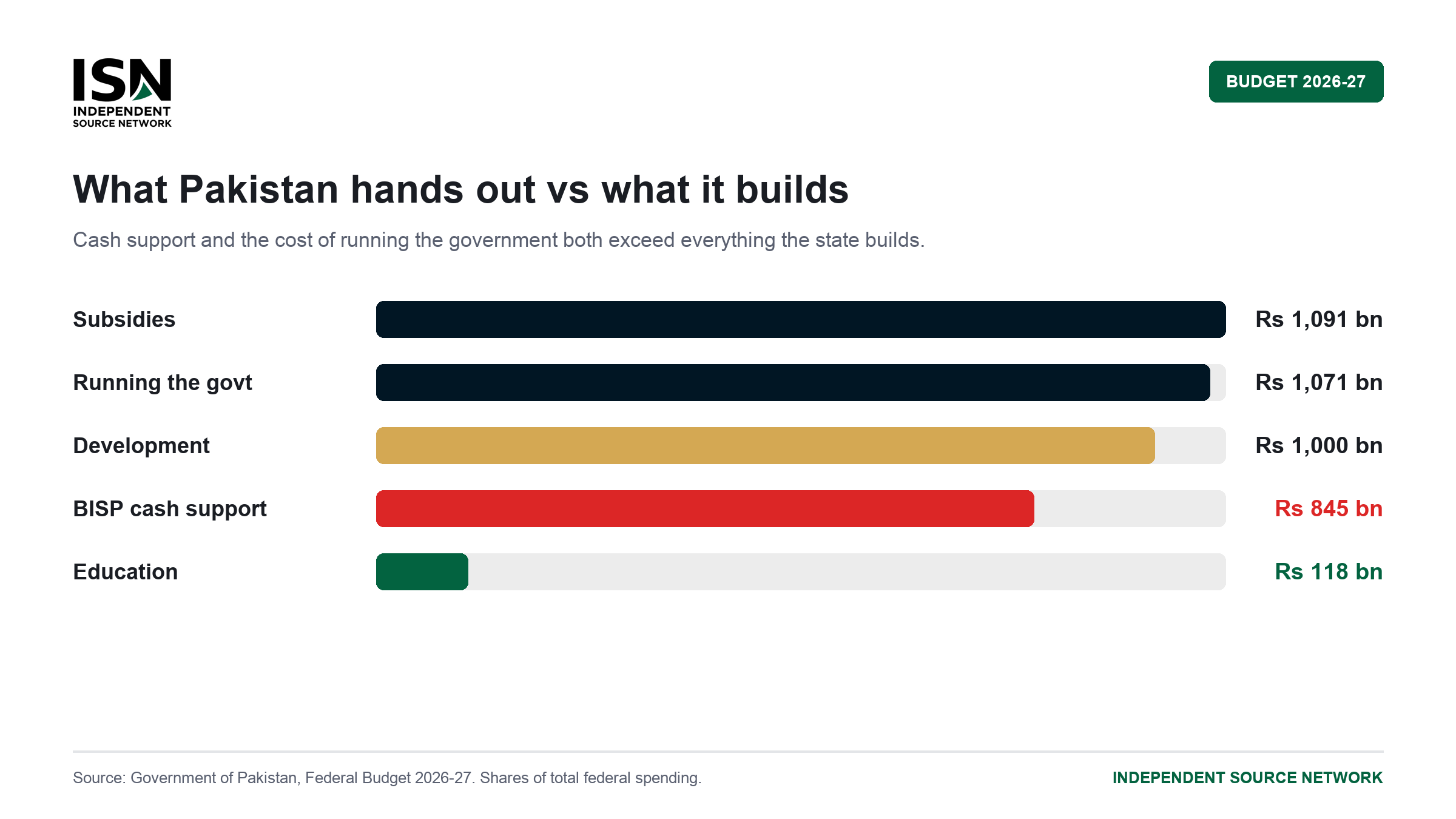
Cash support and other transfers, beside the federal education line.
The seven-to-one ratio is accurate as stated, but it compares a federal cash programme with a federal education line, when most education spending is provincial. Read against total national education spending, the gap is narrower, though cash support remains large relative to what the country invests in schooling.
The case for cash support
The argument for prioritising cash support rests on immediacy and targeting. A poor family needs help now, not in the decade it takes to educate a child, and a means-tested transfer reaches that family directly and reliably. Supporters point out that BISP is well-targeted, pays women, and cushions households against inflation and economic shocks. They note that the International Monetary Fund favours cash transfers precisely because they reach the poor more efficiently than broad subsidies, and that cutting cash support would harm the most vulnerable first.
On this view, education and cash are not true alternatives. Cash keeps families afloat today; education is a separate, longer-term investment, and starving one to fund the other simply moves hardship around.
The case for education
The argument for prioritising education rests on permanence. A cash transfer relieves poverty without ending it, while education equips the next generation to leave poverty for good. Supporters of this view argue that a permanent, growing handout can become a holding pattern, keeping families at the same level year after year, whereas the same money invested in schooling, skills and training would break the cycle. They point to the absence of any published figure for how many families have graduated off cash support as evidence that the programme sustains rather than ends poverty.
This is the argument made forcefully, in opinion form, by the writer Asad Baig in cash is not a plan. In neutral terms, it holds that the test of anti-poverty spending is whether it moves people permanently across the poverty line.
Why it is not a simple either-or
The honest position is that the comparison, while real, is not a straight exchange, for three reasons. First, most education funding is provincial, so the federal trade-off is narrower than the headline ratio suggests. Second, BISP already contains an education-linked component, the conditional stipend tied to school attendance, so part of cash support is itself education spending. Third, both lines are small against the budget as a whole, and both are dwarfed by the same far larger items, interest and defence, examined in the 43 percent.
A serious treatment therefore frames the question not as cash versus education in isolation, but as how to design transfers that relieve need today while also building the capability to escape poverty tomorrow, within a budget where debt and defence claim most of the money.
What the evidence says about cash transfers
The international evidence on cash transfers is broadly positive on relief and mixed on graduation. Well-targeted transfers reliably reduce immediate poverty and improve measures such as food security and school enrolment, especially when paid to women and linked to conditions. Whether they move families permanently out of poverty depends heavily on design: transfers paired with assets, training and enterprise support, the graduation approach, show better long-term results than unconditional cash alone. This is why the size of BISP's graduation and conditional components, relative to its unconditional core, is central to judging the programme.
How other countries approach the choice
The cash-versus-education framing is not unique to Pakistan, and other countries' experience is instructive. Several middle-income countries, notably in Latin America, built large conditional cash-transfer programmes that tied payments to school attendance and health visits, explicitly linking immediate relief to long-term human-capital goals. The lesson most often drawn is that the two objectives need not compete if the transfer is designed to advance both: a conditional payment relieves poverty today while keeping children in school for tomorrow.
The difficulty in Pakistan is one of scale and balance. The conditional and graduation components of BISP are small relative to the unconditional core, and the education system the conditions point children toward is itself thinly funded. So the design that worked elsewhere, cash conditioned on education, depends on an education system able to deliver, which returns the question to the low spending on schooling examined in Pakistan's education budget 2026-27.
What the debate often misses
Both sides of the cash-versus-education argument can obscure a larger point. Even added together, federal cash support and federal education are a modest part of the budget, dwarfed by interest and defence. A reader who frames the choice only as cash against education may miss that the binding constraint is the size of the band left after the largest claims are met. Expanding either cash support or education substantially, without addressing the debt burden, runs into the same wall. This is why analysts who study the trade-off tend to argue that the cash-versus-education question, while real, sits inside a larger question about the structure of the budget as a whole.
Frequently asked questions
Does Pakistan spend more on cash support than education? At the federal level, yes, about seven times more: BISP is about Rs 844.8 billion against federal education of about Rs 118 billion. But most education funding is provincial, so the federal comparison overstates the true trade-off.
Is the seven-to-one comparison fair? It is accurate as stated but needs qualification. It compares a federal cash programme with a federal education line, when most education spending is provincial, and BISP itself includes an education-linked component.
What is the case for cash support? That poor families need help now, that a means-tested transfer reaches them directly, and that cash cushions households against shocks. Supporters argue cash and education are separate needs, not alternatives.
What is the case for prioritising education? That education equips the next generation to leave poverty permanently, while a growing handout can become a holding pattern. The absence of published graduation figures is cited as evidence cash sustains rather than ends poverty.
Does the evidence favour cash or education? The evidence favours well-targeted cash for immediate relief, and is mixed on permanent escape from poverty. Transfers paired with assets and training show better long-term results than unconditional cash alone.
Are cash and education really alternatives? Not straightforwardly. Most education funding is provincial, BISP contains an education component, and both are small beside interest and defence. The deeper question is how to design transfers that relieve need now while building capability for the future.
How have other countries balanced cash and education? Several middle-income countries built large conditional cash-transfer programmes that tied payments to school attendance and health visits, linking immediate relief to long-term goals. The lesson is that the two need not compete if the transfer is designed to advance both.
What does the cash-versus-education debate often miss? That both lines are small beside interest and defence, so the binding constraint is the band of spending left after the largest claims are met. Expanding either substantially runs into the same wall without addressing the debt burden.
Sources and notes
- Government of Pakistan, Federal Budget 2026-27: BISP and education figures are Budget Estimates in billions of rupees.
- The international evidence on cash transfers reflects published research by the World Bank and development economists.
- This article reports the arguments on both sides without endorsing one. The opinion that cash is not a plan is attributed to Asad Baig.


 Admin
Admin