



What Is BISP and How Much Is Its 2026-27 Budget?
Pakistan's largest cash safety net, and its Rs 844.8 billion allocation
By the ISN Media desk • June 2026 • Approx. 5-min read
This is a short, factual answer about the Benazir Income Support Programme and its 2026-27 allocation. The figures are Budget Estimates from the Government of Pakistan, in billions of rupees. For the full explainer, see BISP 2026-27, 844 billion rupees and a 16.9 percent rise.
What is BISP and how much is its 2026-27 budget?
The Benazir Income Support Programme, or BISP, is Pakistan's largest social safety net, a cash-transfer programme that pays low-income families identified through a national means test. Its 2026-27 budget is about Rs 844.8 billion, a rise of about 16.9 percent on the year, within total social protection of about Rs 857 billion. Begun in 2008, it has grown across successive governments into one of the largest cash-transfer programmes in the region.
How it is targeted
Recipients are identified through a national registry that scores households on a means test, rather than being chosen locally, which is intended to reduce the discretion through which patronage usually operates. Payments are made to the woman of the household, a design choice intended to strengthen women's position and improve delivery. The registry is updated periodically through a national survey.
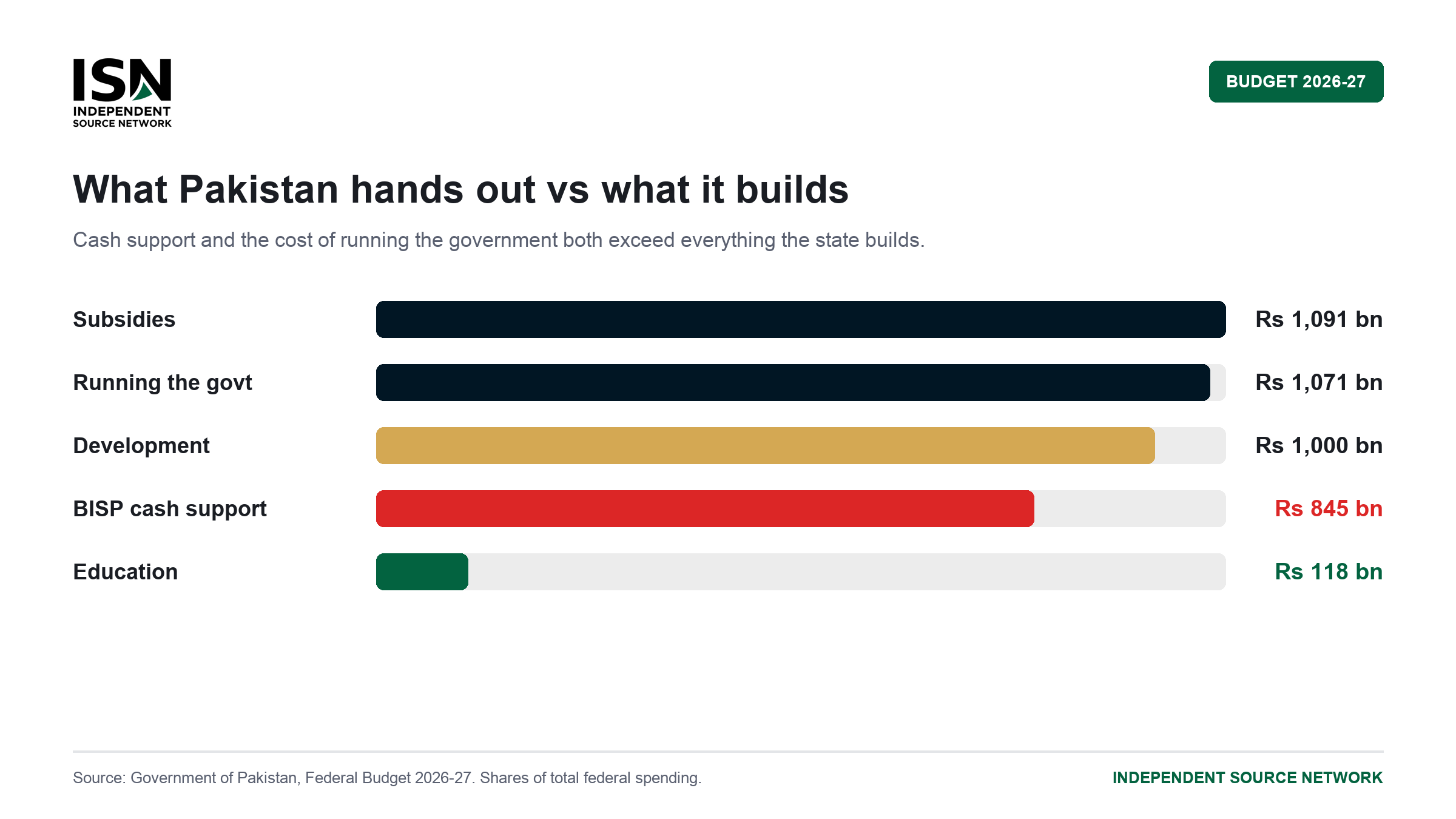
BISP cash support, beside other large transfers and the development budget.
What it pays
The programme runs through several components. The core is an unconditional cash transfer, known as Kafaalat, paid to eligible women. Alongside it are conditional payments: an education stipend, sometimes called Taleemi Wazaif, tied to children remaining in school, and a nutrition component, sometimes called Nashonuma, for mothers and young children.
Why it grew
BISP grew about 17 percent in 2026-27, faster than inflation, in a year when development was cut about 9 percent. Part of the growth reflects support from the International Monetary Fund, which favours direct cash transfers as a more efficient way to reach the poor than broad subsidies and as a cushion against austerity. The full both-sides analysis is in BISP, subsidies and the politics of cash support.
Frequently asked questions
What is BISP? The Benazir Income Support Programme, Pakistan's largest cash safety net, which pays low-income families identified through a national means test. It began in 2008.
How much is BISP in the 2026-27 budget? About Rs 844.8 billion, up about 16.9 percent on the year, within total social protection of about Rs 857 billion.
How are BISP recipients chosen? Through a national registry that scores households on a means test, rather than local selection. Payments are made to the woman of the household.
What does BISP pay? An unconditional core transfer (Kafaalat) to eligible women, plus conditional components: an education stipend (Taleemi Wazaif) and a nutrition component (Nashonuma).
Why did BISP grow this year? It rose about 17 percent, faster than inflation, partly because the IMF favours direct cash transfers over broad subsidies, and partly as a domestic policy choice, even as development was cut.
Is BISP well-run? Its targeting, a biometric, means-tested registry with payment to women, has been praised by the World Bank. Debate centres less on delivery than on its politics and on whether cash alone reduces poverty.
What share of the budget is BISP? About 4.5 percent of the total budget of Rs 18,771 billion. It is a significant line but far smaller than interest (about 43 percent) or defence (about 16 percent).
Sources and notes
- Government of Pakistan, Federal Budget 2026-27: BISP and social-protection figures are Budget Estimates in billions of rupees, rounded for readability.
- BISP's components and targeting reflect the programme's official structure and World Bank assessments.


 Admin
Admin