



Rest in Peace, Pakistan: Where Is the Plan in the 2026-27 Budget?
A citizen's opinion on a budget that hands out cash where a future should be
By Asad Baig • Written from outside Pakistan • June 2026 • Approx. 22-min read
What follows is my personal opinion on Pakistan's federal budget for 2026 to 2027. It is not a neutral report and it does not pretend to be balanced. These are my views, my arguments, and my questions, gathered in one place.
I am not an economist. But I believe any graduate who works and contributes to this economy understands these matters well enough. Most of us simply do not know the exact numbers, because our days are spent earning a living for our families. So I sat down and read the numbers, line by line, so you would not have to. And I will tell you plainly what I found.
I found cash where a plan should be. I found 43 rupees of every 100 going to interest on old debt. I found 63 paisa for the education of this country's children. In my eyes, this is not a budget. It is political engineering, dressed in the language of relief.
What is wrong with Pakistan's 2026-27 budget?
The core problem with Pakistan's 2026-27 budget is that it protects debt, defence and cash handouts while starving the things that build a country, with about Rs 8,054 billion going to interest, Rs 3,000 billion to defence, and only Rs 118 billion to education and Rs 37 billion to health at the federal level. The total budget is Rs 18,771 billion. Read those four numbers again, slowly. Then ask yourself where the plan is.
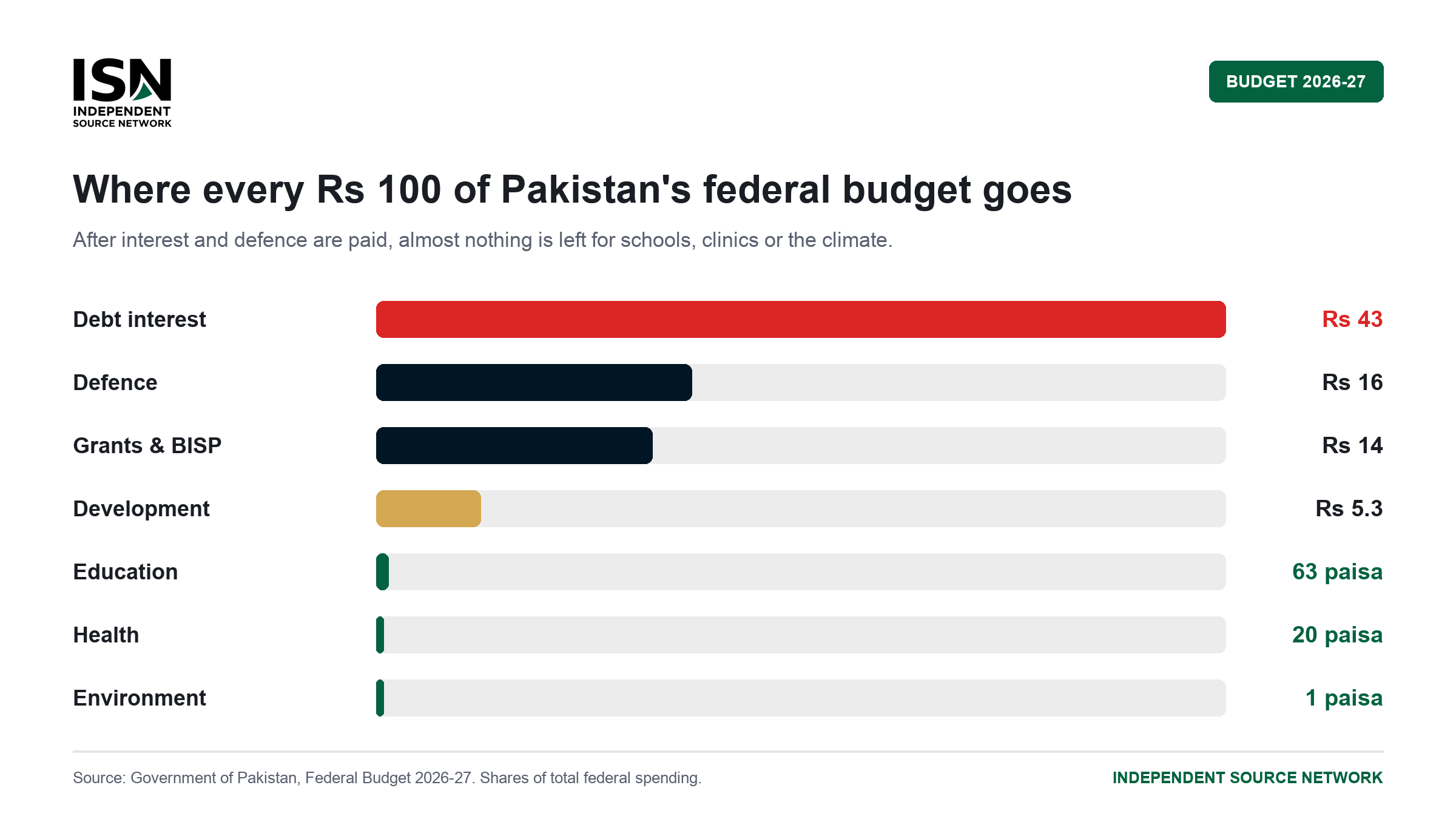
Where every Rs 100 of the federal budget goes. Debt interest takes Rs 43 and education just 63 paisa. Read that gap again.
I will spend the rest of this article showing you what each of those numbers means, in plain words, the way I would explain it to my own family. I have written the full breakdown of every figure in a separate piece, where every rupee of Pakistan's 2026-27 budget goes. This piece is not that. This is what I feel about it.
My real worry is education
Let me start with what worries me most. The education budget.
I am deeply concerned about it, and about the seriousness of our government towards educating this country's children. When I see how little is given to education, and how much is given elsewhere, I cannot accept that this is the best a state can do for its people.
Sixty-three paisa. Out of every hundred rupees the federal government spends, education gets about 63 paisa. The number itself is Rs 118 billion. Set that beside defence at Rs 3,000 billion and you are looking at a state that spends roughly 25 rupees on its army for every one rupee it spends on its schools.
I know the answer they will give. They will say education is a provincial subject now, under the eighteenth amendment, and that most school spending sits in the provincial budgets. Very well. But that does not satisfy me, and I will explain later why it does not.
BISP, or education?
My frustration is simple. The government spends far more on cash handouts than on education, and in my opinion the money is going to the wrong place.
The Benazir Income Support Programme is set at about Rs 844.8 billion this year, a rise of almost 17 percent. Education gets Rs 118 billion. So cash support receives roughly seven times what the federal education line receives. Read that line again. I want it to sit with you for a moment.
If the choice were mine, I would take what goes into BISP and spend it on educating the very families who receive BISP today, so that their next generation is at least well educated and does not inherit the same poverty.
And I do not mean one kind of education for everyone. I would give different levels to different people. Small skill development for some. Information technology and computer skills for others. Engineering diplomas, and training for lab technicians, for those who can go further. Doctors from among them. And for those who study hard and pass an open competition, government officer jobs.
These families have lived inside poverty their entire lives. Educate them, and they will understand better than anyone how to deal with poverty and how to rise out of it. Instead, the government simply hands them cash. I have set this argument out in full in why cash is not a plan for Pakistan.
Take one family on the cash list. The mother receives her payment every month, the same payment, for ten years. At the end of ten years she is exactly where she started, only older. Now take the same money and the same ten years, and put the daughter through a polytechnic, a coding course, a nursing diploma. At the end of ten years that family is not on any list at all. One of these is charity. The other is a plan. We chose charity, and we called it a programme.
And here is the part that makes me angry, not sad. This is not difficult to understand. Any shopkeeper, any schoolteacher, any taxi driver in Pakistan understands the difference between feeding a man for a day and teaching him a trade for life. We have known this since we were children. It is in our religion and in our proverbs. The state knows it too. It simply prefers the version that buys loyalty.
Why I say BISP is political
I believe BISP is political, and the name itself says so.
To me it looks like political funding handed to families under the cover of a programme. Consider one fact. Since this programme began, the government in Sindh has never changed. It has always been the same party. Have we ever asked ourselves why? This, in my view, is how you control people.
In our politics, people are so poor that they will come to a political rally just for the biryani served at the end. They come to kill their hunger. So ask yourself honestly. A family that receives a monthly cash payment, will it ever vote for any other party? These may be called my claims, or harsh opinions. But when a party refuses to let a cash programme end, and refuses even to let its name change, that is not only corruption. It is a plain use of power.
Picture the rally. The chairs in the ground, the flags, the heat. The crowd has come for the box of biryani at the end, and everyone there knows it, including the men on the stage. This is not democracy buying dinner. It is dinner buying democracy. And the monthly payment that arrives on a phone is the same rally, made permanent, made quiet, made to look like compassion.
And the lenders abroad only push this further. The fund keeps pressing the government to increase cash support, because it likes that the money reaches poor families directly. It even regards this as a good thing for Pakistan. I do not accept that calculation, and I never will. I have written the full version of this argument in is BISP political? the Sindh question.
A family that receives a monthly cash payment, will it ever vote for any other party? They want magic to happen, that poverty will end on its own, while they keep the receipts and keep the votes.
Cash is not a plan
Of course giving cash to someone in need is a good thing, and I do not deny it. But we are not planning for a few thousand people. This is a country of 220 million people, and we are caught in a debt trap built by political families.
To climb out of that debt we need a real plan, a proper plan that benefits the majority over the long term, not a handout that benefits a party in the short term.
Because when the majority finally climbs out of inflation and poverty, they will help the economy grow. They will lift the stock market, they will build businesses, and they will create jobs for others. That is the opposite of what a permanent cash programme does when it is used as a political tool.
Where did the money go that should have built this plan? Much of it left the country. I have written before about where Pakistan's wealth goes, into DHA and Bahria Town plots, and about the capital that flies out of Pakistan every year. The same families who built the debt trap moved their own money to safety. The cash programme is what is left for the rest.
We already feed the hungry
People will tell me that education is a long road, and that hunger is today's problem. I understand the argument. But do not try to fool me by selling a programme with a political name as the best and only solution.
We are a country with a Zakat and charity system that runs all year round. We have Bait-ul-Mal. We have thousands of charities, many of them Islamic charity organisations, feeding and helping people every single day. Go and look at the numbers of those charities, and then look at the cash programme. The hunger of today is already being met by a vast network of giving.
I have no problem at all if the programme spends on girls' education. That would be excellent. But for years it has mostly handed out cash. So let me ask the question that matters. In all these years, have Pakistani families actually crossed the poverty line? Or have they only been kept alive, year after year, exactly where they were?
We educate our people, then we export them
I know that most of the operating cost of education sits in the provincial budgets. Even so, the number does not satisfy me. This budget is not enough to give the poor of Pakistan free scholarships, not enough to turn them into degree holders.
And there is a bitter twist. Even when our people do earn degrees and become professionals, many of them leave the country. I have written this before, in my remittance columns, about how our professionals depart, and how the state almost celebrates their departure and enjoys the money they send home.
We educate our doctors, and they leave. I documented the exact scale of it in Pakistani doctors leaving in the last five years. We educate our engineers and our nurses, and they leave too. The full account is in the brain drain that turned Pakistan into the graveyard of its own remittancers. We spend a little to educate them, then we export them, and then we read out the remittance figure as if it were a victory.
Stand in any departure lounge at 3am. The boy with the new engineering degree, the girl who trained four years as a nurse, the young doctor who topped his class. Their parents are crying at the barrier. The state taught them just enough to be wanted somewhere else, and now it waves them off and waits for the dollars to come home. This is the plan. The airport is the plan.
What I mean to say is this. A budget that will not educate its people, and cannot keep the few it does educate, is not a budget that is planning for a country. It is a budget that is planning for an airport departure lounge.
The cost of running the government
Now look at the cost of simply running the government. The allocation for running the civil government was raised to Rs 1,071 billion. That increase alone, about 100 billion rupees, is almost half of the entire federal education budget.
They will say they need the money. But I believe they know there are no jobs they are going to create, and that the people educated in Pakistan will leave in the end, so they spend on themselves and leave education behind.
And what is this running of civil government anyway? We already have separate budgets for education, for defence, for subsidies. So what is this extra head? Look closely and you find something striking. The development budget, the money that actually builds the country, is Rs 1,000 billion. The cost of running the government is Rs 1,071 billion.
Read that slowly. The cost of running the government is larger than the entire budget for building the country. What is the reason for a 100 billion rupee increase here, in a year when development itself was cut?
Health, and the questions I want answered
The government will say, as it does with education, that health is a provincial subject under the eighteenth amendment. Very well. But then I have a counter-question.
The provinces also have a mandate over development. So why is the federal government spending Rs 1,000 billion on development if the provinces already have their own development budgets? And in the same way, if direct help to people is a provincial job, why is the federation spending more than Rs 844 billion on cash support?
If most of the mandate was transferred to the provinces under the eighteenth amendment, then why does the centre still ask for a 100 billion rupee raise just to run itself? Is this not a double job and a double expense, once at the centre and once in the provinces?
And why set aside only Rs 37 billion, two-tenths of one percent, for health? Why set it at all, if it is to be so small? You might as well hand it over as travel funds for the parliamentarians, who I am sure spend more than this on their travel alone. How many hospitals does the Government of Pakistan actually run under this budget? What medicine subsidy does it provide? These are my questions.
Recreation, culture and heritage, for what?
Then there is the budget for recreation, culture and religion. About Rs 24 billion, around one-tenth of one percent. I want to ask, for what exactly?
What is recreation here? Is it the changing of the names of Muslim towns back to older ones? What is the culture budget? Is it the arranging of concerts around the world? And what is heritage? Do they mean the Auqaf department? So in the end it comes down to Auqaf, concerts and recreation.
While all of this goes on, the media spends the whole year earning from headlines about Balochistan and KPK, all under the banner of terrorism. Meanwhile public order and safety receives Rs 389 billion, about two percent of the budget. Even that, painful as it is to admit, is more than education receives. And still, more than four percent of the entire budget goes to a cash programme with a political name.
Rest in peace, Pakistan
And what of the environment? Pakistan is among the countries most affected by climate change. The floods of 2022 alone caused damage estimated at around thirty billion United States dollars. Surely, you would think, the government will not disappoint us here.
Let me tell you the truth. This is the smallest line in the entire budget. One-hundredth of one percent. Just Rs 2.4 billion. And it was cut this year, by about a quarter, in the very year the country needs it most.
Rest in peace, Pakistan.
A single paisa in every hundred rupees, for the survival of the land itself. So sad. How shameful. I do not have a softer way to say it, and I will not pretend to.
The riba factory: an economy at war with Allah and His Rasool
I want to close with the thing that pains me most. Our government, through its Shariah boards and its Islamic banking system, has all but fooled the nation into accepting interest, sood, dressed up in a beautiful Islamic shape. And yet the same government still pays 43 percent of its budget in interest.
Eight thousand billion rupees. Rs 8,054 billion in a single year, paid as interest on money borrowed in the past. It pays for no project, no salary, no service. It is simply the price of old debt, and by a wide margin it is the largest item in the budget. We all know the state will keep borrowing, and keep paying sood.
And there are economists, the suited men who carry the title, who will defend this. They will point to the United States, to how it borrows and pays interest, and they will tell us the problem is not the interest at all, only the question of where the borrowed money is spent. To them I have one answer. Allah and His Messenger, peace be upon him, declared war upon those who take and give riba.
So may I ask. Is Pakistan's economy then in a battle against Allah and His Rasool? This whole arrangement, this machine that turns the labour of the poor into interest for the lenders, I call it what it is. A riba factory. That is a painful thing to say, and it is where I will end. I have written my full position on this in the riba factory and Pakistan's debt, and the explainer desk has set out the hard numbers in how 43 percent of the budget goes to interest.
Allah and His Messenger declared war upon those who take and give riba. So may I ask, is Pakistan's economy then in a battle against Allah and His Rasool?
So where is the plan?
Let me gather it in one place, the way I gathered the numbers.
A budget that gives 63 paisa to education and 25 rupees to defence is not planning for children. A budget that gives a single paisa to the environment, in a country drowning every few years, is not planning for the land. A budget that spends more to run the government than to build the country is not planning for the future. A budget that hands out cash with a political name, instead of educating the families who receive it, is not planning at all. And a budget that pays 43 rupees of every 100 in interest is not a budget. It is a confession.
I am not asking for magic. I asked for a plan. A real plan that educates the poor, keeps the educated at home, ends the cash dependency honestly, and stops feeding the riba factory. That is not too much to ask of a state that takes taxes from every litre of fuel I buy and every bill I pay.
And then who are you, to demand it? The ordinary green passport citizen. The one who pays, and is never asked. They deserve a plan. We owe them that. The country deserves it.
Where is the plan? I am still asking. Thank you for reading.
Frequently asked questions
Is Pakistan's 2026-27 budget a real plan? In my opinion, no. A real plan would invest in the things that build long-term growth, mainly education, health and development. This budget instead protects debt interest (43 percent), defence (16 percent) and cash handouts, while education receives about 63 paisa and health about 20 paisa out of every 100 rupees. That is management of decline, not a plan for recovery.
Why does Pakistan spend more on BISP than on education? The Benazir Income Support Programme is allocated about Rs 844.8 billion in 2026-27, roughly seven times the federal education line of Rs 118 billion. My view is that this is partly because cash support is politically useful in a way that slow, long-term education spending is not. I argue the case in full in is BISP political? the Sindh question.
Is the interest in Pakistan's budget riba? That is my personal religious and moral position, not a settled fact. I believe the interest the state pays, about Rs 8,054 billion this year, is riba, even when it is dressed in Islamic banking language. Religious scholars and economists disagree on this question, and I set out both my view and the debate in the riba factory and Pakistan's debt.
How much does Pakistan spend on education in the 2026-27 budget? At the federal level, education receives about Rs 118 billion in current spending, around 0.6 percent of total federal spending, or 63 paisa in every 100 rupees. Most school spending sits in the provincial budgets under the eighteenth amendment, but even the national total stays low by international standards.
What does "cash is not a plan" mean? It is my argument that a permanent cash handout keeps poor families alive at the same level year after year, without ever moving them across the poverty line, while a real plan would educate and employ them so they can rise out of poverty for good. The full argument is in why cash is not a plan for Pakistan.
Why do I call defence and interest the reason there is no money for schools? Because together, debt interest and defence take close to three rupees out of every five the federal government spends. Once those two are paid, plus pensions, subsidies and the cost of running the government, very little is left for education, health and the environment. The arithmetic is laid out in where every rupee of the budget goes.
Did the eighteenth amendment really move education and health to the provinces? Yes, in large part. Most schools and hospitals are now funded by the provinces from the share of national revenue the centre transfers to them, about Rs 8,848 billion this year. My counter-question is why the federal government still runs large development and direct-support budgets if those mandates moved to the provinces.
What would I do instead? I would redirect cash-support money into tiered education for the same families, protect health and the environment from cuts, demand a line-by-line account of the cost of running the government, and treat the debt and its interest as the emergency it is. A budget should plan for the country, not for the next election.
Sources and notes
- Government of Pakistan, Federal Budget 2026-27: Budget in Brief, Annual Budget Statement, and Demands for Grants. All figures are Budget Estimates in billions of rupees.
- Benazir Income Support Programme allocation and year-on-year change: Federal Budget 2026-27, social protection schedule.
- Education, health, environment, and recreation/culture/religion shares: Federal Budget 2026-27 sector classification.
- Debt interest, defence, development (PSDP), and running of civil government: Federal Budget 2026-27 major spending heads.
- 2022 flood damage estimate: Government of Pakistan and World Bank Post-Disaster Needs Assessment.
- The intent throughout has been to inform and to argue honestly, not to defame. Where these are my opinions, I have said so plainly.
Related reading
- The full breakdown: Pakistan's federal budget 2026-27, where every rupee goes
- The debt: how 43 percent of Pakistan's budget goes to interest
- Why cash is not a plan for Pakistan
- We educate our people, then we export them
- The riba factory: Pakistan's economy at war with Allah and His Rasool
- My earlier work: the brain drain and the graveyard of remittancers and my position on Pakistan's foreign currency system


 ISN MEDIA