



The Riba Factory: Pakistan's Economy at War With Allah and His Rasool
Why I believe a budget that pays 43 percent in interest is a machine for sood
By Asad Baig • Written from outside Pakistan • June 2026 • Approx. 9-min read
I want to write about the thing that pains me most in this whole budget. Our government, through its Shariah boards and its Islamic banking system, has all but fooled the nation into accepting interest, sood, dressed up in a beautiful Islamic shape. And yet the same government still pays 43 percent of its budget in interest. I do not have a soft way to say what I believe that is. I will say it plainly, the way I said it in where is the plan.
Is the interest in Pakistan's budget riba?
In my belief, yes, the interest Pakistan pays is riba, even when it is dressed in the language of Islamic banking, and a state that pays about Rs 8,054 billion of interest in a single year while promoting Islamic finance is living a contradiction. This is my religious and moral position, not a settled fact, and I will give the other side its say. But I will not hide my view, because I hold it with my whole heart.
That is where I stand. Now let me explain the factory.
Eight thousand billion rupees, every year
Let me set the number down hard. The federal government will pay about Rs 8,054 billion in interest this year, around 43 percent of all federal spending. It is the single largest line in the budget, larger than defence and everything the state builds, combined. It pays for no school, no hospital, no road. It is simply the price of old debt.
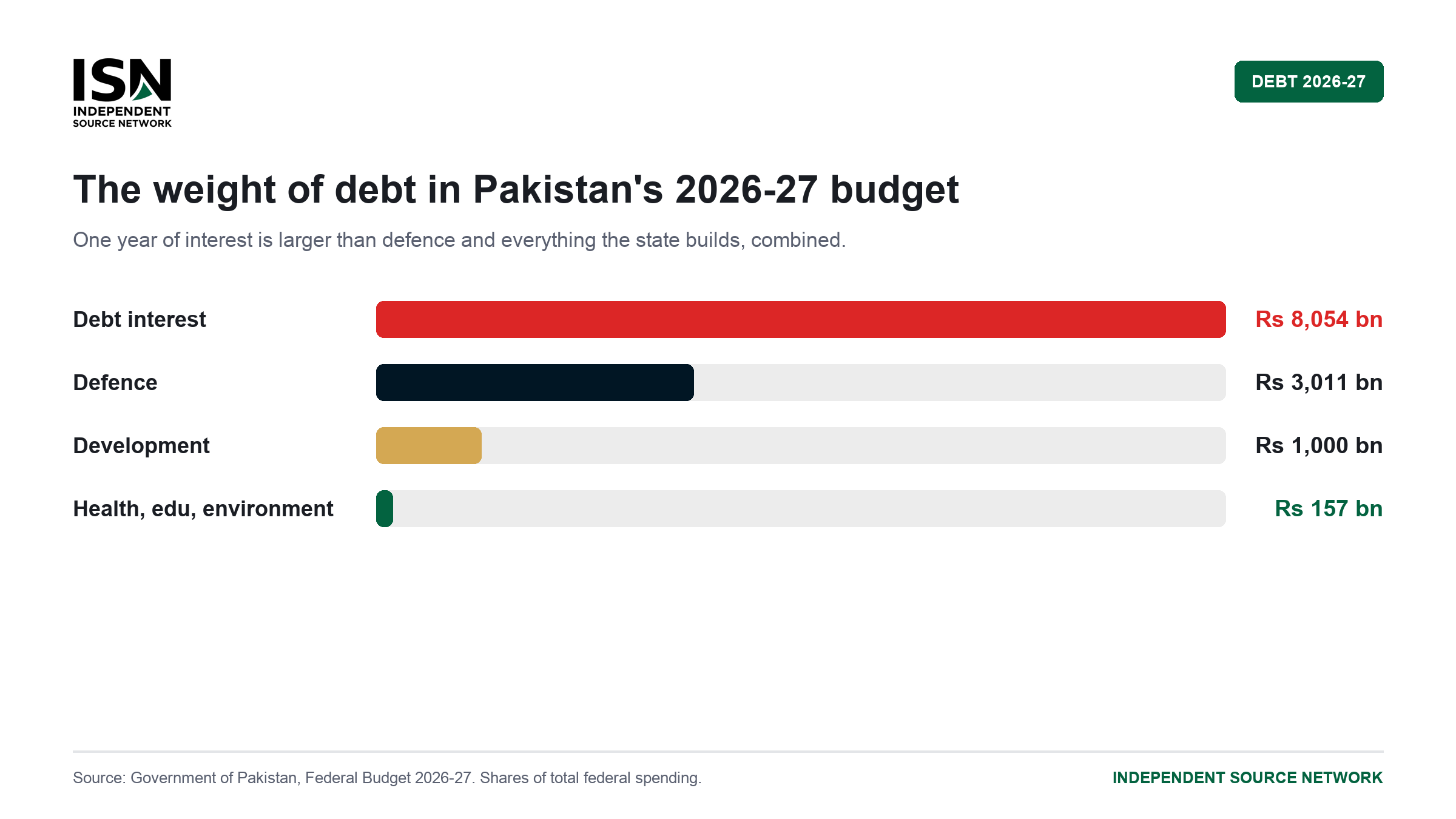
One year of interest, beside what it could have built. The full mechanism is in the 43 percent.
We all know the state will keep borrowing, and keep paying sood. The whole machine, turning the labour of the poor into interest for the lenders, I call it what it is. A riba factory.
The hypocrisy that pains me
Here is what I cannot accept. The same state that pays 43 percent of its budget in interest also stands up and tells us it is building an Islamic economy. It has Shariah boards. It has Islamic banking windows. It has fooled good, believing people into thinking the sood has been cleaned, only because it now wears a beautiful name.
You cannot have it both ways. You cannot tell the believer that his savings account is now halal because you changed the label, and then pay 43 rupees of every 100 you spend as interest to your lenders. That is not an Islamic economy. That is a sood economy with an Islamic signboard.
You cannot tell the believer his account is now halal because you changed the label, and then pay 43 rupees of every 100 as interest. That is a sood economy with an Islamic signboard.
How the economists will answer, and why I do not accept it
I know the economists will read this differently, the suited men who carry the title. They will point to the United States, to how it borrows and pays interest, and they will tell me the problem is not the interest at all, only the question of where the borrowed money is spent. To them I have one answer.
Allah and His Messenger, peace be upon him, declared war upon those who take and give riba. So I ask, plainly. Is Pakistan's economy then in a battle against Allah and His Rasool? That is a heavy thing to say, and I do not say it lightly. I say it because I believe it.
I do not claim every scholar agrees
I will be honest, because honesty is part of faith. Not every scholar agrees with me. Some say that the borrowing of a modern state is a different matter from a moneylender squeezing a poor man, and that necessity changes the ruling. Some point to the Islamic financing certificates the government already uses for part of its domestic debt. The Federal Shariat Court itself has ruled against riba, and the debate over what that means in practice is real and ongoing.
Let them argue it. I am not a mufti and I do not pretend to be. But I am a believing citizen who can read a budget, and when I see 43 percent of it going to interest while the state sells me Islamic banking, my heart tells me something is wrong, and I will not be quiet about it. The reference desk lays out both sides without taking mine in interest and riba, the religious argument over Pakistan's debt.
Borrowing to pay the interest on the borrowing
What makes it a factory, and not just a debt, is the loop. The state borrows. It cannot pay back the interest, so it borrows again to pay the interest. Then it borrows a third time to pay the interest on the second loan. Around and around. The primary surplus this year is about Rs 2,828 billion, which means before interest the government actually takes in more than it spends. The deficit exists almost entirely because of interest on old debt. I explain that machinery in the debt trap, why Pakistan borrows to pay its own interest.
Sit with what that means for a believer. Every year, a larger share of the labour of the poorest people in this country, the taxes hidden in the fuel they buy and the soap they wash with, is converted into interest and handed to lenders. The factory never stops, and its only product is sood. We did not inherit this from some foreign occupier. We built it ourselves, with our own hands, and then we blessed it with a green signboard.
A painful place to end
This is where I end, because it is the thing that pains me most. We are a Muslim country that took a loan, and another to pay the interest on the first, and another to pay the interest on that. We built a factory whose only product is sood, and we hung a green signboard on it.
I do not have a clever closing line for this one. I only have a question, and I will leave it with you. If Allah and His Messenger declared war on riba, what are we doing? That is a painful thing to say, and it is where I will stop.
Frequently asked questions
Is the interest in Pakistan's budget riba? In my belief, yes. I hold that the interest the state pays, about Rs 8,054 billion this year, is riba even when dressed in Islamic banking language. This is my religious and moral position, not a settled fact, and respected scholars disagree on the question of state borrowing.
How much interest does Pakistan pay? About Rs 8,054 billion in 2026-27, roughly 43 percent of all federal spending, and the single largest line in the budget. The mechanism is explained in the 43 percent.
What is your problem with Islamic banking in Pakistan? My problem is not Islamic finance itself. It is a state that promotes Islamic banking to its people while paying 43 percent of its own budget in interest. I argue that is a contradiction, a sood economy with an Islamic signboard.
Do all scholars agree that state interest is riba? No. Some scholars distinguish modern sovereign borrowing from exploitative private lending, or cite necessity, and the government raises part of its debt through Islamic instruments. The debate is genuine, and I present it in interest and riba.
Are you issuing a religious ruling? No. I am a believing citizen, not a mufti. I am stating my own conviction about what I see in the budget, and inviting the reader to sit with the question.
Why do you call it a "factory"? Because of the loop. The state borrows, then borrows again to pay the interest, then again to pay the interest on that. The deficit exists almost entirely because of interest on old debt, even though the government runs a primary surplus. A machine whose only product is sood, running year after year, is what I mean by a riba factory.
Sources and notes
- Government of Pakistan, Federal Budget 2026-27: debt interest is a Budget Estimate of about Rs 8,054 billion, around 43 percent of federal spending.
- The view that this interest is riba is my own religious and moral position, clearly stated as opinion. The contrary scholarly views are acknowledged.
Related reading
- The pillar: where is the plan, my opinion on the 2026-27 budget
- The numbers: the 43 percent, how debt interest eats Pakistan's budget
- The debate: interest and riba, the religious argument over Pakistan's debt
- Siblings: cash is not a plan, we educate our people, then we export them, is BISP political, the Sindh question


 ISN MEDIA