



We Educate Our People, Then We Export Them
A budget that will not teach its children, and cannot keep the few it does
By Asad Baig • Written from outside Pakistan • June 2026 • Approx. 9-min read
I know that most of the operating cost of education sits in the provincial budgets. I will say that at the start, so no one corrects me as if it changes my point. Even so, the number does not satisfy me. This budget is not enough to give the poor of Pakistan free scholarships, not enough to turn them into degree holders. And there is a bitter twist on top of it. Even when we do educate our people, properly, many of them leave.
This is the part of where is the plan that I have carried with me the longest, because I have lived it. Eight years outside Pakistan. I have watched it happen to my own family, my own friends.
Why does Pakistan lose the people it educates?
Pakistan loses the people it educates because the state spends just enough to train them and gives them no reason to stay, so its doctors, engineers and nurses leave for countries that will pay and respect them. Then the same state reads out the remittance figure every year as if it were a victory. At the federal level education gets about Rs 118 billion, 63 paisa in every 100 rupees, while a single year of debt interest is about 68 times that. A country that funds its children last cannot be surprised when they grow up and leave.
That is the argument. Let me walk you through it.
Sixty-three paisa, and what it buys
Federal spending on education is about Rs 118 billion, six tenths of one percent of the budget. Set it beside defence at about Rs 3,011 billion and you are looking at roughly 25 rupees on the army for every one rupee on schools.
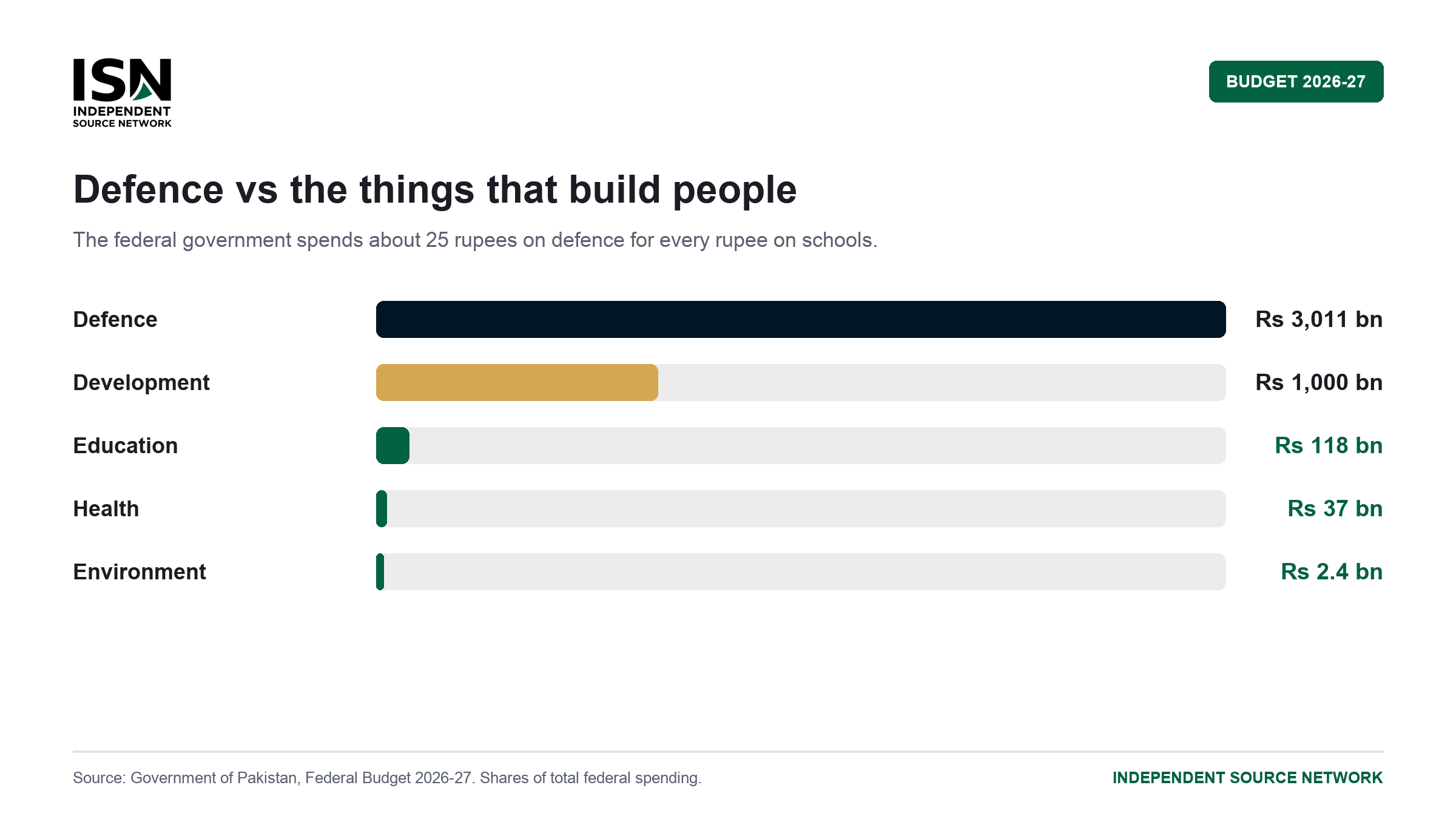
Defence beside the things that build people. The full sector breakdown is in education, health and the smallest shares.
I will be fair. Some lines did rise. Federal education and training almost doubled this year, and the Higher Education Commission rose by about a sixth. Real increases, and I will not pretend otherwise. But a little more of almost nothing is still almost nothing. The base is too small for the rises to matter in a real classroom.
We educate them, then we export them
Here is the wound the budget does not show on any line. We have become, by our own official registrations, one of the largest exporters of skilled people in the world. We train a doctor and she leaves. We train an engineer and he leaves. We train a nurse and she leaves too.
I have documented the scale of it in my remittance columns. The doctors who left in the last five years, in Pakistani doctors leaving in the last five years. The doctors and engineers now abroad, in the numbers of Pakistani doctors and engineers overseas. The whole story, in the brain drain that made us the graveyard of our own remittancers.
Stand in any departure lounge at 3am. The boy with the new engineering degree, the girl who trained four years as a nurse, the young doctor who topped his class. Their parents are crying at the barrier. The state taught them just enough to be wanted somewhere else, and now it waves them off and waits for the dollars.
We spend a small sum to train them, and then we watch that investment board a plane and pay its taxes in another country. And the state celebrates. It reads out the remittance figure like a trophy.
The remittance trophy
I want to be clear about what bothers me here. A country that celebrates the money its children send home from abroad is a country that has quietly given up on keeping them. The remittance figure is not a sign of strength. It is the receipt for a loss. It measures how many of our best we have sent away.
The government job is not to look at the economy or the remittance only. It is also to look at people's emotions. They want magic to happen, that the remittance will rise on its own forever, and at what cost? They do not know or do not care. All the good people they have sent outside, and with the rest they make the government and the system.
This is also experience, not only emotion
Let me tell you that this is not my emotion only. This is also experience. I have spent eight years outside Pakistan, and I have watched the brain drain happen to my own family, my own friends, my own community. Eight Eids on a video call. Eight years of watching parents wave their children off at the airport and then go home to an empty house, and tell the neighbours their son is doing well abroad, because what else is there to say.
People will tell me, go ask them, the parents are happy, their son sends money. And maybe they will say that, with a brave face. But ask them again, quietly, at night, what they would trade to have their child at the same dinner table. That is the cost the budget never counts. The remittance figure does not have a column for it.
What I mean to say
What I mean to say is this. A budget that will not educate its people, and cannot keep the few it does educate, is not a budget that is planning for a country. It is a budget that is planning for an airport departure lounge.
This is not an argument to spend less on education. It is an argument to spend, and then to give the educated a reason to stay. Pair the scholarship with a job. Pair the degree with a country worth building a life in. Otherwise we are simply running a training college for the hospitals of London and the offices of the Gulf, and paying for it ourselves. I argue the way out, redirecting the handout into real education, in cash is not a plan.
Frequently asked questions
Why does Pakistan lose the people it educates? Because the state spends just enough to train them and gives them no reason to stay. Its doctors, engineers and nurses leave for better pay and respect abroad, and the state then treats the remittances they send back as a success rather than as the cost of losing them.
How much does Pakistan spend on education? At the federal level about Rs 118 billion, roughly 63 paisa in every 100 rupees. Adding development lines like the Higher Education Commission, the federal total is around Rs 200 billion. Most school spending is provincial, but the national total still sits below 2 percent of the economy.
Did the education budget rise this year? Parts of it did. Current education rose about 4.5 percent, the Higher Education Commission about 16.5 percent, and federal education and training almost doubled. The rises are real but small in rupees because the base is very low.
Why do educated Pakistanis emigrate? Low pay, instability, and a sense that the country offers them no future are the main reasons. I have documented the scale across my brain-drain columns, starting with the brain drain and the graveyard of remittancers.
Are remittances not a good thing? Remittances help families and reserves, but I argue that celebrating them is celebrating the export of our own talent. A high remittance figure measures how many skilled people the country could not keep.
What would keep educated Pakistanis from leaving? Pay that respects their training, stability, and a sense that the country has a future for them. The point is not to spend less on education but to pair it with reasons to stay, so the investment in a doctor or an engineer benefits Pakistan rather than the labour markets of the Gulf and the West, which paid nothing to train them and reap the whole reward.
Sources and notes
- Government of Pakistan, Federal Budget 2026-27: education and defence figures are Budget Estimates in billions of rupees.
- Emigration and remittance figures are documented in my published brain-drain series; see the linked pieces.
- Where I argue that education spending and emigration are one policy, that is my opinion, clearly stated.
Related reading
- The pillar: where is the plan, my opinion on the 2026-27 budget
- Education, health and the smallest shares of Pakistan's budget
- Siblings: cash is not a plan, the riba factory, is BISP political, the Sindh question
- My earlier work: the brain drain and the graveyard of remittancers, Pakistani doctors leaving in the last five years


 ISN MEDIA