



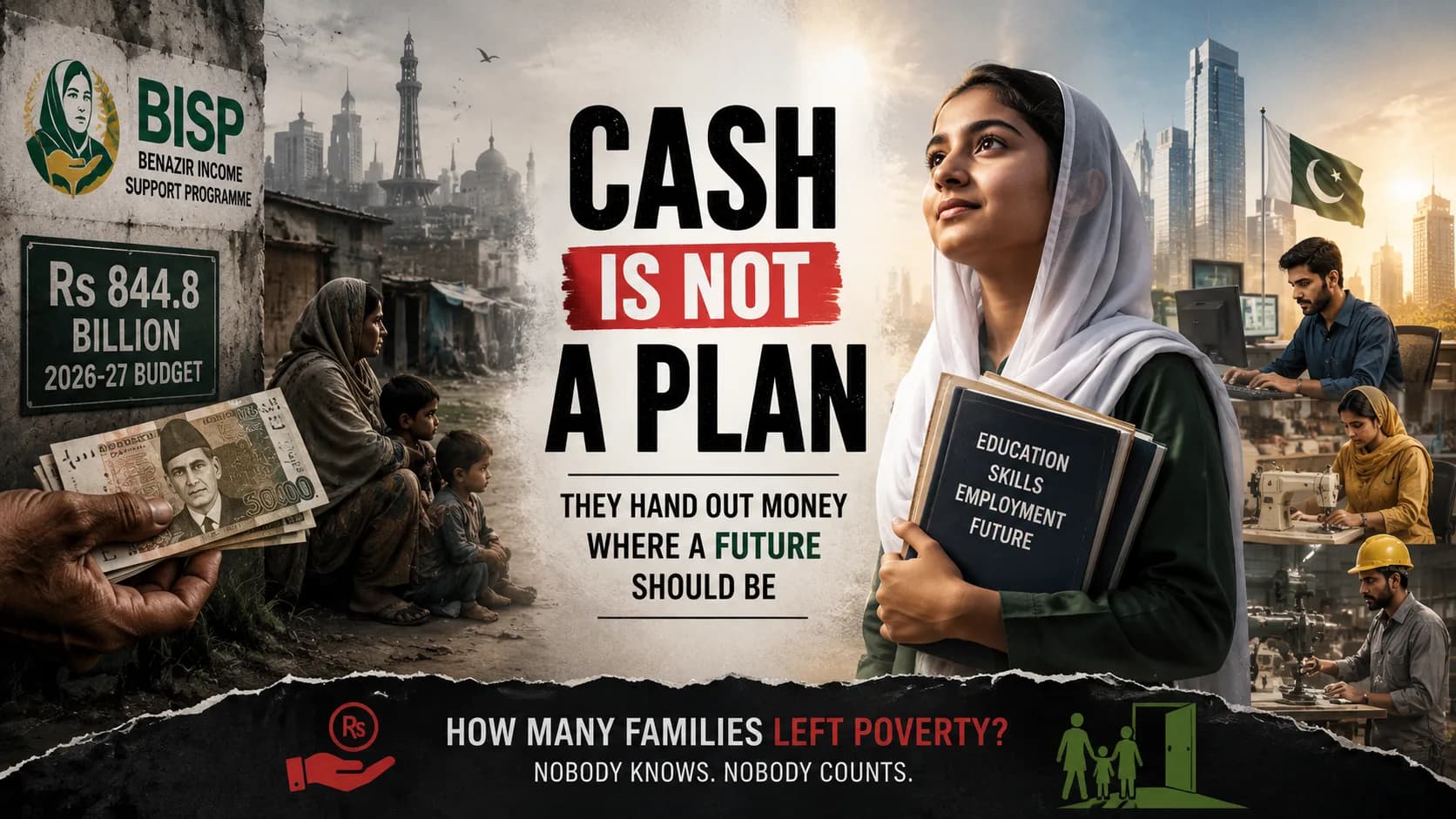
Cash Is Not a Plan: They Hand Out Money Where a Future Should Be
Why I believe BISP keeps the poor alive without ever letting them leave
By Asad Baig • Written from outside Pakistan • June 2026 • Approx. 9-min read
Of course giving cash to someone in need is a good thing, and I do not deny it. I want to say that first, before anyone twists my words. If a family is hungry tonight, feed them tonight. Only a cruel man argues with that.
But we are not talking about feeding a few thousand people tonight. We are talking about a country of 220 million, caught in a debt trap built by political families, being handed cash year after year and told this is the answer. It is not the answer. In my eyes, it is the absence of one. This piece is part of my wider argument in where is the plan.
Why is cash support not a plan for poverty?
Cash support is not a plan because it keeps a poor family at exactly the same level, year after year, without ever moving them across the poverty line, while a real plan would educate and employ them so they could rise out of poverty for good. In Pakistan's 2026-27 budget the Benazir Income Support Programme receives about Rs 844.8 billion, roughly seven times the federal education line of Rs 118 billion. We are spending far more to keep people where they are than to help them leave.
That is the whole argument in one paragraph. Let me open it.
The number, and what it is beside
BISP rose to about Rs 844.8 billion this year, a jump of almost 17 percent, in the same budget where development, the money that builds the country, was cut by about 9 percent. So the thing that keeps people in place grew, and the thing that could lift them shrank. Read that again.
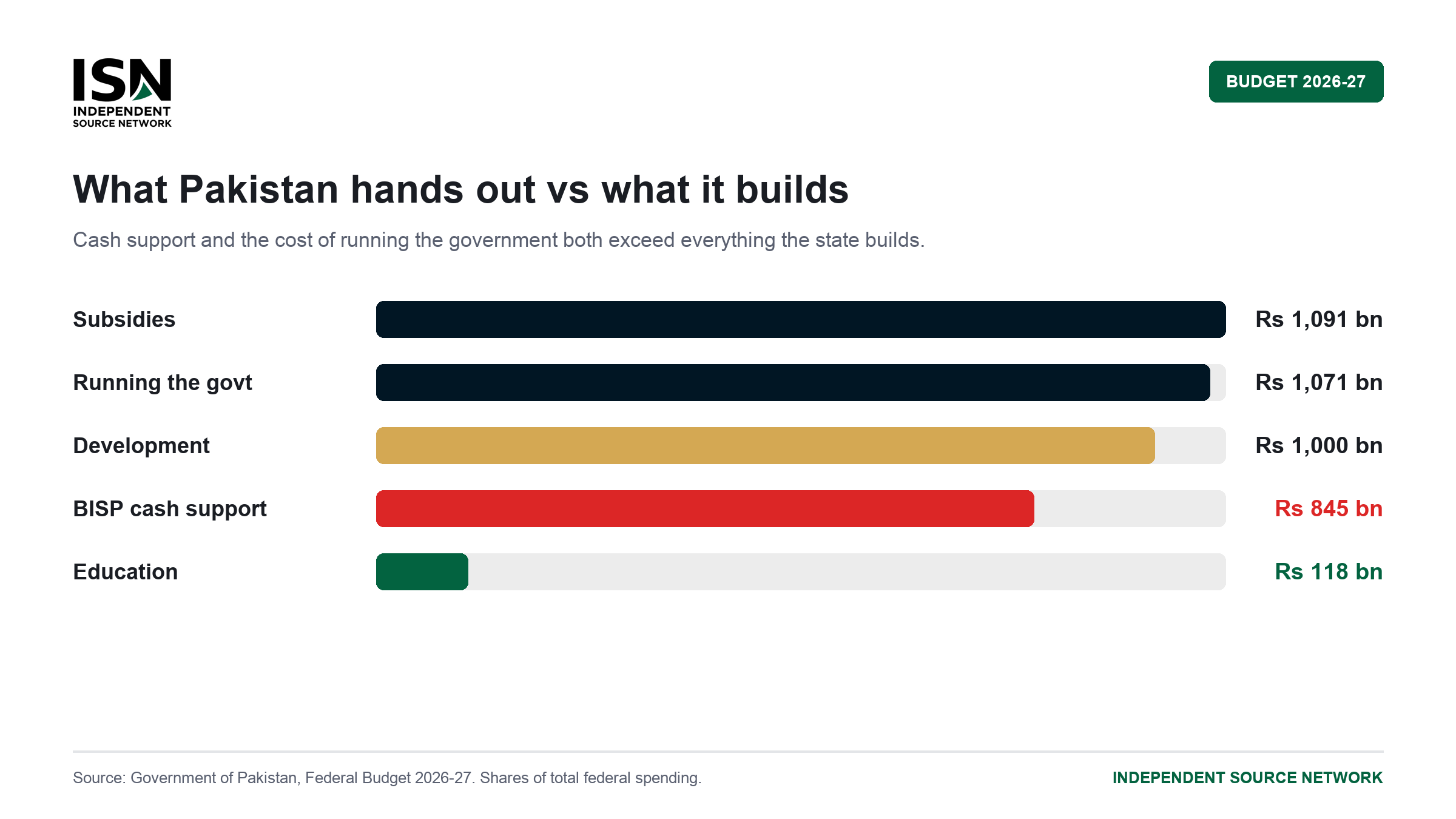
What we hand out, beside what we build. The handout is seven times the education budget.
I am not against the poor receiving help. I am against a state that has decided the poor should receive help forever, instead of receiving a way out once.
Feed a man for a day, or teach him a trade for life
Our religion tells us the difference. Our proverbs tell us. Every mother in every poor house in this country already knows it. You can feed a man for a day, or you can teach him a trade for life. The first is charity. The second is a plan.
If the choice were mine, I would take what goes into the handout and spend it on educating the very families who receive it today. And not one kind of education for all of them. Different levels for different people. Skill training for some. Computer and IT skills for others. Engineering diplomas, lab technicians, for those who can go further. Doctors from among them. And for those who study hard and pass an honest, open competition, real government jobs.
Take one family on the cash list for ten years. At the end she is exactly where she started, only older. Take the same money and the same ten years, and put her daughter through a polytechnic. At the end that family is on no list at all. One is charity. The other is a plan.
These families have lived inside poverty their whole lives. Educate them and they will understand better than any consultant how to climb out of it. Instead, the state simply hands them cash, and calls it a programme. I make the education side of this case in we educate our people, then we export them.
We already feed the hungry
People throw hunger at me to end the argument. They say education is a long road, and hunger is today. I understand it. But do not sell me a handout with a political name as the only answer to hunger.
We are a country with Zakat and charity running all year round. We have the Bait-ul-Mal. We have thousands of charities, many of them religious, feeding people every single day. Go and look at their numbers, and then look at the handout. The hunger of today is already being met by a vast network of giving. So the state's special job should be the thing charity cannot do well, which is education, and the long climb out.
I will be fair to the other side, because I always am. A state payment is steady in a way charity is not. That is the honest reason for a public safety net. But a safety net is meant to catch you and let you climb back up, not to become the floor you live on for life.
The question they never answer
Here is the question I will keep asking until someone answers it. In all these years of payments, have Pakistani families actually crossed the poverty line? Or have they only been kept alive, exactly where they were?
The honest answer is that nobody publishes it. The state can tell you to the rupee how much it paid out. It cannot tell you how many families it set free. And I believe that silence is not an accident. A number that embarrasses you is a number you do not collect. A state proud of its handout would count the people who left it. This one counts only the people still on it. I take the politics of that further in is BISP political, the Sindh question.
What a plan would look like
Let me say plainly what I would do, because attacking is easy and building is hard. I would not cut off a family that is genuinely hungry tomorrow morning. But I would change what the money is for. I would tie far more of it to education and skill, so a family on the list has a clear road off the list. I would publish, every year, how many families left for good, and make a minister answer for that number, not for the amount disbursed.
When the majority finally climbs out of poverty, they will help the economy grow. They will lift the market, build businesses, and create jobs for others. That is the opposite of what a permanent handout does when it is used as a political tool. That is the difference between a plan and a payment.
And do not tell me the money is not there. The money is there. It left the country. The same families who built the debt trap moved their own wealth to safety, into Dubai property and offshore accounts, while the rest were handed a monthly payment to keep them quiet. I have written about where that money goes in the capital that flies out of Pakistan every year and in where Pakistan's wealth goes, into DHA and Bahria plots. The handout is not generosity. It is what is left for the people after the few have taken theirs.
Frequently asked questions
Why is cash support not a plan for poverty? Because it keeps a poor family at the same level year after year without moving them across the poverty line. A real plan would educate and employ them so they can rise out of poverty for good. Cash relieves need; it does not end it.
How much is BISP in the 2026-27 budget? About Rs 844.8 billion, up roughly 17 percent on the year, while development was cut about 9 percent. That is about seven times the federal education line of Rs 118 billion.
Are you against helping the poor? No. Immediate help for a genuinely hungry family is right. My argument is against a permanent handout replacing a real plan to educate and employ people so they can leave poverty.
Doesn't Pakistan need cash transfers because people are hungry now? Hunger today is already met substantially by Zakat, Bait-ul-Mal and a large charity network. The state's distinctive job should be the thing charity cannot do well: education and the long climb out of poverty.
Has BISP actually reduced poverty? This is the central open question, and the budget does not answer it. Cash keeps families from falling further, but whether years of payments have moved them across the poverty line, rather than holding them in place, is not measured or published.
Sources and notes
- Government of Pakistan, Federal Budget 2026-27: Budget in Brief and social-protection schedule. BISP and education figures are Budget Estimates in billions of rupees.
- The comparison of cash support to the federal education line is simple arithmetic on those figures.
- Where I argue that cash is not a plan, that is my opinion, clearly stated as such.


 ISN MEDIA