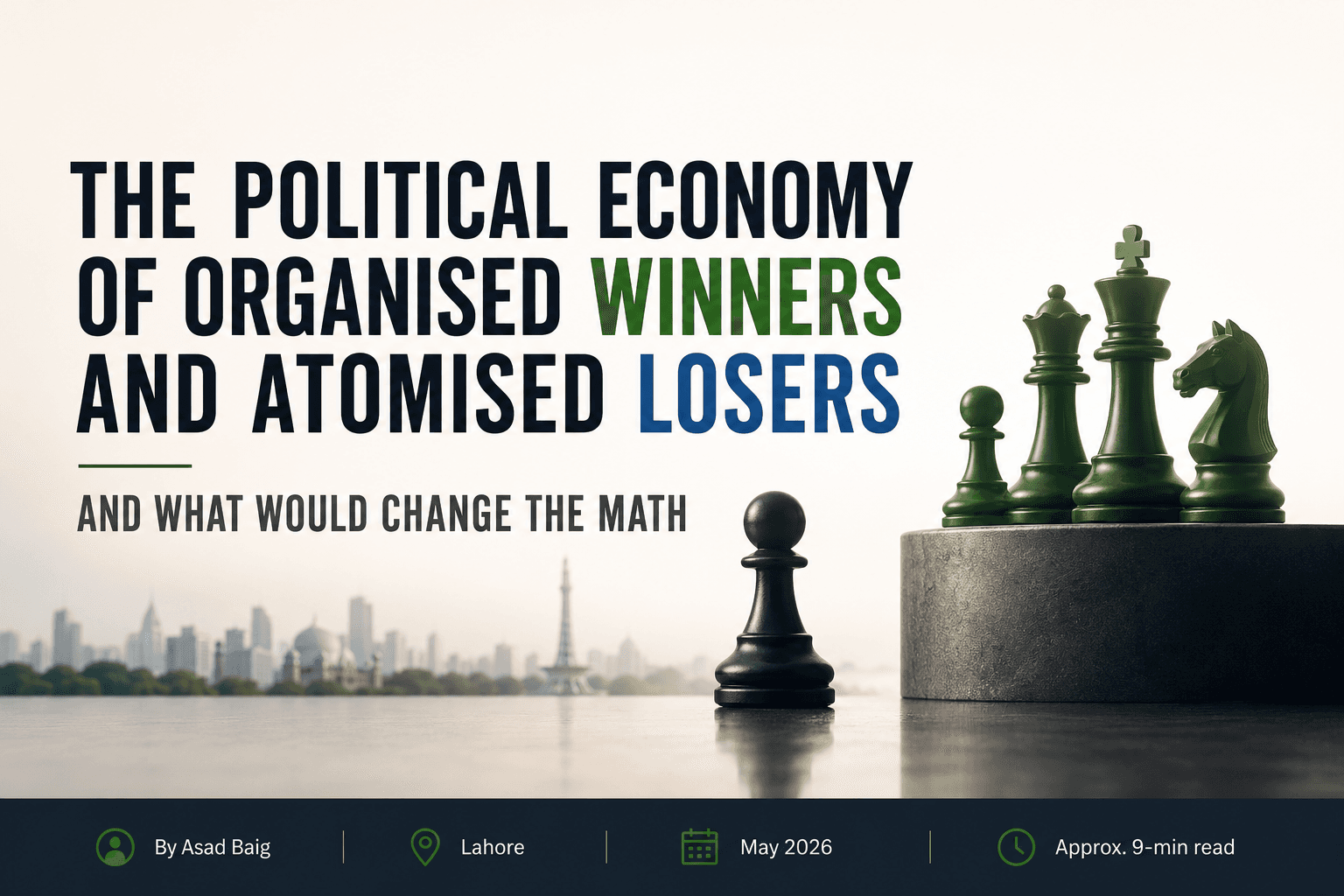
The political economy of organised winners and atomised losers, and what would change the math
By Asad Baig · Lahore · May 2026 · Approx. 9-min read
What this cluster post is part of
This is one of four cluster posts under the Productive Capital Account: a reform proposal for Pakistan's FCY system. The companion posts are PCA eligibility, caps, and mechanics explained, the five FATF-compliant safeguards of the Productive Capital Account, and Pakistan reserves 5-year outlook under PCA reform.
This post focuses on the political economy question that hangs over every Pakistani FCY reform conversation. The technical case is overwhelming. The economic case is clear. The international precedent is established. The 5-year benefit projection is $125 to 180 billion. Yet the system persists. Why?
The political economy in one paragraph
The Pakistani FCY system has not been reformed in 33 years not because the technical case was unclear, but because the political math has favoured the 200,000 organised beneficiaries against the 165 million atomised potential reform beneficiaries. Approximately 200,000 organised beneficiaries earn $8 to 21 billion annually from the current arrangement and are politically powerful, economically integrated, and institutionally embedded: bank executives, bank shareholders, senior bureaucracy, elite families with offshore wealth, politically connected industrialists, exchange company owners. The 165 million potential beneficiaries are atomised, individually frustrated, and have not yet recognised themselves as a class with shared interest. Despite the 825-to-1 ratio favouring reformers in headcount, the 200,000 win because they are organised. The math changes when the dispersed organise. This article explains the mechanism in detail.
Why dispersed reformers usually lose
Five reasons, all well-documented in political economy literature.
Why 200,000 Win Against 165 Million
[1] | Organisation versus atomisation Winners are organised through industry associations, lobbying networks, political donations, family/business connections, direct policymaker access, professional advisers. Losers are atomised: each individual loses moderate amounts, no organised political voice, sectors don't recognise shared interest. |
|---|---|
[2] | Concentrated costs versus diffuse benefits 200,000 with strong individual incentive to fight reform; 165 million with weak individual incentive to organise. Concentrated losers always outfight diffuse winners in the absence of organisation. |
[3] | Visibility problem Reforms produce diffuse, delayed benefits; status quo produces immediate, concentrated harms to specific institutions if changed. The visible cost of reform is concentrated; the invisible benefit is dispersed. |
[4] | System opacity Most Pakistanis don't connect FCY policy to inflation, banking fees to economic underdevelopment, elite extraction to their daily lives. The technical complexity protects the system. |
[5] | Distrust cycle Government suspects business community wants tax breaks; business community suspects government will exploit any flexibility. Mutual distrust prevents coordination. Coordination failure persists. |
Each of these can be addressed. None is a fact of nature. They are facts of organisation.
Who specifically wins
The 200,000 Beneficiaries, Breakdown
Group | Headcount |
|---|---|
Bank executives benefiting from system | ~5,000 senior |
Bank shareholders | ~50,000 (concentrated) |
Senior bureaucracy benefiting | ~50,000-100,000 |
Elite families with offshore wealth | ~10,000-50,000 individuals |
Politically connected industrialists | ~5,000-20,000 |
Exchange company owners and operators | ~5,000-10,000 |
TOTAL BENEFICIARIES | ~125,000-235,000 |
The annual stake of these beneficiaries is $8 to 21 billion across all categories. Their organisation runs through:
The Pakistan Banks' Association
Industrial associations like the All Pakistan Textile Mills Association
Political party donor networks
Family and business connections within the elite
Professional advisers, lawyers, and consultants
Direct access to State Bank, Federal Board of Revenue, and Ministry of Finance senior officials
The institutional embedding is deep. Banks that profit from forced conversions sit on the boards of the regulators who write the rules. Politicians who hold offshore wealth design the laws governing offshore wealth. Bureaucrats who exercise discretionary approval rents draft the procedures requiring discretionary approval. The architecture defends itself.
Who specifically loses
The 165 Million Potential Beneficiaries, Breakdown
Group | Headcount |
|---|---|
IT companies (employees) | ~600,000-800,000 |
Freelancers (verified ADB) | 2.37 million |
Goods exporters and employees | ~3-5 million |
Importers (would also benefit) | ~500,000-1 million |
Overseas Pakistani diaspora | ~9 million |
Working class affected by inflation | ~150 million+ |
TOTAL POTENTIAL BENEFICIARIES | ~165 million |
165 million people losing for the benefit of approximately 200,000 people. That is the ratio of approximately 825 losers for every winner.
But the 165 million are not organised. They suffer individually. They blame various scapegoats. They develop individual workarounds: a Wyoming LLC here, a Wise account there, a UAE subsidiary somewhere else. Each workaround is a small victory for the system. Economic activity continues. The productive class is constrained but not desperate. The status quo persists.
The system depends on individual frustration not becoming collective action. The day it does, the math changes.
What would change the math
What Would Change The Political Math
[1] | Productive class organisation If even 10% of the 165 million atomised losers organise politically, that is 16.5 million people. 16.5 million organised > 200,000 organised. |
|---|---|
[2] | Crisis severe enough to force restructuring Pakistan came close in 2022-2023 but bilateral support prevented full crisis. Future crises may not be similarly cushioned. |
[3] | Generational replacement Current beneficiaries are concentrated in older generations. Estimated timeline: 10-20 years for significant generational shift. |
[4] | Technological disruption Cryptocurrency, decentralised finance, and the digital economy may eventually make the current restriction system technically obsolete. Already happening to some degree. |
Of these four scenarios, only the first is something reformers can actively accelerate. The second and third happen on their own timelines. The fourth is structural but slow.
Productive class organisation, articulated through industry bodies and amplified through media platforms, is the scenario that turns the 825-to-1 ratio from a problem into the foundation of a winning political coalition.
For the practical agenda for productive class organisation, see why the productive class must organise: my call to action.
The class analysis
What we have documented is essentially:
An elite class that has built and maintains a system serving its interests
A productive class that pays the cost without recognising itself as a class
A working class bearing the inflation cost without understanding the cause
A diaspora providing the dollar inflows without proportional voice
The system is sustainable as long as the productive and working classes do not recognise their shared interests against the elite class. The moment they do, the political math changes dramatically.
This is not a hypothetical observation. It is a description of every successful political reform in modern history. Civil rights. Suffrage extension. Welfare state expansion. Anti-corruption movements. Each happened when atomised losers organised themselves into a class with shared interests and demanded the change that the organised winners had been preventing.
Pakistan's FCY framework is the same problem in a different domain.
What productive Pakistanis must do
For reform to happen, the math has to shift. The productive class has to organise itself. The eight-step agenda:
Build awareness. Articulate publicly and persistently the connections between FCY policy, banking profits, currency weakness, inflation, and elite wealth flight.
Organise through existing bodies. P@SHA, FPCCI, KCCI, LCCI must become more aggressive advocates. Cross-sector coalitions across IT, textiles, freelancers, goods exporters, service exporters.
Engage politically. Make banking policy a campaign issue across party lines. Support reform-minded candidates across party lines. Hold representatives accountable for specific votes.
Demand transparency. Public disclosure of bank profit sources, FCY restriction beneficiaries, and politician offshore assets.
Use media platforms. Articles, interviews, content. Fill the information vacuum that protects the system.
Document personal experience. Make the human cost visible. Specific stories make abstract policy real.
Build international voices. Pakistani diaspora can advocate from positions of greater safety and credibility.
Persist. Reform of entrenched systems takes time. The first generation of advocates may not see victory. They begin the work anyway.
In closing
The technical case for the PCA is overwhelming. The economic case is clear. The international precedent is established. The risk mitigation is structural. The 5-year benefit is $125 to 180 billion. None of this matters unless the politics change.
The system has not reformed in 33 years not because the technical case was unclear, but because the political math favoured the 200,000 organised beneficiaries against the 165 million atomised potential reform beneficiaries. The PCA gets adopted only when that math changes.
The math changes when the productive class recognises itself as a class. The math changes when industry associations make banking policy a top-tier political demand. The math changes when MNAs and MPAs face campaign accountability for their votes on FCY frameworks. The math changes when foreign journalists ask Pakistani politicians about offshore wealth and the politicians cannot answer without losing votes.
These changes are achievable. They have not happened. Whether they happen is what determines whether Pakistan's productive class continues to subsidise the elite extraction architecture or finally builds the productive-class banking framework it deserves.
The next move is ours.
Thank you for reading.
, Asad Baig, Lahore, May 2026
Frequently asked questions
Why hasn't Pakistan reformed its FCY framework in 33 years despite the overwhelming technical case? Because the political math has favoured the 200,000 organised beneficiaries against the 165 million atomised potential reform beneficiaries. Beneficiaries are organised through industry associations, lobbying networks, political donations, and direct policymaker access. The 165 million are atomised, individually frustrated, and have not yet organised themselves as a class with shared interests.
Who are the 200,000 beneficiaries of the current Pakistani FCY system? Five categories: bank executives benefiting from the system (~5,000 senior positions), bank shareholders (~50,000 with concentrated wealth), senior bureaucracy benefiting (~50,000-100,000), elite families with offshore wealth (~10,000-50,000), politically connected industrialists (~5,000-20,000), and exchange company owners and operators (~5,000-10,000). Combined total: ~125,000-235,000 individuals with annual stake of $8-21 billion.
Who are the 165 million potential beneficiaries of FCY reform? IT companies (~600,000-800,000 employees), freelancers (2.37 million verified by ADB), goods exporters and employees (~3-5 million), importers (~500,000-1 million), overseas Pakistani diaspora (~9 million), and working class affected by inflation (~150 million+).
What is the 825-to-1 ratio? Approximately 165 million potential reform beneficiaries against 200,000 current system beneficiaries, a ratio of approximately 825 losers for every winner. Despite the disparity in headcount, the 200,000 win because they are organised, while the 165 million are atomised.
What would change the political math for FCY reform? Four scenarios: (1) productive class organisation - if even 10 percent (16.5 million) organise politically, they outnumber organised beneficiaries; (2) balance-of-payments crisis severe enough to force restructuring; (3) generational replacement - current beneficiaries are concentrated in older generations, estimated 10-20 year timeline; (4) technological disruption through cryptocurrency, decentralised finance, and digital economy.
Why is "the system depends on individual frustration not becoming collective action" the key insight? Because Pakistani productive class members have learned to navigate the system individually through Wyoming LLCs, Mercury accounts, UAE free zone companies, and similar offshore structures. Each individual workaround is a small victory for the system: economic activity continues, the productive class is constrained but not desperate, status quo persists. The system depends on this individual adaptation continuing rather than collective political demand emerging.
Can a Pakistani crisis force FCY reform? Pakistan came close to forced restructuring during the 2022-2023 crisis when reserves dropped below $3 billion and import cover fell to less than three weeks. Bilateral support prevented full crisis. Future crises may not be similarly cushioned. A balance-of-payments crisis severe enough that the existing system literally cannot continue is a reform-forcing scenario.
How can the Pakistani diaspora help drive FCY reform? The diaspora has particular leverage. It can advocate from positions of greater safety than domestic critics. It can use platforms with foreign journalists, professional networks abroad, and international forums to put pressure on Pakistani policy conversation. The Roshan Digital Account exists in part because diaspora was politically powerful. The same power can be used to demand a Productive Capital Account.
Sources
Position Paper: The Foreign Currency Account Problem in Pakistan, May 2026, Section 7
Pakistan Banks' Association membership and policy data
Industrial association memberships (APTMA, FPCCI, P@SHA, KCCI, LCCI)
Asian Development Bank verification of 2.37 million Pakistani freelancers
OCCRP "Dubai Unlocked" investigation, May 2024
A.F. Ferguson submission to Pakistan Supreme Court on UAE-held assets (September 2018)
Atlas of Offshore World data on Pakistani offshore wealth



 ISN MEDIA