Palestine: The Complete Story — From Ancient Scripture to Modern Statehood
A comprehensive, fact-based account of the land, its people, and the competing claims that have shaped one of history's most enduring conflicts.
The Name: Where "Palestine" Comes From
The name Palestine is one of the oldest continuously used geographic designations in the world. Its roots predate both the modern Israeli and Palestinian national movements by millennia.
The earliest traces of the name appear in Egyptian inscriptions from the time of Pharaoh Ramses II and Ramses III, roughly around the 12th century BCE, referring to a people called "Peleset." The Hebrew Bible uses a cognate term — Pelesheth (פלשת) — appearing no fewer than 250 times to refer to the Philistines, an Aegean people of Indo-European origin who settled along the southern Mediterranean coast of Canaan around 1200 BCE. In its original Hebrew usage, Pelesheth denoted only the narrow coastal strip of Philistia, not the entire region.
The Greek historian Herodotus, writing in the 5th century BCE, was the first to use the term in its recognizable form. He described "a district of Syria, called Palaistinê" stretching from Phoenicia to Egypt. Philosophers and geographers who followed — Aristotle, Ptolemy, and others — used the term similarly, and by this period it already referred to a broader region than just the Philistine coastal strip. Scholars have noted an intriguing possible wordplay: the first seven letters of Palaistinê correspond to the Greek palaistês, meaning "wrestler" — the same attribute from which the name "Israel" derives, since the patriarch Jacob was renamed Israel ("one who struggles with God") after wrestling with an angel at the river Jabbok (Genesis 32:28).
The name was formalized by Rome in the 2nd century CE. After crushing the Bar Kokhba Revolt in 135 CE, Emperor Hadrian renamed the province of Judaea to Syria Palaestina. Whether intended as a deliberate slight to sever the Jewish connection to the land, or simply a practical adoption of the most commonly known geographic term (as some historians argue), the name endured. Under Byzantine rule it became the basis for the provinces of Palaestina Prima, Secunda, and Tertia. The Arabic form Filastin continued its use through the Islamic period and into the Ottoman centuries. The British revived "Palestine" as an official political-territorial name in 1920 under the League of Nations Mandate.
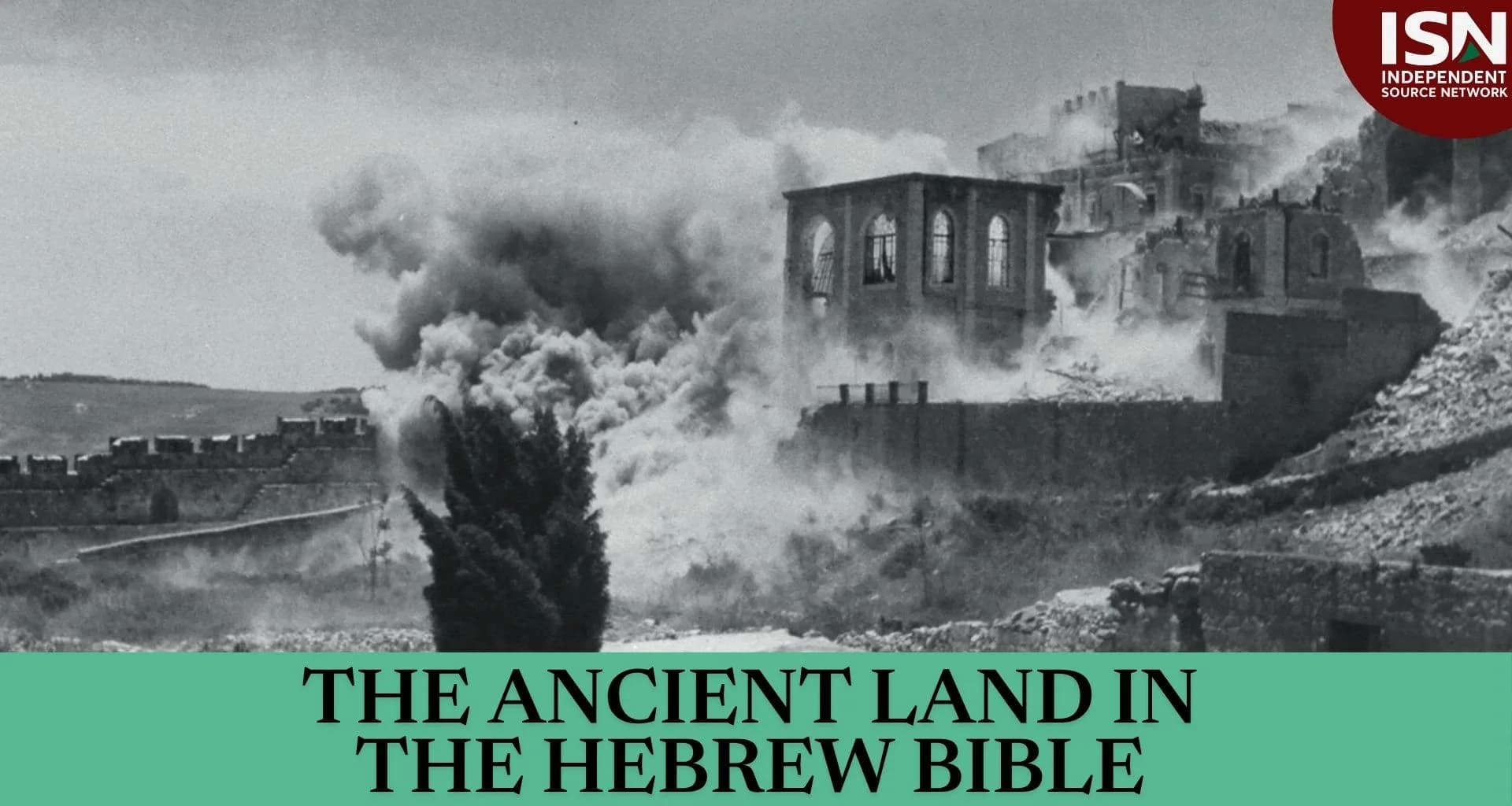
The Ancient Land in the Hebrew Bible
The land that today encompasses Israel and the Palestinian Territories occupies a central position in the Hebrew Bible (Tanakh). Understanding the biblical narrative is essential not because it resolves competing modern claims, but because it is the foundational text through which both Zionist and many Christian movements have framed their relationship to this territory.
The Abrahamic Covenant
The Hebrew Bible's claim to the land begins with God's call to Abram (later renamed Abraham) in the Book of Genesis. Three key chapters form the architecture of what theologians call the "Abrahamic Covenant":
Genesis 12:1–3 — God commands Abram to leave his homeland and go to the land of Canaan, promising: "I will make of you a great nation, and I will bless you and make your name great, so that you will be a blessing. I will bless those who bless you, and him who dishonors you I will curse; and in you all the families of the earth shall be blessed." Abram obeys and travels to Canaan.
Genesis 15:18–21 — God formalizes the covenant through a sacrificial ceremony. He tells Abram: "To your descendants I have given this land, from the river of Egypt as far as the great river, the river Euphrates" — a vast territory encompassing the lands of the Kenites, Kenizzites, Kadmonites, Hittites, Perizzites, Rephaites, Amorites, Canaanites, Girgashites, and Jebusites. The text also foretells that Abraham's offspring will be enslaved in a foreign land for 400 years before returning.
Genesis 17:7–8 — God formally establishes the covenant as "everlasting," promising Abraham: "I will give to you and to your offspring after you the land of your sojournings, all the land of Canaan, for an everlasting possession; and I will be their God." Circumcision is instituted as the sign of the covenant.
The Line of Inheritance
The biblical narrative carefully traces the line through which the land promise passes. Abraham's son Isaac inherits Canaan (Genesis 26:3), while his other son Ishmael — whom Islamic and Arab tradition regards as the forefather of the Arab peoples — receives blessings and a promise of nationhood but in a different territory, "east of Egypt as one goes to Assyria" (Genesis 25:18). Isaac's son Jacob (renamed Israel after the wrestling encounter in Genesis 32:28) inherits the Canaan promise, while his twin Esau settles in Edom to the south. Jacob's twelve sons become the founders of the twelve tribes of Israel.
The Conquest Under Joshua
The Book of Joshua describes the Israelite entry into Canaan after the Exodus from Egypt and the 40 years of wandering in the wilderness. Joshua leads the military conquest of the land, dividing it among the twelve tribes. This narrative of conquest and settlement forms the historical basis of the ancient Israelite claim to the land. The Philistines — from whom the name Palestine would later derive — appear as the Israelites' principal adversaries along the coastal plain, most famously in the story of David and Goliath (1 Samuel 17).
How Different Traditions Read These Texts
The Hebrew Bible's land promises are interpreted in starkly different ways depending on religious and political perspective:
The traditional Jewish and Zionist reading holds that God made an unconditional, everlasting covenant granting the land of Canaan to the Jewish people as the descendants of Abraham, Isaac, and Jacob. This belief became a cornerstone of the modern Zionist movement in the late 19th century and remains central to religious Zionism today.
Islamic tradition reveres Abraham (Ibrahim) as a prophet and patriarch, but traces Arab lineage through Ishmael (Ismail), Abraham's firstborn son. The Quran affirms the holiness of the land and Jerusalem (Al-Quds), but does not accept exclusive Jewish ownership of the territory. Muslims also maintain deep historical and religious ties to the land, particularly through the Al-Aqsa Mosque in Jerusalem, considered the third holiest site in Islam.
Critical and scholarly perspectives note that the Hebrew Bible was compiled over centuries by communities seeking to make sense of their identity and relationship to God. The Hebrew word olam (עולם), translated as "everlasting" or "forever" in many English Bibles, more literally means "a long time" or "antiquity" — the same word used elsewhere for expressions like "days of old." Many biblical scholars also observe that the land promises in the Hebrew Bible were conditional on the people's faithfulness to the covenant, not absolute guarantees of perpetual possession (see Deuteronomy 28, which outlines blessings for obedience and curses — including exile — for disobedience). Some Christian theologians, particularly in the Reformed tradition, argue that the New Testament reinterprets the land promise as finding its ultimate fulfillment in Christ and a "heavenly country" (Hebrews 11:16), not a specific geographic territory.
The Balfour Declaration: Sixty-Seven Words That Changed History
On 2 November 1917, in the midst of World War I, British Foreign Secretary Arthur James Balfour sent a short letter to Lord Lionel Walter Rothschild, a leader of the British Jewish community, for transmission to the Zionist Federation of Great Britain and Ireland. The letter — just 67 words in its operative clause — became one of the most consequential documents in modern Middle Eastern history.
The Full Text
The letter, housed today in the British Library, reads:
Foreign Office, November 2nd, 1917
Dear Lord Rothschild,
I have much pleasure in conveying to you, on behalf of His Majesty's Government, the following declaration of sympathy with Jewish Zionist aspirations which has been submitted to, and approved by, the Cabinet.
"His Majesty's Government view with favour the establishment in Palestine of a national home for the Jewish people, and will use their best endeavours to facilitate the achievement of this object, it being clearly understood that nothing shall be done which may prejudice the civil and religious rights of existing non-Jewish communities in Palestine, or the rights and political status enjoyed by Jews in any other country."
I should be grateful if you would bring this declaration to the knowledge of the Zionist Federation.
Yours sincerely, (Signed) Arthur James Balfour
Context and Motivations
At the time the declaration was issued, Palestine was still part of the Ottoman Empire, though British forces were actively fighting to take it. The population of Palestine was overwhelmingly Arab — the Jewish community constituted a small minority. Several motivations converged to produce the declaration:
The statement was the product of Zionist advocates both inside the British government — including Balfour himself, Prime Minister David Lloyd George, and cabinet member Herbert Samuel — and from outside, most importantly the Zionist leader Chaim Weizmann, who had cultivated close relationships with Britain's political elite. From a strategic standpoint, British officials hoped the declaration would secure Jewish support for the Allied war effort, particularly in the United States and Russia. It was also part of Britain's broader plan to control Palestine after the war, competing with French claims under the Sykes-Picot Agreement of 1916.
The Declaration's Two Promises
The Balfour Declaration contained two commitments in tension with each other. It supported "the establishment in Palestine of a national home for the Jewish people," while simultaneously stipulating that "nothing shall be done which may prejudice the civil and religious rights of existing non-Jewish communities in Palestine." The term "existing non-Jewish communities" referred to the Arab population, which at the time constituted roughly 90% of Palestine's inhabitants — yet they were not named, identified only by what they were not.
This ambiguity — between a "national home" and full statehood, between Jewish aspirations and Arab rights — would define the next century of conflict.
Incorporation into International Law
The Balfour Declaration was incorporated into the terms of the League of Nations Mandate for Palestine, which was formally approved in July 1922 and came into effect in September 1923. This gave the declaration the force of international law and made it the guiding principle of British policy in Palestine for three decades. Britain governed Palestine under this mandate from 1920 until 1948, during which Jewish immigration increased dramatically, Arab resistance grew, and violence between the communities escalated repeatedly.
Palestinian Perspective on the Balfour Declaration
Palestinians and many Arab states have long viewed the Balfour Declaration as an act of colonial imposition — a European power promising the homeland of one people to another without consulting the existing inhabitants. In the Palestinian Declaration of Independence (1988), the Palestine National Council explicitly cited the historical injustice of the British Mandate era. Palestinian President Mahmoud Abbas has repeatedly called the declaration "unjust," and in 2017, on its centenary, the Palestinian Authority demanded a formal British apology. Britain declined.
The Palestinian Declaration of Independence: 15 November 1988
On 15 November 1988, in Algiers, Algeria, the Palestine National Council (PNC) — the legislative body of the Palestine Liberation Organization — proclaimed the establishment of the State of Palestine. The declaration was written by the Palestinian poet Mahmoud Darwish and read by PLO Chairman Yasser Arafat. It was adopted by a vote of 253 in favour, 46 against, and 10 abstaining.
Key Statements from the Declaration
The declaration proclaimed "the establishment of the State of Palestine in the land of Palestine with its capital at Jerusalem," and affirmed that the state "shall be for Palestinians, wherever they may be, therein to develop their national and cultural identity and therein to enjoy full equality of rights."
It invoked a vision of democratic governance, pledging that "religious and political beliefs and human dignity shall be safeguarded under a democratic parliamentary system of government built on the freedom of opinion; and on the freedom to form parties; and on the protection of the rights of the minority by the majority and respect of the decisions of the majority by the minority; and on social justice and equal rights, free of ethnic, religious, racial or sexual discrimination."
The declaration explicitly cited UN General Assembly Resolution 181 (the 1947 Partition Plan) as providing "conditions of international legitimacy that ensure the right of the Palestinian Arab people to sovereignty." It also stated that the State of Palestine "believes in the settlement of regional and international disputes by peaceful means, in accordance with the UN Charter and resolutions."
Arafat's Clarification at the United Nations
One month later, in December 1988, Arafat addressed the UN General Assembly in Geneva (the session had been moved from New York after the US denied Arafat a visa). In a subsequent press conference, Arafat stated: "We accept two states, the Palestine state and the Jewish state of Israel." He also declared: "Our statehood provides salvation to the Palestinians and peace to both Palestinians and Israelis. Self-determination means survival for the Palestinians. And our survival does not destroy the survival of the Israelis."
This marked the first time the PLO publicly accepted a two-state solution. Following these statements, the United States began direct negotiations with the PLO for the first time.
The Modern State of Palestine: Facts and Figures
Geography
The State of Palestine claims sovereignty over two geographically separate territories: the West Bank (including East Jerusalem) and the Gaza Strip, with a combined area of approximately 6,020 km² (2,324 square miles). This constitutes roughly 23% of the area of pre-1948 British Mandate Palestine. The West Bank borders Israel and Jordan; the Gaza Strip borders Israel and Egypt and has a coastline on the Mediterranean Sea. The climate is mostly Mediterranean in the West Bank, with Judean Desert conditions to the east, and semi-arid Mediterranean in Gaza. The declared capital is East Jerusalem; government institutions operate from Ramallah.
Population
As of 2026, the population is estimated at approximately 5.69 million (UN data). The population density — around 946 per km² — makes it one of the most densely populated territories in the world. The median age is 20.3 years. Approximately 85% of the population lives in urban areas. The language is Arabic; the religion is predominantly Sunni Islam, with a small Christian minority. Millions more Palestinians live in diaspora communities across Jordan, Lebanon, Syria, and the wider world.
Government
The Palestinian Authority (PA), established by the Oslo Accords in 1994, governs parts of the West Bank. The government structure includes a President (head of state), a Prime Minister (head of government), a Cabinet, and the Palestinian Legislative Council (PLC). As of 2025–2026, Mahmoud Abbas serves as President (in office since 2005, though his elected four-year term expired in 2009), Hussein al-Sheikh as Vice President (a newly created position as of April 2025), and Mohammad Mustafa as Prime Minister (appointed March 2024). Hamas, a separate political and militant organization, has controlled the Gaza Strip since 2007 following its victory in the 2006 PLC elections and the subsequent Fatah-Hamas split.
Economy
Palestine is classified as a lower-middle-income developing economy, with an average annual income of approximately US$2,710 per capita. It has no independent currency, using the Israeli shekel, Jordanian dinar, and US dollar. The economy is heavily dependent on trade with Israel (over 80% of exports) and international aid, and has been chronically affected by Israeli movement restrictions, the Gaza blockade (since 2007), and recurring conflict. Major exports include olives, fruit, vegetables, limestone, citrus, flowers, and textiles.
International Recognition: A Diplomatic Transformation
The Arc of Recognition (1988–2025)
When the PLO declared statehood in November 1988, approximately 80 countries extended recognition, primarily members of the Arab League, former Soviet bloc, and African and Asian states. In 2010–2012, most Central and Latin American states followed. In November 2012, the UN General Assembly voted 138–9 (with 41 abstentions) to grant Palestine non-member observer state status — a significant upgrade from its previous observer entity status.
In May 2024, amid the ongoing war in Gaza, Spain, Ireland, and Norway jointly recognized Palestine, followed by Slovenia and Armenia. Then came the most dramatic diplomatic shift: in September 2025, ahead of the UN General Assembly, G7 nations recognized Palestine for the first time — France, the United Kingdom, and Canada — along with Australia, Belgium, and Portugal, among others.
As of September 2025, 157 of 193 UN member states — over 81% — recognize the State of Palestine. Notable holdouts include the United States, Germany, and Italy. The US has consistently used its Security Council veto to block Palestine's full UN membership, arguing that statehood should result from direct negotiations between Israel and the PA.
Key UN Milestones
2011: Palestine admitted as a member of UNESCO (prompting the US to suspend its UNESCO payments)
2012: Granted non-member observer state status at the UN General Assembly
2015: Became a state party to the Rome Statute of the International Criminal Court
2024: UN General Assembly Resolution ES-10/23 granted Palestine additional rights at the UN, including seating with member states and the right to introduce agenda items — but not the right to vote
2025: The UN General Assembly endorsed the New York Declaration charting a path to Palestinian statehood, by a vote of 142 in favour, 10 against, and 12 abstentions
Official Statements at the UN
At the September 2025 UN General Assembly, President Abbas told world leaders that Palestinians had been facing what he described as a devastating war in Gaza, and thanked the countries that had recently recognized Palestinian statehood, saying the recognition offered his people hope for peace. He also emphasized that symbolic recognition alone was not enough to address the present crisis, calling for concrete action to end the occupation.
The representative of France, introducing the New York Declaration alongside Saudi Arabia, stated: "This Declaration lays out a single roadmap to deliver the two-State solution." Israel's delegate rejected the declaration, calling it a "carefully staged performance for headlines" that "undermines negotiations and benefits only Hamas."
The Humanitarian Reality (2025–2026)
According to reports from UNICEF, OHCHR, and Human Rights Watch:
At least 3.3 million people in the State of Palestine require humanitarian assistance. In Gaza, massive infrastructure damage, severely limited humanitarian access, and the collapse of healthcare services have created critical needs. Waterborne diseases and polio have threatened public health. Approximately 132,000 children remain at risk of malnutrition. Over one million children have been affected in their access to education.
In the West Bank, Human Rights Watch reports that Israeli authorities demolished 2,577 Palestinian homes and structures between 2024 and the first nine months of 2025. A 2025 OCHA survey documented 849 movement obstacles restricting Palestinian movement across the West Bank. Demolitions and settler violence displaced nearly 8,000 people during this period, in addition to approximately 32,000 displaced during Israeli military raids in the northern West Bank.
A May 2026 UN Human Rights report warned that the human toll in Gaza and the West Bank continued at catastrophic levels, with ongoing displacement and suffering despite a ceasefire in Gaza.
Core Unresolved Disputes
The Israeli-Palestinian conflict involves several fundamental disputes that remain unresolved despite decades of negotiation:
Borders: Palestinians claim statehood within the 1967 lines (the West Bank, Gaza, and East Jerusalem). Israel has constructed extensive settlements across the West Bank, which most of the international community considers illegal under international law (specifically the Fourth Geneva Convention), though Israel disputes this characterization.
Jerusalem: Both sides claim Jerusalem as their capital. Israel controls the entire city and declared it its "complete and united" capital in 1980 — a move not recognized by most of the international community. Palestinians claim East Jerusalem, including the Old City with its holy sites sacred to Judaism, Christianity, and Islam.
Refugees: The displacement of approximately 700,000 Palestinians during the 1948 war (known to Palestinians as the Nakba, or "catastrophe") and subsequent conflicts created one of the world's longest-running refugee crises. UNRWA registers over 5.9 million Palestinian refugees and their descendants. The Palestinian demand for a "right of return" under UN General Assembly Resolution 194 remains a central issue.
Sovereignty: Despite widespread international recognition, Palestine does not exercise full sovereignty over its claimed territories. Under the Oslo Accords, the West Bank was divided into Areas A, B, and C: the PA has civil and security control in Area A (roughly 18% of the West Bank), civil control in Area B (roughly 22%), while Israel retains full control of Area C (roughly 60%).
Internal Division: The political split between Fatah (controlling the PA in the West Bank) and Hamas (governing Gaza since 2007) has fractured Palestinian governance and undermined the case for unified statehood.
Historical Timeline
Period | Key Events |
|---|---|
~1200 BCE | Philistines (from the Aegean) settle the southern Mediterranean coast of Canaan |
~1000 BCE | Israelite kingdoms under David and Solomon; First Temple built in Jerusalem |
586 BCE | Babylonian conquest; destruction of the First Temple; Jewish exile |
5th century BCE | Herodotus first uses "Palaistinê" in Greek literature |
135 CE | Roman Emperor Hadrian renames Judaea to "Syria Palaestina" after the Bar Kokhba Revolt |
638 CE | Muslim Arab conquest of Palestine under Caliph Umar |
1099–1291 | Crusader kingdoms in Palestine |
1517–1917 | Ottoman rule over Palestine |
2 November 1917 | Balfour Declaration issued |
1920–1948 | British Mandate for Palestine |
29 November 1947 | UN General Assembly Resolution 181 (Partition Plan) |
14 May 1948 | State of Israel declared; first Arab-Israeli war; Palestinian Nakba |
1964 | Palestine Liberation Organization (PLO) founded |
June 1967 | Six-Day War; Israel occupies West Bank, Gaza, East Jerusalem, Sinai, Golan Heights |
1987 | First Intifada begins |
15 November 1988 | PLO proclaims the State of Palestine; ~80 countries recognize it |
September 1993 | Oslo Accords signed; mutual recognition between Israel and the PLO |
1994 | Palestinian Authority established |
2000–2005 | Second Intifada |
2005 | Israel withdraws from Gaza; Mahmoud Abbas elected PA President |
2006 | Hamas wins Palestinian legislative elections |
2007 | Hamas takes control of Gaza; Fatah-Hamas split |
2011 | Palestine admitted to UNESCO |
29 November 2012 | Palestine granted non-member observer state status at the UN |
2015 | Palestine becomes a state party to the International Criminal Court |
7 October 2023 | Hamas attack on Israel; Israel-Hamas war begins in Gaza |
May 2024 | Spain, Ireland, Norway recognize Palestine; US vetoes UN membership bid |
September 2025 | France, UK, Canada (first G7 nations) recognize Palestine; UN endorses New York Declaration |
April 2025 | Vice Presidency created; Hussein al-Sheikh appointed |
Conclusion
The question of Palestine sits at the intersection of ancient scripture, modern nationalism, colonial history, international law, and human suffering. The Hebrew Bible records divine promises concerning the land of Canaan that have been interpreted for millennia — and still are — in radically different ways by Jews, Christians, Muslims, and secular scholars. The Balfour Declaration of 1917 introduced a new layer of complexity by committing a colonial power to support a Jewish national home in a land overwhelmingly inhabited by Arabs, setting into motion a conflict that has now endured for over a century.
What is not in dispute is the factual record: a people numbering nearly six million, recognized as a state by over 80% of the world's nations, living under conditions of occupation, division, and humanitarian crisis, still seeking the sovereignty and self-determination that most of the international community has affirmed as their right.
Sources
Hebrew Bible / Tanakh: Genesis 12, 15, 17, 25, 32; Exodus 3, 15; Joshua; 1 Samuel 17; Deuteronomy 3, 28; Psalms 60, 83, 87, 105, 108
Balfour Declaration (1917): Avalon Project, Yale Law School; Institute for Palestine Studies; Britannica
Palestinian Declaration of Independence (1988): UN Archives; Institute for Palestine Studies; Declaration Project
Arafat's UN Speech (1988): JMCC Archives; Palquest Encyclopedia
UN General Assembly & Security Council Records: press.un.org; UNRIC
Human Rights Watch: World Report 2026
UNICEF: Humanitarian Action for Children — State of Palestine (2026)
OHCHR: State of Palestine reports (2025–2026)
Britannica: "Palestine," "Balfour Declaration," "Palestinian Authority," "Palestinian Statehood"
Council on Foreign Relations: "The Quest for Palestinian Statehood" (2025); "Who Governs the Palestinians?" (2024)
Etymology: etymonline.com; Jewish Virtual Library; Decolonize Palestine; Timeline of the Name Palestine (Wikipedia)
Biblical Scholarship: Christians for Social Action; Christ Over All; BibleStudyTools.com; The Conversation
Worldometer / UN Population Division: Population data (2026)
WorldData.info / GeoFactbook: Country statistics
Axios, PBS, Al Jazeera: Recognition and diplomatic coverage (2024–2025)
This article was compiled from publicly available, authoritative sources including international organizations, academic institutions, primary historical documents, and religious texts. All claims are attributed to their respective sources. The article aims to present the factual and historical record as objectively as possible, acknowledging the deeply contested nature of many of these issues. Compiled June 2026.



 ISN MEDIA