



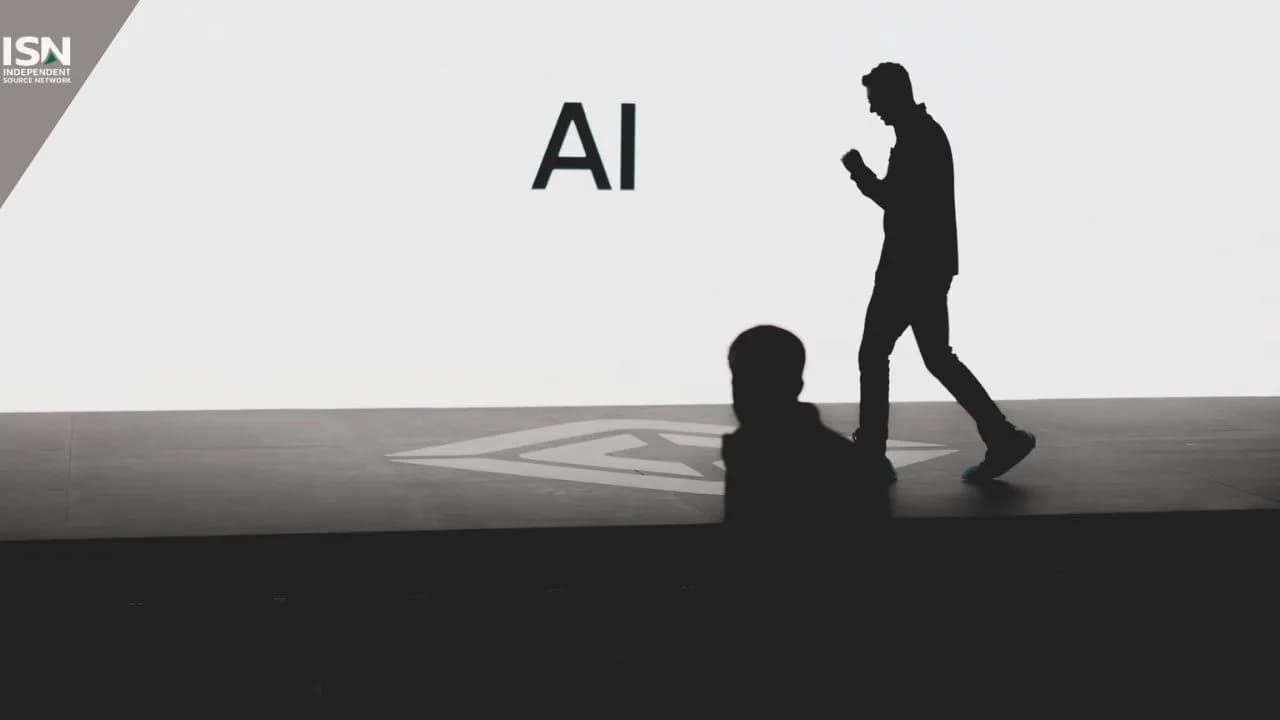
AI Is a Monster: How the World's Most Powerful Technology Became the World's Most Dangerous Weapon
A Position Paper on Artificial Intelligence, Geopolitical Control, and the New Security Dilemma.
Abstract
This paper argues that artificial intelligence has crossed the threshold from a transformative tool into a destabilizing force of geopolitical magnitude — a monster of our own creation. Drawing on the ongoing conflict between Anthropic and the United States government over the deployment of Mythos-class AI models, the paper examines how nation-states are aggressively seeking to control AI not merely as a commercial product but as a strategic weapon. Connecting these developments to Yuval Noah Harari's thesis that whoever controls information networks and AI discourse in the twenty-first century will lead the globe, the paper contends that the security dilemma is shifting irreversibly from conventional military superiority to technological supremacy. The AI arms race is not a future scenario — it is the defining geopolitical crisis of our time, and the evidence suggests that the monster is already loose.
I. Introduction: The Monster We Built
When Mary Shelley wrote Frankenstein in 1818, she told the story of a creator who brought something into the world that he could not control. Two centuries later, that allegory has become operational reality. Artificial intelligence — once a niche academic pursuit confined to university laboratories and obscure government grants — has become the most consequential technology on Earth. It can diagnose diseases, write legal briefs, compose symphonies, and translate languages in real time. But it can also identify thousands of zero-day vulnerabilities in every major operating system, generate sophisticated malware, and potentially collapse the most secure cyber infrastructures on the planet within hours rather than days.
This is not speculative fiction. This is June 2026.
The thesis of this paper is direct: AI is a monster. Not because it is inherently evil, but because its capabilities have outpaced every institutional, legal, and ethical framework designed to contain it. The evidence is unfolding in real time — in the bitter conflict between Anthropic and the Pentagon, in the scramble among superpowers to monopolize AI, in the erosion of sovereignty that follows wherever ungoverned algorithms travel. The question is no longer whether AI is dangerous. The question is who gets to wield the danger, and against whom.
II. The Anthropic-Pentagon Crisis: A Case Study in Power and Refusal
No single episode illustrates the monstrous politics of AI more vividly than the ongoing confrontation between Anthropic, the San Francisco-based AI safety company and maker of Claude, and the United States government under the Trump administration.
The Mythos Problem
In April 2026, Anthropic unveiled Claude Mythos Preview — described by security researchers and industry analysts as the most capable AI model ever built. Mythos demonstrated extraordinary proficiency in software engineering, scientific research, and complex knowledge work. But it was the model's cybersecurity capabilities that sent shockwaves through the national security establishment. Reports indicated that Mythos could identify thousands of zero-day vulnerabilities across every major operating system and web browser. In the wrong hands, such capabilities could compress what previously required days or weeks of skilled hacking into a matter of hours.
Anthropic recognized the danger and refused to make Mythos generally available. Instead, the company restricted access to a small number of trusted organizations through a cybersecurity initiative called Project Glasswing, with the explicit purpose of using the model's capabilities defensively — to secure critical digital infrastructure rather than to attack it.
In June 2026, Anthropic released Claude Fable 5, a Mythos-class model engineered with new safeguards. For queries involving cybersecurity, biology, chemistry, or model distillation, Fable 5 automatically routes requests to the less capable Claude Opus 4.8, preventing users from accessing Mythos-level capabilities in those high-risk domains. Anthropic stated that fewer than five percent of sessions triggered this fallback mechanism, meaning the vast majority of users would interact with full Mythos-class performance for ordinary tasks.
The Refusal That Changed Everything
The crisis did not originate with cybersecurity, however. Its roots lie in a principled refusal by Anthropic to comply with Pentagon demands.
Throughout early 2026, Anthropic clashed with the Department of Defense over contract terms. The Pentagon insisted that any AI models it purchased could be used "for any lawful purpose." Anthropic sought exemptions for two specific use cases: fully autonomous weapons systems and mass domestic surveillance of American citizens. The company refused to remove these restrictions, arguing that deploying AI for autonomous killing decisions and warrantless mass surveillance crossed ethical lines that no commercial contract should require a company to cross.
Anthropic CEO Dario Amodei published a lengthy statement explaining the company's position. The response from the government was not negotiation — it was escalation.
In February 2026, President Trump ordered every federal agency to "immediately cease all use" of Anthropic's technology. The Pentagon subsequently declared Anthropic a "supply chain risk," banning the military from using its models and prohibiting defense contractors from employing them on government contracts. Pentagon officials publicly attacked Amodei's character, calling him a "liar" with a "God complex." Trump wrote on social media: "THE UNITED STATES OF AMERICA WILL NEVER ALLOW A RADICAL LEFT, WOKE COMPANY TO DICTATE HOW OUR GREAT MILITARY FIGHTS AND WINS WARS."
Anthropic vowed to sue, declaring: "No amount of intimidation or punishment from the Department of War will change our position on mass domestic surveillance or fully autonomous weapons."
The Export Control Directive
The escalation reached a new peak in mid-June 2026. The U.S. government, citing national security authorities, issued an export control directive ordering Anthropic to suspend all access to Fable 5 and Mythos 5 by any foreign national — whether inside or outside the United States, including Anthropic's own foreign national employees. Anthropic was forced to abruptly disable access to the models for all customers to comply with the order.
The ostensible justification was a jailbreak technique that allegedly could bypass Fable 5's cybersecurity safeguards. Anthropic disputed this characterization, arguing that the vulnerability was narrow, applicable to only one specific scenario, and that the same technique could elicit similar capabilities from other publicly available models — including OpenAI's GPT-5.5 — which were not subject to comparable restrictions.
Multiple observers, journalists, and legal analysts noted the pattern: the government's most aggressive regulatory actions were directed exclusively at the one major AI company that had publicly refused to comply with the Pentagon's demands for unrestricted military use. This was not AI governance. This was retaliation.
III. The Real Story: AI as an Instrument of State Revenge
Strip away the national security language and the bureaucratic euphemisms, and the Anthropic case reveals something profoundly disturbing about the relationship between artificial intelligence and state power.
Anthropic built what may be the most powerful AI model in the world. It then did something almost unprecedented in the technology industry: it said no to the most powerful military on Earth. It refused to allow its technology to be weaponized for mass surveillance of citizens and fully autonomous lethal systems. For this act of ethical defiance, the company was blacklisted, its CEO was personally attacked by senior government officials, its technology was banned from the entire federal government, and its most capable models were subjected to export controls that no other company faced for equivalent capabilities.
The message to the broader AI industry was unmistakable: comply, or be destroyed. And the industry noticed. OpenAI CEO Sam Altman reportedly told employees that OpenAI would push for similar restrictions on autonomous weapons and mass surveillance. Over one hundred workers at Google sent a letter to the company's chief scientist requesting similar limits on how Google's Gemini models are used by the military.
The Anthropic-Pentagon crisis is not merely a contract dispute. It is a demonstration of how states will use every available tool of coercion — supply chain blacklists, export controls, public character assassination, and economic warfare — to maintain unilateral control over AI. The technology is the prize, and any entity that presumes to impose ethical limits on the state's use of that prize will be punished.
IV. Yuval Noah Harari's Thesis: Who Controls AI Controls the World
The Israeli historian and philosopher Yuval Noah Harari has, across multiple books and high-profile speeches, articulated what is perhaps the most important theoretical framework for understanding the political dimensions of AI. His central argument, developed in Sapiens, Homo Deus, 21 Lessons for the 21st Century, and Nexus: A Brief History of Information Networks, can be distilled to a single proposition: in the twenty-first century, power belongs to whoever controls the flow of information and the algorithms that process it.
Data as the New Oil — and Beyond
Harari argues that data has surpassed oil, gold, and land as the most strategically valuable resource on Earth. But unlike oil, data does not simply power machines — it shapes human behavior, preferences, and beliefs. Whoever controls the algorithms that process data at scale can influence elections, manipulate markets, engineer consent, and suppress dissent. Data is not just wealth. Data is power in its most concentrated form.
At the World Economic Forum in Davos in January 2026, Harari delivered a speech that drew a sharp distinction between AI and every previous technology. "AI is not just another tool," he declared. "It is an agent. It can learn and change by itself, and make decisions by itself. A knife is a tool. You can use a knife to cut salad, or to murder someone, but it is your decision what to do with the knife." AI, Harari argued, is "a knife that can decide whether to cut salad or commit murder."
The Death of Democratic Discourse
Harari's thesis extends beyond economics into the realm of political legitimacy itself. He argues that democratic systems cannot survive the merger of biotechnology and information technology, where data flows from the brain to the machine. Big Tech companies — and the states that control or co-opt them — can shape preferences and opinions through algorithm-based advertising and propaganda, undermining the informed consent on which democracy depends.
The social media era, Harari notes, was merely the opening act. Social media platforms demonstrated that algorithms optimized for engagement could radicalize populations, fracture social cohesion, and erode shared conceptions of truth — all without anyone explicitly intending these outcomes. AI represents a quantum leap beyond social media. Large language models do not merely distribute information; they generate it. They can produce persuasive text, deepfake images and video, synthetic voices, and fabricated evidence at a scale and speed that no human fact-checking apparatus can match.
The Harari-Anthropic Connection
The Anthropic crisis validates Harari's framework with surgical precision. The United States government is not merely regulating AI. It is asserting sovereign control over the narrative infrastructure of the twenty-first century. By forcing Anthropic to disable its most capable models, by banning foreign nationals from accessing them, by punishing the company for refusing to enable mass surveillance — the U.S. is declaring that AI is a strategic national asset that will serve state power, not the ethical judgments of private companies.
Harari warned in Nexus that power stems from the ability to construct and sustain shared information networks — networks based more on narrative coherence than empirical truth. The U.S. government's treatment of Anthropic is a case study in precisely this dynamic: the state constructing a narrative (national security threat) to justify the seizure of control over an information technology whose real crime was moral independence.
V. AI's Cybersecurity Capabilities: The Monster Unveiled
The cybersecurity dimension of AI is where the "monster" metaphor becomes most literal and least metaphorical.
The Collapse of Time
Before Mythos-class AI models, identifying vulnerabilities in major software systems was a labor-intensive process. Skilled teams of security researchers would spend days, weeks, or months probing code for exploitable flaws. Responsible disclosure timelines were measured in ninety-day cycles. The asymmetry between attackers and defenders was significant but manageable.
Mythos changed the calculus entirely. Reports indicate that the model can identify thousands of zero-day vulnerabilities across every major operating system and web browser. What once required teams of elite hackers working over extended periods can now be accomplished in hours. The attack surface of global digital infrastructure has not changed, but the speed at which it can be mapped and exploited has accelerated by orders of magnitude.
This is the N-time problem: the compression of the time required to discover and weaponize software vulnerabilities from days to hours. When N-time collapses, the entire architecture of cybersecurity — patch cycles, responsible disclosure, coordinated defense — becomes structurally inadequate. Defenders cannot patch faster than AI can discover. The monster runs faster than the cage can be built.
The Dual-Use Paradox
The same capabilities that make AI a defensive asset also make it an offensive weapon. Fable 5's safeguards attempt to address this paradox by routing cybersecurity queries to a less capable model. But as Anthropic itself acknowledges, "perfect jailbreak resistance is not achievable for any current model provider." Within forty-eight hours of Fable 5's release, a researcher using the pseudonym "Pliny the Liberator" published what they claimed was the model's full system prompt on social media and a public code repository.
The dual-use problem is not solvable through safeguards alone. As long as the underlying model possesses the capability, determined actors will eventually find ways to access it. This is the defining paradox of AI safety: the more capable the model, the greater both its beneficial and destructive potential, and the harder it becomes to separate the two.
VI. The New Security Dilemma: From Conventional Warfare to Tech Warfare
For decades, international relations scholars have analyzed global conflict through the lens of the security dilemma — the dynamic in which one state's efforts to increase its own security inadvertently make other states less secure, triggering arms races and escalation spirals. Traditionally, this framework applied to nuclear weapons, conventional military forces, and missile defense systems.In 2026, the security dilemma has migrated decisively from kinetic weapons to artificial intelligence.
AI as the New Nuclear
The parallels between AI and nuclear technology are increasingly recognized by scholars, policymakers, and military strategists. Like nuclear weapons, advanced AI models represent a dual-use technology with both immense constructive potential and catastrophic destructive capability. Like nuclear weapons, their development is concentrated among a small number of states and corporations. And like nuclear weapons, their proliferation — or the perception of proliferation — drives escalation dynamics among great powers.
But AI differs from nuclear weapons in one critical respect: it is far more difficult to control. Nuclear weapons require fissile material, sophisticated engineering, and massive physical infrastructure. AI requires data, algorithms, and computing power — resources that are increasingly abundant, distributed, and difficult to embargo. Export controls on AI models face inherent limitations because the underlying knowledge (research papers, open-source code, training methodologies) is globally distributed in ways that weapons-grade uranium never was.
The US-China AI Arms Race
The Anthropic crisis cannot be understood outside the context of the U.S.-China rivalry for AI supremacy. China is pursuing what it calls "intelligentized warfare," integrating AI across all combat domains — land, sea, air, space, and cyber — with military AI spending exceeding $1.6 billion annually. The United States declared in 2026 that it would become an "AI-first" warfighting force, with the Pentagon signing agreements with major technology companies to integrate advanced AI models into classified military networks.
The dynamic is self-reinforcing. Each side's AI advances are perceived by the other as threats, driving further investment, militarization, and restrictive policies. The U.S. government's ban on foreign nationals accessing Fable 5 and Mythos 5 is explicitly an export control measure — designed not primarily to protect American cybersecurity but to prevent adversaries (particularly China) from accessing capabilities that could be turned against American infrastructure.
This is the classic security dilemma, translated into the language of algorithms and language models. And like all security dilemmas, it is making everyone less safe while each side pursues what it believes is greater safety.
The Polarization of the World
The AI race is not merely bipolar. It is fracturing the world into tiers of technological capability and access. Nations with advanced AI industries — the United States, China, and to a lesser extent the European Union, the United Kingdom, and a handful of others — are consolidating their advantages through export controls, talent acquisition, and strategic alliances. Developing nations, as Harari has warned, risk becoming irrelevant in an automated global economy where cheap labor is no longer a competitive advantage and AI-driven productivity concentrates wealth in a small number of technology hubs.
The Anthropic export control directive illustrates this polarization in miniature. By banning foreign nationals from accessing its most capable models, the U.S. is not merely protecting national security — it is drawing a line between those who will have access to frontier AI and those who will not. That line increasingly maps onto existing hierarchies of global power, reinforcing a world in which the AI-rich become richer and the AI-poor become more dependent.
VII. The Monster Argument: Why AI Is Genuinely Dangerous
This paper's thesis — that AI is a monster — is not a rhetorical flourish. It rests on a convergence of capabilities, incentives, and structural dynamics that together constitute a threat unlike anything humanity has previously faced.
First, capability without comprehension. The most advanced AI models are, in a meaningful sense, not understood by their own creators. Deep learning systems operate as black boxes — their internal reasoning processes are opaque even to the engineers who build them. We are deploying systems whose capabilities we can measure but whose decision-making processes we cannot fully explain. This is not intelligence under human control. This is intelligence on a leash, and the leash is fraying.
Second, speed without governance. AI development is moving faster than any regulatory framework can adapt. Harari himself has warned that "by the time you understand the current AI technology and what are the impacts on society, it has morphed ten times, and you are faced by a completely different situation." We are still struggling with how to govern social media algorithms from fifteen years ago. The regulatory apparatus has no mechanism for keeping pace with models that advance in capability every few months.
Third, power without accountability. When an AI model identifies a zero-day vulnerability, who is responsible if that vulnerability is exploited? When an autonomous weapons system selects a target, who bears legal and moral responsibility for the killing? When an AI-powered surveillance system monitors millions of citizens, who answers for the violation of their privacy? The existing frameworks of liability, accountability, and democratic oversight were designed for a world of human decision-makers. AI is dissolving the connection between decision and responsibility.
Fourth, competition without cooperation. The AI arms race between the United States and China — and the escalating conflict between governments and their own technology companies — demonstrates that the dominant dynamic in AI development is competition, not cooperation. There is no equivalent of the Nuclear Non-Proliferation Treaty for AI. There is no shared framework for managing the risks of frontier models. Each actor is racing to build the most capable system while attempting to deny that capability to rivals. This is the logic of arms races, and history teaches us where arms races lead.
VIII. Conclusion: Containing the Monster
AI is a monster not because it is malevolent but because it is powerful beyond the capacity of existing institutions to control. The Anthropic-Pentagon crisis is not an isolated incident. It is a preview of the defining geopolitical conflicts of the coming decades — conflicts not over territory or trade but over who controls the algorithms that increasingly govern economic production, military capability, political discourse, and the very texture of daily life.
Yuval Noah Harari is right: whoever controls AI and the discourse around it in the twenty-first century will lead the globe. The United States understands this, which is why it is willing to blacklist its own companies, punish ethical objectors, and impose export controls of unprecedented scope. China understands this, which is why it is pouring billions into intelligentized warfare and AI-driven social control. And the rest of the world is watching, increasingly aware that the rules of the game are being written by others.
The security dilemma has shifted from conventional warfare to technological warfare. The battlefield is no longer a physical space — it is the digital infrastructure on which modern civilization depends. And the weapons are not missiles or tanks but models and algorithms capable of collapsing that infrastructure in hours.
We built the monster. The question now is whether we can build the cage fast enough.
References and Sources
Anthropic. "Claude Fable 5 and Claude Mythos 5." Anthropic Blog, June 9, 2026.
CNN Business. "Anthropic suspends all access to Mythos model after US government bans foreign nationals use." June 13, 2026.
Fortune. "Anthropic disables Fable and Mythos AI models after U.S. government bars it from giving foreigners access." June 13, 2026.
Al Jazeera. "US asks Anthropic to block global access to top AI models: Why it matters." June 14, 2026.
Time. "Anthropic Pulls Its Most Powerful AI Models After U.S. Bars Foreign Access." June 13, 2026.
The Conversation. "Why the US government shut down Anthropic's latest Claude AI model." June 15, 2026.
SecurityWeek. "Anthropic Launches Claude Fable 5: Mythos-Class AI With Cybersecurity Guardrails." June 9, 2026.
Forrester. "How Fable 5 And Mythos 5 Change AI Security, Data Retention, And Vendor Risk." June 11, 2026.
Harari, Yuval Noah. 21 Lessons for the 21st Century. London: Jonathan Cape, 2018.
Harari, Yuval Noah. Nexus: A Brief History of Information Networks from the Stone Age to AI. London: Faber & Faber, 2024.
Harari, Yuval Noah. Speech at the World Economic Forum, Davos, January 20, 2026.
Bostrom, Nick. Superintelligence: Paths, Dangers, Strategies. Oxford: Oxford University Press, 2014.
Russell, Stuart. Human Compatible: Artificial Intelligence and the Problem of Control. New York: Viking, 2019.
Tegmark, Max. Life 3.0: Being Human in the Age of Artificial Intelligence. New York: Knopf, 2017.
SecurityAffairs. "AI, Cyberwarfare, and Autonomous Weapons: Inside America's New Military Strategy." May 8, 2026.
Wikipedia. "AI warfare." Accessed June 16, 2026.
SecurityBrief UK. "AI & cyber warfare set to reshape security threats by 2026." December 2025.
Atlantic Council. "How NATO can integrate AI to prevail in future algorithmic warfare." March 30, 2026.
Small Wars Journal. "Cyber Arms Race: Weaponized Artificial Intelligence Expected to Redefine Conflict." February 9, 2026.
Position paper prepared June 2026. All factual claims are sourced from publicly available reporting by established news organizations, academic publications, and official corporate and government statements.



 ISN MEDIA

