The "Currency Will Crash" Argument: Why It Does Not Apply to Verified Earner Reform
The most common objection to Pakistani FCY reform, and the structural reason it does not apply to the proposal on the table
By Asad Baig · Lahore · May 2026 · Approx. 9-min read
What this cluster post is part of
This is one of four cluster posts under what India, Singapore, UAE, Malaysia and Bangladesh do that Pakistan refuses to. The companion posts are India's liberalised foreign currency framework explained, Singapore, UAE and Malaysia: three FCY models Pakistan has refused to adopt, and Bangladesh and Pakistan: two neighbours, two FCY outcomes.
This post addresses the most common technical objection to Pakistani FCY reform. The argument that liberalising will crash the rupee. The argument is delivered with great seriousness. It is also wrong about the specific reform Pakistan needs. Here is why.
The argument and the response in one paragraph
The "currency will crash" argument against Pakistani FCY reform applies to a hypothetical reform that allows Pakistanis to convert PKR to USD freely. That reform was the original PERA 1992 framework. It collapsed in 1998, exactly as critics predicted, because it created a one-way pump from PKR into USD bookkeeping liabilities that the State Bank could not honour. The Productive Capital Account reform I am proposing does the opposite. It does not authorise PKR-to-USD conversion. It authorises USD-to-USD passage through the Pakistani banking system without forced conversion. The dollars in question are already foreign-source dollars. They arrive via Stripe, PayPal, Wise, Payoneer, or a wire from documented foreign clients. They are dollar supply, not dollar demand. Under this reform, the rupee strengthens, not weakens. Anyone who continues to make the "currency will crash" argument against this specific reform is either uninformed about how dollar supply affects exchange rates, or dishonest about which interest they are protecting. There is no third option.
The two reforms, very different
The "currency will crash" argument is structurally correct about Reform A and structurally incorrect about Reform B. The two reforms produce opposite effects on currency markets because they operate in opposite directions.
Reform A creates dollar demand from existing rupee holders. Anyone with rupees can rush to convert. The rupee falls.
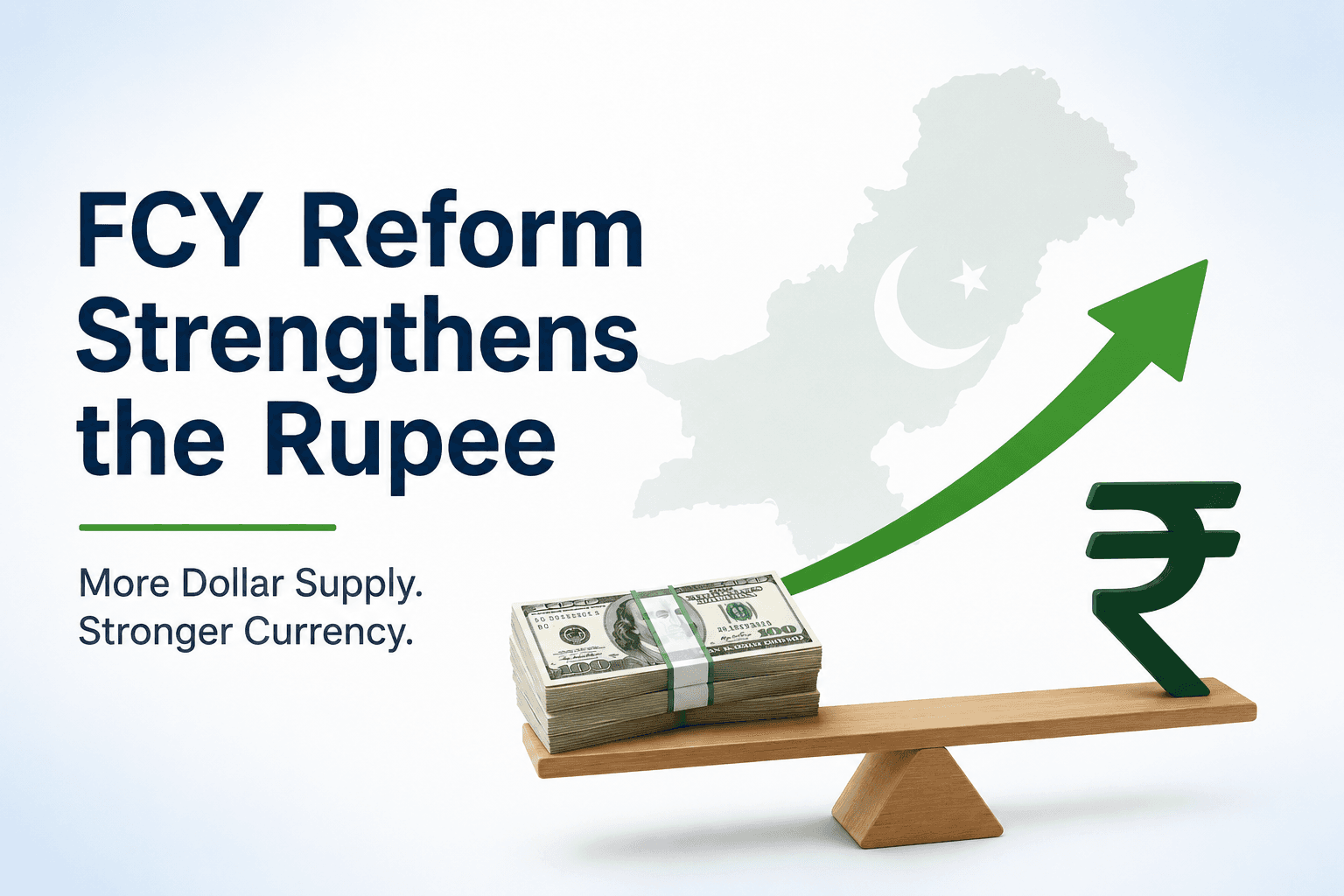
Reform B creates dollar supply by inviting offshore-held earnings to flow through Pakistani banks instead of Wyoming or Dubai. The rupee strengthens, because more dollars enter the formal banking system.
Why people conflate the two
The conflation is partly historical and partly tactical.
The conflation is convenient for everyone defending the current framework. It allows them to argue against PERA's ghost while preventing reform B from being evaluated on its own terms.
The dollar supply mechanism
Under the Productive Capital Account proposal:
Pakistani IT companies receive payments from foreign clients
Currently, much of this flows through Wyoming LLCs, Mercury, Wise, Payoneer (offshore)
Under PCA, holders have operational reason to route through Pakistani banks
Each dollar that flows through a Pakistani bank is a dollar in the formal Pakistani banking system
More dollars in the formal system = more dollar supply = stronger rupee
The mechanism is not theoretical. It is the same mechanism that produced reserves growth in every country that adopted productive-class FCY frameworks after their initial liberalisation periods. Singapore did it. UAE did it. India does it.
The question of how much repatriation actually occurs depends on how competitive the Pakistani onshore framework becomes relative to existing offshore alternatives. The PCA is designed to be competitive: market interest rates on USD, no Pakistani markup on cards, free conversion to PKR at market rates, integration with international payment processors. If the framework is operationally superior or comparable to offshore alternatives, repatriation flows can be substantial.
The Productive Capital Account 5-year projection of $30 to 50 billion in offshore productive class wealth repatriated is built on this mechanism. For the broader projection methodology, see the Productive Capital Account: a reform proposal for Pakistan's FCY system.
The PERA 1998 lesson, applied correctly
The right lesson from PERA 1998 is not "do not liberalise". The right lesson is "do not allow PKR-to-USD conversion at the deposit point of an FCY framework". PERA's collapse was structurally caused by allowing PKR holders to create dollar liabilities that the SBP could not back with hard currency.
The PCA closes this exact mechanism. Only foreign-source dollars are accepted. There is no PKR-to-USD conversion at the deposit point. There is no liability mismatch. There is no mechanism by which a panic event could produce a 1998-style freeze.
For the full mechanism analysis of PERA's collapse, see the 1992 Protection of Economic Reforms Act: PERA explained and May 28, 1998: the day Pakistan froze all foreign currency accounts.
The five-country evidence
Five peer countries operate productive-class FCY frameworks. Five out of five have stable or strengthening currencies under those frameworks (subject to general macroeconomic factors that are unrelated to the FCY framework itself).
Five Countries, Currency Outcomes Under Liberal Fcy
Country | Liberal FCY framework | Currency stable? |
|---|---|---|
Singapore | Multi-currency residence | ✓ Stable |
UAE | Resident multi-currency | ✓ Pegged stable |
India | RFC + EEFC + LRS | ✓ Managed stable |
Malaysia | Resident FCY accounts | ✓ Stable |
Bangladesh | ERQ accounts | ✓ Managed stable |
If liberal productive-class FCY frameworks caused currency crashes, none of these five countries would have stable currencies. They have stable currencies. The argument that Pakistani liberalisation would crash the rupee, if applied consistently, would predict crashes that have not occurred in any of these comparable cases.
The argument is therefore not a general principle. It is a specific claim about a specific mechanism (PKR-to-USD conversion under PERA-style frameworks). The claim is correct about that specific mechanism. It is incorrect when applied to verified-earner reform.
A practical test for the argument
When someone makes the "currency will crash" argument against Pakistani FCY reform, the test is:
Does the proposed reform allow PKR-to-USD conversion at the deposit point?
If yes, the argument may apply. (And the reform should not be supported.)
If no, the argument does not apply. (And the speaker is either confused or arguing in bad faith.)
The Productive Capital Account proposal does not allow PKR-to-USD conversion at the deposit point. It accepts only foreign-source dollars. The "currency will crash" argument therefore does not apply to the PCA.
Anyone who continues to make this specific argument against this specific reform should be asked to demonstrate the specific mechanism by which dollar supply (not dollar demand) causes currency depreciation. The mechanism does not exist in standard economics. The argument is therefore either uninformed or dishonest.
In closing
The "currency will crash" argument is the most common technical objection to Pakistani FCY reform. It is also the most easily refutable. The argument confuses two reforms that operate in opposite directions on currency markets. PERA 1992 was a dollar-demand reform. The Productive Capital Account is a dollar-supply reform. The two have opposite effects on the rupee.
If you accept the lesson of PERA 1998, you should be more comfortable with the PCA, not less. The PCA is structurally designed to prevent the mechanism that destroyed PERA. The PCA is the reform that PERA should have been if PERA had been designed competently.
The next time someone tells you the rupee will crash if Pakistan liberalises, ask them which mechanism they are proposing. If they cannot specify, the conversation is not honest. If they say "PKR-to-USD conversion", point out that the PCA does not include this. If they say "any FCY reform", point them to Singapore, UAE, India, Malaysia, and Bangladesh, none of which have crashing currencies under their respective frameworks.
The arithmetic, as always, is clear. The path forward is, as it always has been, a choice. The "currency will crash" argument is not a reason to delay reform. It is a reason to design reform correctly.
Thank you for reading.
, Asad Baig, Lahore, May 2026
Frequently asked questions
What is the "currency will crash" argument against Pakistani FCY reform? The argument is that liberalising Pakistan's foreign currency framework will produce mass conversion from PKR to USD, causing the rupee to depreciate catastrophically. The argument is structurally correct about reforms that allow PKR-to-USD conversion at the deposit point (such as PERA 1992) and structurally incorrect about reforms that accept only foreign-source dollars (such as the Productive Capital Account proposal).
Why is the argument correct about PERA 1992? PERA 1992 allowed unlimited PKR-to-USD conversion in foreign currency accounts. This created a one-way pump from PKR into USD bookkeeping liabilities that the SBP could not actually back with hard currency. When demand for actual USD spiked in May 1998, the framework collapsed, exactly as the argument predicted.
Why is the argument incorrect about the Productive Capital Account? The PCA does not allow PKR-to-USD conversion at the deposit point. It accepts only foreign-source dollars. The dollars arrive as dollars from foreign clients, foreign employers, or international payment processors. The PCA creates dollar supply (more USD entering Pakistan) rather than dollar demand (PKR holders converting to USD). Under the PCA, the rupee strengthens, not weakens.
How does dollar supply versus demand affect exchange rates? More dollars entering an economy through formal channels increases the supply of foreign currency relative to local currency, which strengthens the local currency. Fewer dollars entering through formal channels (because productive earners route through offshore structures instead) reduces dollar supply, weakening the local currency. The mechanism is well-established in international economics.
What is the practical test for whether the "currency will crash" argument applies? Ask whether the proposed reform allows PKR-to-USD conversion at the deposit point. If yes, the argument may apply. If no, the argument does not apply. The Productive Capital Account does not allow PKR-to-USD conversion at the deposit point, so the argument does not apply to the PCA.
Why do peer countries with liberal FCY frameworks not have crashing currencies? Because productive-class FCY frameworks (as opposed to PKR-to-USD conversion frameworks) create dollar supply rather than dollar demand. Singapore, UAE, India, Malaysia, and Bangladesh all operate liberal FCY frameworks alongside stable or managed-stable currencies. The empirical evidence does not support a general "liberalisation causes crash" rule.
How does the PCA prevent the 1998 mechanism? The PCA accepts only foreign-source dollars (no PKR conversion at deposit), requires mandatory source verification, requires ATL filer status for residents, requires beneficial ownership transparency, applies income-based caps, and ensures FX assets match FX liabilities. There is no liability mismatch that could produce a 1998-style freeze.
Why do some Pakistani policymakers continue to make the argument despite the evidence? Three possible reasons. First, technical illiteracy about how dollar supply affects exchange rates. Second, conflation of all FCY reforms under a single label. Third, bad-faith use of the argument to defend the current extraction architecture without engaging with the specific reform proposal on its merits.
Sources
Protection of Economic Reforms Act 1992
State Bank of Pakistan Annual Reports 1990-1999
Reserve Bank of India, Master Direction on Foreign Exchange Management
Bank Negara Malaysia, Foreign Exchange Administration Rules
Bangladesh Bank, Foreign Exchange Regulations
Monetary Authority of Singapore, Banking Regulations
Central Bank of UAE, Banking Regulations
IMF Article IV consultation reports for Pakistan and comparator countries
Position Paper: The Foreign Currency Account Problem in Pakistan, May 2026


 ISN MEDIA