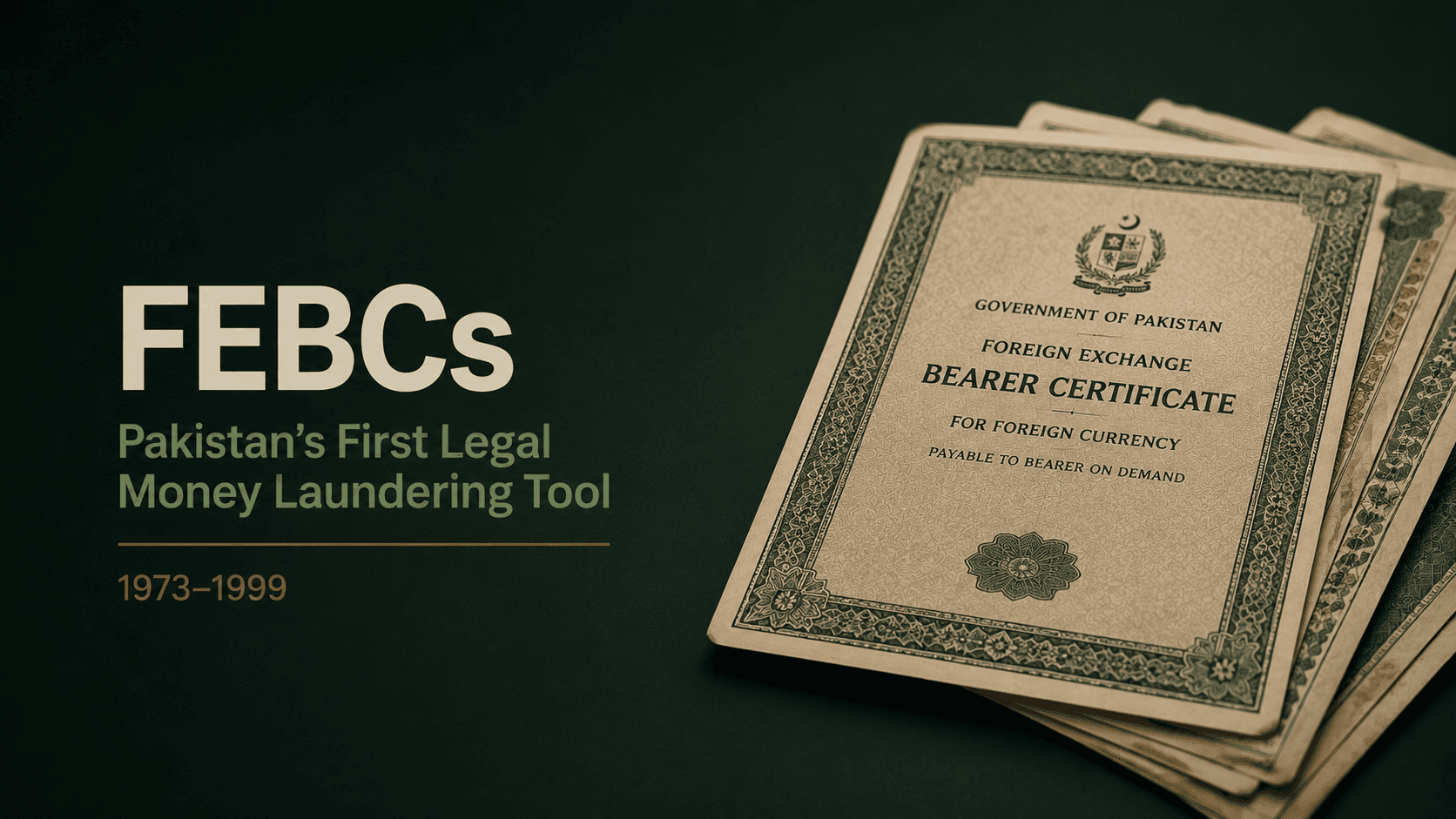
Government-issued anonymous bearer instruments introduced in 1973, the first legal money laundering tool in Pakistani history
By Asad Baig · Lahore · May 2026 · Approx. 5-min read
The short answer
Foreign Exchange Bearer Certificates (FEBCs) were government-issued anonymous bearer instruments denominated in foreign currency, introduced by Bhutto's government in 1973. They had no identity requirement (anonymous holders), were tax-free, could be encashed in dollars or rupees, and were initially small in scale. Under Zia-ul-Haq's expansion in the 1980s, FEBCs became widely available, with several billion USD worth in circulation by 1991. They were the first government-created legal money laundering instrument in Pakistani history and established the principle that anonymous foreign currency holding was acceptable through specific government channels that the elite could navigate. FEBCs were phased out under the Musharraf government after 1999.
This is a Tier 3 long-tail spoke under the Pakistan FCY restriction era (1947 to 1985) and parent pillar the foreign currency account in Pakistan: a 76-year history (1947 to 2026).
FEBC features
Febc Features (1973-1999)
Anonymous holders | No identity required |
|---|---|
Tax status | Tax-free |
Denomination | Foreign currency |
Encashment | Dollars or rupees |
Transferability | Without registration |
Initial scale (1973) | Small |
Peak circulation (1991) | Several billion USD |
Phase-out | Under Musharraf government post-1999 |
The combination of features (anonymous, tax-free, transferable without registration, denominated in foreign currency) made FEBCs uniquely suited to elite wealth preservation. Ordinary Pakistanis did not have access to the cash to buy them at meaningful scale. The elite did.
How FEBCs fit into Pakistani FCY history
FEBCs were introduced under Bhutto's restriction era (1971 to 1985). The same government that nationalised banks and tightened FCY restrictions on ordinary Pakistanis simultaneously created a government-issued vehicle for elite wealth preservation. The contradiction was not accidental. It was the architecture of Pakistani FCY policy operating exactly as designed.
Under Zia-ul-Haq's expansion in the 1980s, FEBCs became more widely available. Tax immunity was codified. They could be transferred without registration. They became a parallel currency for elite transactions. By 1991, several billion USD worth was in circulation.
When PERA 1992 was passed, FEBCs continued to operate alongside the new FCY accounts. FEBCs filled the role of providing anonymous foreign currency holding for those who did not want documented FCY accounts. The two systems were complementary tools for the elite, not alternatives.
FEBCs were phased out under the Musharraf government after 1999, as part of post-FATF tightening and the broader move toward documented banking. By 2007, they were largely retired.
Frequently asked questions
What were Foreign Exchange Bearer Certificates? Government-issued anonymous bearer instruments denominated in foreign currency, introduced by Bhutto's government in Pakistan in 1973. They had no identity requirement, were tax-free, could be encashed in dollars or rupees, and were transferable without registration.
Why were FEBCs created? Officially, to attract foreign currency holdings into formal channels during a reserves-strapped period. Operationally, they became the first government-created legal money laundering instrument in Pakistani history and established the principle that anonymous foreign currency holding was acceptable through specific government channels.
Who used FEBCs? Primarily the Pakistani elite who had access to cash at scale. Industrial families, senior politicians, military leadership, senior bureaucrats with offshore connections, and wealthy traders. Ordinary Pakistanis lacked the cash and the access to use FEBCs at meaningful scale.
When were FEBCs phased out? Under the Musharraf government after 1999, as part of post-FATF tightening and the broader move toward documented banking. By 2007, they were largely retired.
How much FEBC circulation was there at peak? By 1991, several billion USD worth was in circulation. The exact figure is uncertain because FEBCs were anonymous bearer instruments and tracking was deliberately limited.
How did FEBCs relate to PERA 1992? FEBCs continued to operate alongside PERA 1992's foreign currency accounts. The two systems were complementary tools for the elite, not alternatives. FCY accounts provided documented banking with source-inquiry immunity (PERA Section 5). FEBCs provided anonymous holding without any source verification.
Sources
1973 Bhutto-era FEBC introduction legislation
Zia-era FEBC expansion regulations 1985-1991
Musharraf-era FEBC phase-out documentation
Position Paper: The Foreign Currency Account Problem in Pakistan, May 2026


 Admin
Admin