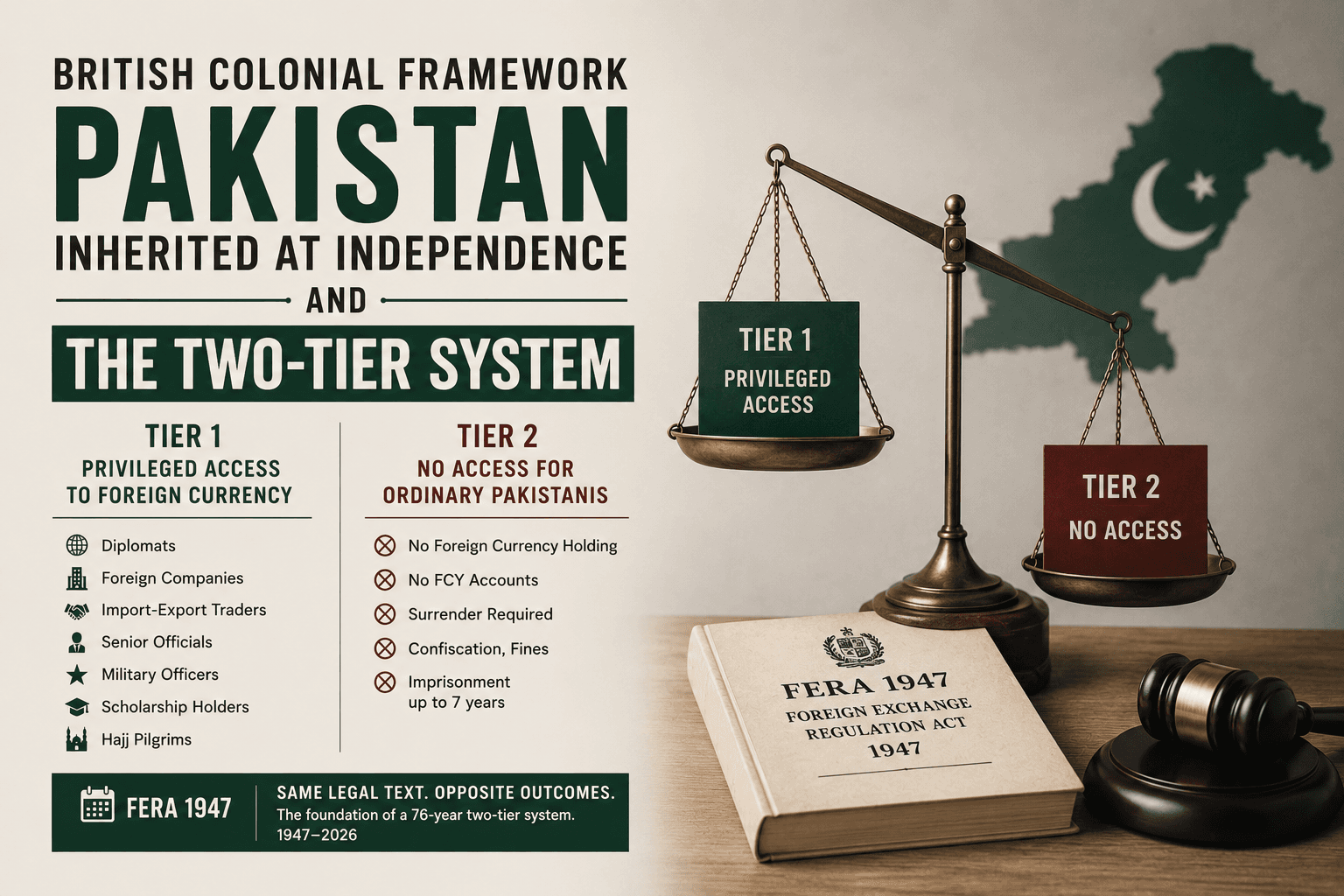
The British colonial framework Pakistan inherited at independence and the two-tier system it established
By Asad Baig · Lahore · May 2026 · Approx. 5-min read
The short answer
FERA stands for the Foreign Exchange Regulation Act, originally enacted by the British in 1947. Pakistan adopted FERA wholesale at independence in August 1947. It became the foundational piece of legislation governing foreign currency in Pakistan for decades. Pakistan was part of the Sterling Area until 1971, meaning its foreign exchange policies were largely subordinated to British monetary management for the first twenty-four years of its existence. From day one of independence, FERA established a two-tier access system: privileged categories (foreign companies, diplomats, approved traders, senior officials) had foreign currency access while ordinary Pakistanis did not. Holding foreign currency in any form was prohibited for ordinary citizens, with penalties including confiscation, fines, and imprisonment up to seven years.
This is a Tier 3 long-tail spoke under the Pakistan FCY restriction era (1947 to 1985) and parent pillar the foreign currency account in Pakistan: a 76-year history (1947 to 2026).
Who had FCY access under FERA 1947
Privileged categories with FCY access from day one of independence:
Foreign diplomatic missions (unrestricted under Vienna Convention)
Foreign companies operating in Pakistan (operational accounts)
Pakistani diplomatic personnel abroad
Approved import-export traders (Letters of Credit)
Senior bureaucrats on official duty (foreign currency travel allowances)
Military officers in foreign training (allowances and procurement)
Government scholarship students (foreign currency stipends)
Hajj pilgrims (limited annual allowance)
For the vast majority of Pakistanis (farmers, traders, workers, professionals, small businessmen), the rules were severe:
Holding foreign currency in any form was prohibited
Opening foreign currency bank accounts was forbidden
Receiving foreign currency required immediate surrender to State Bank
Penalties included confiscation, fines, and imprisonment up to seven years
The British comparison
What is consistently absent from Pakistani discussions of FERA is that Britain itself maintained similar restrictions on its own citizens. From 1939 until 1979, a forty-year period, British citizens could not freely hold foreign currency, could not open foreign currency accounts at will, could not take pounds out of the country beyond strict limits. The British travel allowance for citizens going abroad was limited to fifty pounds per person per year as late as 1966.
So when Pakistan inherited FERA in 1947, it inherited a framework the British were also using on themselves. The critical difference was experiential: Britain had a reserve currency, Pakistan held sterling reserves not its own. British citizens were roughly equally constrained; Pakistan's class differentiation in implementation was immediate.
Frequently asked questions
What is FERA 1947? The Foreign Exchange Regulation Act of 1947, originally enacted by the British. Pakistan adopted FERA wholesale at independence in August 1947. It became the foundational piece of legislation governing foreign currency in Pakistan for decades.
Why did Pakistan adopt FERA at independence? As a newly independent country in 1947, Pakistan inherited the legal frameworks of British India, including FERA. Pakistan was also part of the Sterling Area until 1971, meaning its foreign exchange policies were largely subordinated to British monetary management.
Did Britain maintain similar restrictions on its own citizens? Yes. Britain operated strict exchange controls from 1939 until 1979, a forty-year period. British citizens could not freely hold foreign currency, could not open foreign currency accounts at will, and could not take pounds out of the country beyond strict limits. Britain only liberalised under Margaret Thatcher in 1979.
Who had FCY access under FERA 1947 in Pakistan? Privileged categories: foreign diplomatic missions, foreign companies, Pakistani diplomats abroad, approved import-export traders, senior bureaucrats on duty, military officers in foreign training, government scholarship students, and Hajj pilgrims with limited allowance. Ordinary Pakistanis (farmers, traders, workers, small businessmen) had no FCY access.
What were the penalties for ordinary Pakistanis holding foreign currency under FERA? Confiscation of the currency, fines, and imprisonment up to seven years. The penalties were severe and applied selectively in practice, with the elite finding workarounds while ordinary citizens bore the enforcement.
How did FERA establish the two-tier FCY system? The same legal text produced opposite outcomes for different classes from day one of independence. Privileged categories had documented access. Ordinary citizens had none. The two-tier pattern, restrictions hurting ordinary citizens while elite finds workarounds, became the most persistent feature of Pakistani FCY policy across all eras since.
Sources
Foreign Exchange Regulation Act 1947 (inherited from British colonial framework)
State Bank of Pakistan, historical records 1947 to 1985
Position Paper: The Foreign Currency Account Problem in Pakistan, May 2026
British exchange control history 1939-1979


 Admin
Admin