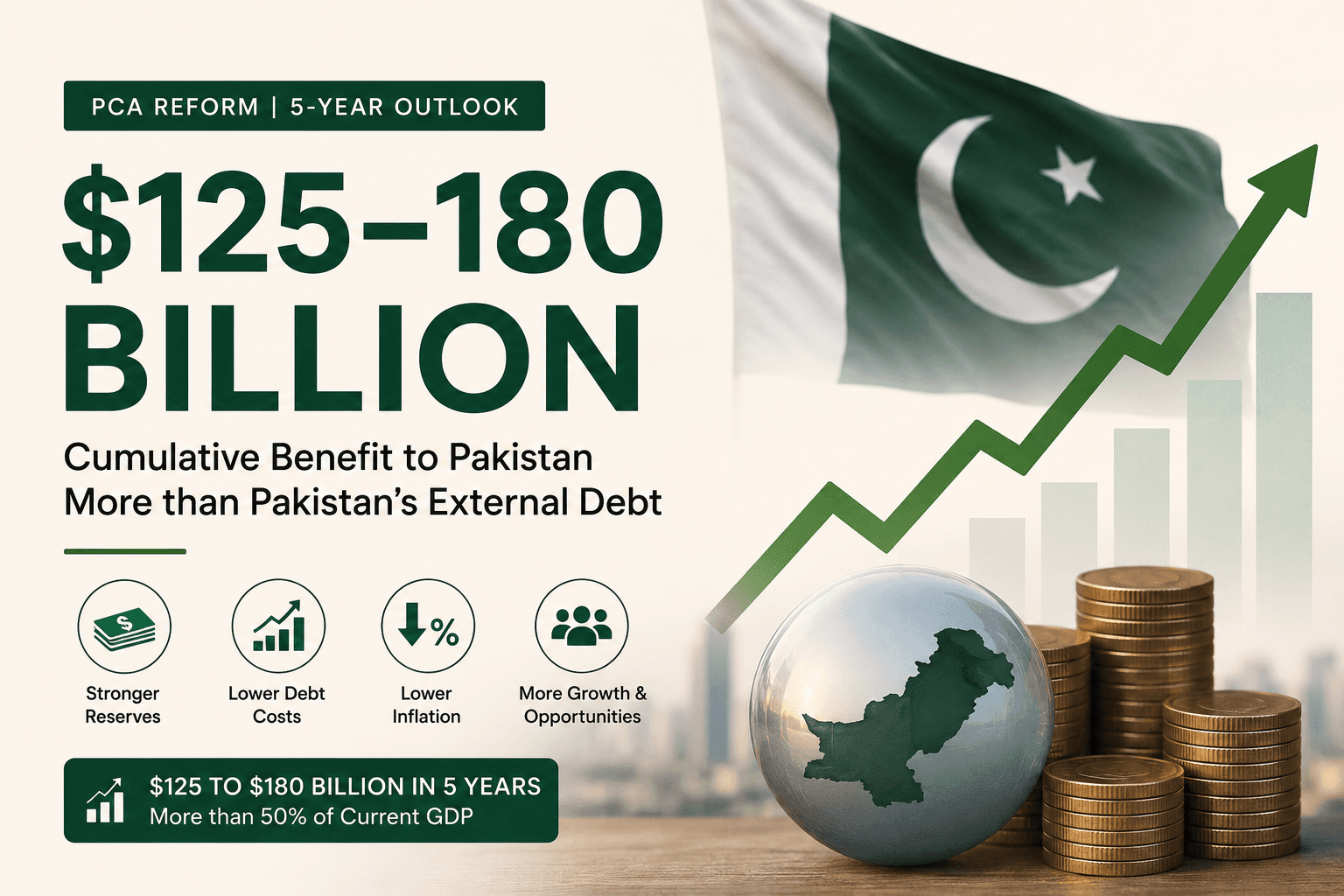
$125 to 180 billion cumulative, more than Pakistan's external debt
By Asad Baig · Lahore · May 2026 · Approx. 4-min read
The short answer
The Productive Capital Account reform is projected to deliver $125 to 180 billion in cumulative 5-year benefit to Pakistan. The components: $25 to 35 billion in additional reserves from productive class repatriation, approximately $25 billion in reduced debt-service costs from currency strengthening, $15 to 20 billion in reduced borrowing costs from lower risk premium, $10 to 15 billion in avoided IMF programme costs, $20 to 25 billion in household inflation savings, and $30 to 60 billion in indirect gains from FDI, formalisation, and retained talent. The total exceeds Pakistan's current external debt of $130 billion and represents more than 50 percent of current GDP.
This is a Tier 3 long-tail spoke under Pakistan reserves 5-year outlook under PCA reform.
The breakdown
5-year Projected Benefit TO Pakistan ($ Billions)
Low | High |
|---|---|
$25 | $35 |
$25 | $25 |
$15 | $20 |
$10 | $15 |
$20 | $25 |
$30 | $60 |
$125 | $180 |
Frequently asked questions
What is the projected 5-year benefit of PCA reform? $125 to 180 billion cumulative, more than Pakistan's external debt and more than 50 percent of current GDP.
What is the largest single component of the projected benefit? Indirect gains from FDI, formalisation, and retained talent ($30 to 60 billion). The largest direct cash component is additional reserves ($25 to 35 billion) plus reduced debt-service costs (~$25 billion).
Are these projections guaranteed? No. They are scenarios based on comparable country experience and Pakistan-specific conditions. Actual outcomes depend on implementation quality, external conditions, Pakistani political stability, speed of phased rollout, compliance enforcement rigor, and industry response.
How does this compare to Pakistan's current external debt? Pakistan's current external debt is approximately $130 billion. The projected 5-year benefit of $125-180 billion is comparable to or exceeds the entire external debt. A reform that produces this benefit could fund external debt repayment over the same period.
How does this benefit reach 165 million Pakistanis? Through inflation reduction (working class), currency stability (everyone), economic opportunity (productive class), and reduced government dependence on costly external borrowing (state).
Sources
Position Paper: The Foreign Currency Account Problem in Pakistan, May 2026, Section 6
World Bank Pakistan Country Update 2025
IMF Article IV consultation reports for Pakistan


 ISN MEDIA