



Sixty-Three Paisa for a Child: What Pakistan Spends on Its Own People
Education, health and the environment, the smallest, saddest lines in the budget
By Asad Baig • Written from outside Pakistan • June 2026 • Approx. 23-min read
I want to put the smallest lines of this budget in one place, the ones for educating a child, treating the sick, and saving the land we live on. I want them together because together they tell the truth about what this state thinks its people are worth. The figures are the government's own, in billions of rupees. I have changed nothing. I have only laid them side by side.
These are the lines that worry me most, and I have said why in where is the plan. Here I will give you the numbers, and the one honest excuse the government has, and then you can decide for yourself whether you accept it. For the full budget around these lines, read where every rupee goes.
How much does Pakistan spend on education and health?
At the federal level, education gets about Rs 118 billion and health about Rs 37 billion in 2026-27, roughly 63 paisa and 20 paisa out of every 100 rupees the federal government spends. The one honest thing I must tell you is that under the eighteenth amendment most schools and hospitals are paid for by the provinces, so these federal figures understate what the country spends in total. But even after I allow for all of that, what Pakistan spends on educating and treating its people, as a country, stays shamefully low by any decent standard.
That paragraph has the number and the excuse in it. Now let me open both.
A number you can hold
Rs 118 billion for education means nothing until you put it next to something. So put it next to defence, at about Rs 3,011 billion. The federal government spends roughly 25 rupees on the army for every one rupee it spends, at the centre, on schools. Put it next to interest, at Rs 8,054 billion, and a single year of interest is about 68 times the federal education line.
| This... | ...beside this | The gap |
|---|---|---|
| Defence, 3,011 | Education, 118 | About 25 times education |
| Defence, 3,011 | Health, 37 | About 80 times health |
| Debt interest, 8,054 | Education, 118 | About 68 times education |
| Social protection, 857 | Health and education, 155 | Over 5 times the two combined |
| Debt interest, 8,054 | Health, education, environment, 157 | About 51 times all three |
Figures in billions of rupees, FY2026-27 Budget Estimates.
These are not my opinions. They are arithmetic. I am not saying the army should have nothing. I am asking you to look at 25 to 1, at 80 to 1, and to feel what those ratios say about where a child stands in this country's order of love.
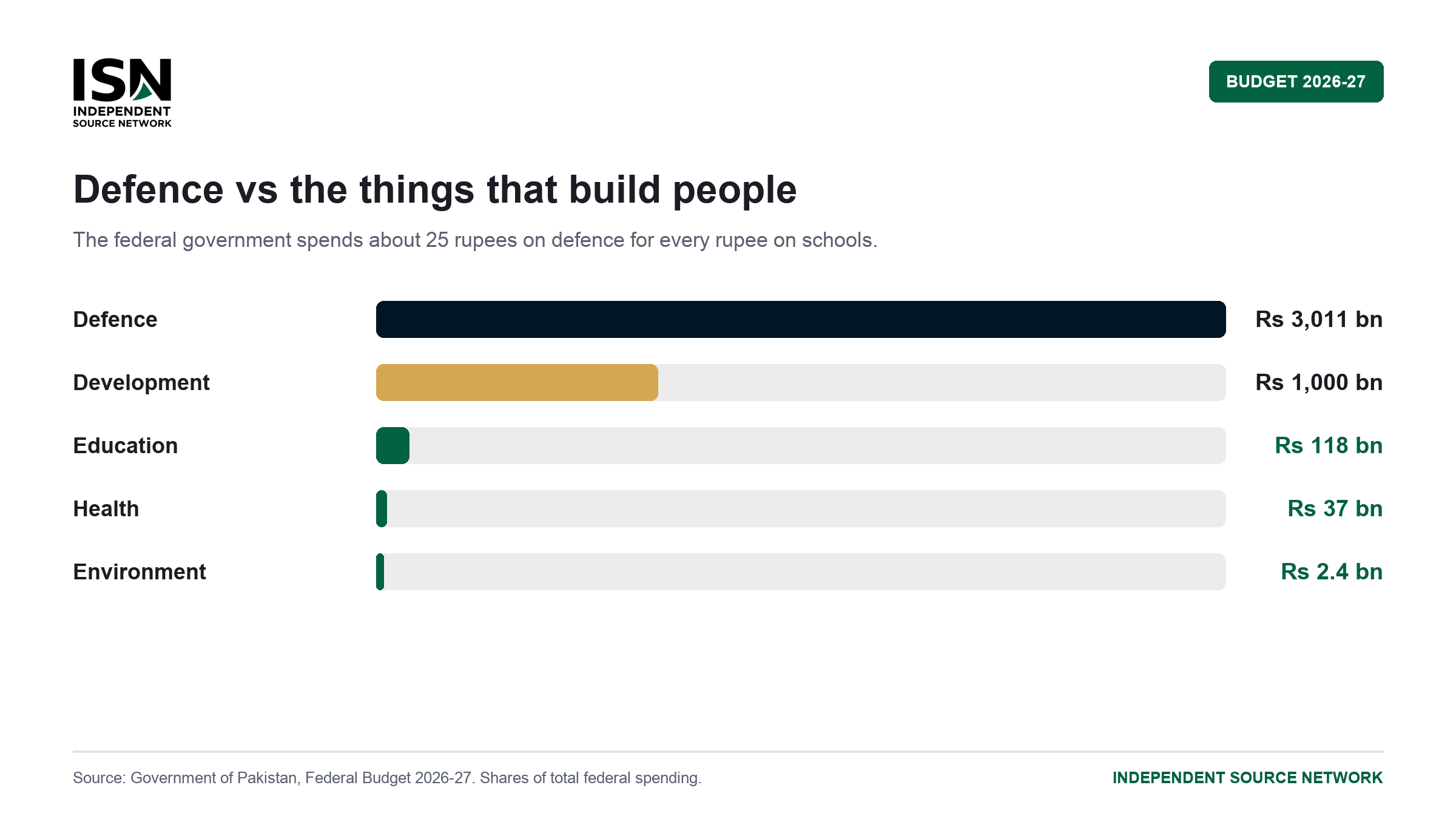
Defence beside the things that build people. About 25 rupees on the army for every rupee on a child's school.
Education: 63 paisa in the hundred
Federal spending on education is about Rs 118 billion in current terms, roughly six tenths of one percent of the budget, 63 paisa in every 100 rupees. The current line did rise a little this year, from about Rs 112.7 billion to Rs 117.7 billion, about 4.5 percent.
And I will be fair, because I promised the numbers would talk. The federal total is larger once you add development spending. The Higher Education Commission rose from about Rs 39.5 billion to Rs 46.0 billion, about 16.5 percent. The development line for federal education and training almost doubled, from about Rs 18.6 billion to Rs 36.3 billion. Add these and the federal contribution comes to around Rs 200 billion, a little above one percent.
| Education line | FY 2025-26 | FY 2026-27 | Change |
|---|---|---|---|
| Education, current | 112.7 | 117.7 | +4.5% |
| Higher Education Commission (dev.) | 39.5 | 46.0 | +16.5% |
| Federal education and training (dev.) | 18.6 | 36.3 | +95.4% |
Figures in billions of rupees. (dev.) marks a development allocation.
So yes, parts of it rose, and rose faster than inflation, and I will not pretend otherwise. But the base is so small that even the bigger number stays small. A little more of almost nothing is still almost nothing. I take the schools figure apart in Pakistan's education budget, 63 paisa in every 100 rupees.
Health: 20 paisa, and the excuse
Health is smaller still. About Rs 37 billion, two tenths of one percent of the budget. The current health line did rise about 17 percent this year, from about Rs 32.0 billion to Rs 37.4 billion, but from a base so low that the rise barely registers in a real hospital.
Now the excuse, and I will give it to you fairly, because it is the government's strongest card. Under the eighteenth amendment, passed in 2010, most schools and hospitals were handed to the provinces. The provinces pay for them out of the share of national revenue the centre transfers to them, about Rs 8,848 billion this year. So a sector that looks tiny in the federal budget is not always one the country neglects. Often the money for it simply sits in the provincial accounts instead. I deal with health in full in Pakistan's health budget, 20 paisa and the 18th amendment.
The eighteenth amendment, and why I do not let it end the argument
Because that excuse is the government's whole defence, it deserves its own section, and a fair hearing, and then my answer.
Fairly stated, the amendment did two things to the budget. It moved most school and hospital money to the provinces, so the federal figures understate what the country really spends. And it left the centre still running some ministries and schemes in those same devolved areas, which some call wasteful duplication and others call genuinely national work, like federal universities and disease programmes that cross provincial lines.
Here is my answer, the same one I gave in my opinion piece. Very well, health and education are provincial now. But then I have a counter-question. The provinces also have a mandate over development. So why is the federation still spending Rs 1,000 billion on development? And if direct help to the poor is a provincial job, why is the centre spending more than Rs 844 billion on cash support? You cannot tell me a thing is the province's job when it is a school, and the centre's job when it is a handout. I explain the mechanism in the 18th amendment, why these figures understate spending.
A sector that looks tiny in the federal budget is not always one the country neglects. Sometimes the money simply sits in the provincial accounts. But you cannot use that excuse for schools and forget it for handouts.
The honest national picture
So let me give you the fair version, the whole country's spending, federal and provincial together, because that is the only number that settles it.
For many years, Pakistan's combined federal and provincial spending on education has stayed below 2 percent of the size of the economy. That is beneath the level of about 4 percent that bodies like UNESCO recommend, and beneath what several of our neighbours spend. Public health spending, federal and provincial together, has stayed low in the same way.
This is the honest conclusion, and I will hold both halves of it. The federal figures alone make it look worse than it is, because of devolution. But the national figures, everything together, still show a country that gives a low share of its wealth to teaching and treating its own people. Both are true at once. The excuse explains the small federal line. It does not explain the small country.
What the low numbers mean in a real house
A budget share is a number on a page. What it does, or fails to do, is what a family actually lives. And on that, the cost of these small lines is not abstract.
Pakistan has one of the largest populations of out-of-school children in the world, counted in the tens of millions by UNICEF and others, and most of them are the poorest, and most of those are girls. Even the children who do sit in a classroom often cannot read a simple sentence or do basic sums at the age they should. On the health side, the low spending shows up in stunted children, and in families who fall into debt to pay for treatment a public hospital could not give them.
I am not blaming one budget line for all of that. Delivery is provincial, and money is only one part of it. But this is why the argument is not just accounting. When a country gives less than 2 percent of its wealth to education, year after year, the result is not a gap in a table. It is a generation outside the school gate, and another generation inside it that is not learning enough. That is the human shape of 63 paisa.
Go to a government school in a poor district. Look for the toilet that does not work, the class of sixty with one teacher, the boy in grade five who cannot read grade two. Then drive past the new motorway interchange, lit all night, and the grand new government building with its marble. The budget is not an abstract thing. It is the difference between those two scenes, written down in advance, and signed.
I have seen both Pakistans. The one that sends its children to a school with no roof, and the one that sends its children abroad to study and never come back. Both are made by the same budget. One is starved so the other can leave. And we are asked to call this a plan.
The environment: a single paisa
The smallest line of all is the environment. About Rs 2.4 billion. One hundredth of one percent of the budget. A single paisa in every hundred rupees. And they cut it this year, by about a quarter, from Rs 3.2 billion, in the very year a drowning country needs it most.
I will be fair once more. Some climate money is scattered across other heads, development schemes, the disaster authority, the provinces. So the environment line alone understates the total. But even after that, for a country ranked again and again among the most exposed on earth to climate shocks, a country whose 2022 floods caused damage of around thirty billion US dollars, a federal line of Rs 2.4 billion is the cruellest mismatch in the whole budget. Rest in peace, Pakistan. I deal with it in the environment gets one paisa.
Think of 2022. A third of the country under water. Villages gone, crops gone, children sleeping on the embankments of the roads. Thirty billion dollars of damage, by the government's own count. And then think of this budget, written after all of that, setting aside two and a half billion rupees, a single paisa in the hundred, for the environment, and then cutting even that by a quarter. It is not that they forgot. They remembered, looked at the floods, and decided the land was worth one paisa. That is the part I cannot forgive.
Recreation, culture and religion
Recreation, culture and religion together come to about Rs 24 billion, thirteen hundredths of one percent. That one line mixes three different things, sport, our heritage and arts, and the running of religious affairs, including the pilgrimage and the Auqaf endowments. So the part that goes purely to culture and heritage is a fraction even of that small sum. Housing and community is smaller again, about Rs 19 billion.
Put them all together and the pattern of the whole table is confirmed. Once the giants, interest, defence, pensions and transfers, have eaten, what is left for the visible work of a state, its schools, clinics, parks, heritage and clean air, is barely a single rupee of the hundred at the centre. That is the order of priorities, written in their own numbers.
The bitter twist
And there is a wound the budget does not show on any line. Even when we do educate our people, properly, to a profession, many of them leave.
We have become, by our own official registrations, one of the biggest exporters of skilled people in the world. I have written the full story of it, in the brain drain that made us the graveyard of our own remittancers, in the doctors leaving in the last five years, and in the doctors and engineers now abroad. We spend a small sum to train them, and then we watch that investment board a plane and pay taxes in another country.
This is not an argument to spend less. It is an argument to spend, and then to give them a reason to stay. An education budget read on its own is half a story. Read it beside the emigration figures and a harder question stares back. Are we funding our own future, or are we quietly subsidising the hospitals of London and the offices of the Gulf?
And the state knows. It reads out the remittance figure every year like a victory, the dollars our exported doctors and engineers send home. But a country that celebrates the money its children send from abroad is a country that has quietly given up on keeping them. The education budget and the departure lounge are the same policy, seen from two ends. I have written the whole of it in my remittance columns, and it begins, every time, with a budget that would not invest in its own people while they were still here.
Pakistan beside its neighbours
The clearest way to know if our spending is low is to set it beside countries like ours, because a share of the economy means nothing without a measuring stick. And the comparison does not flatter us.
On education, both India and Bangladesh have for years put a higher share of their economies into schooling than we have, and some smaller neighbours higher still. The benchmark people quote, around 4 percent of the economy, sits two to three times above our combined federal and provincial effort of under 2 percent. On health, the same story. We spend low not just against rich countries, but against neighbours at our own income level.
And it shows. Bangladesh, which started poorer than us, has turned steady social spending into gains in literacy, in girls' education, in health, that now run ahead of us on several measures. I am not saying money alone explains it, because delivery and honesty matter as much. But a country cannot reach its neighbours' results while spending a neighbour-low share of its wealth. The same comparison runs through my colleagues' work on why our textile industry fell behind Bangladesh's.
Why these lines stay small
Let me be precise about why these sectors are starved, because it is not an accident of one year. The budget is ruled by a few huge, fixed claims. Interest takes about 43 rupees of every 100. Defence takes 16. Pensions, grants and the cost of running the government take most of what is left. By the time the giants have eaten, the rupees left for a child's school or a mother's clinic are few, no matter what any minister promises.
This is the link between this article and the 43 percent, how debt interest eats the budget. The schools are not small because someone hates schools. They are small because they stand last in the queue, behind interest and defence, for the few rupees those two leave behind. That is why I keep saying the real fight is over the debt and the tax net, the things that decide how much room exists at all.
What I would do instead
I will not only point at what is wrong. Let me tell you what I would do, because a complaint without a plan is just noise, and I have had enough of noise.
I would take a large part of what we hand out as cash and spend it on educating the very families who receive it, so the next generation inherits a skill and not a queue. And I do not mean one school for all of them. I would give different levels to different people. Small skill training for some. Computer and information technology skills for others. Engineering diplomas, and training for lab technicians, for those who can go further. Doctors from among them. And for those who study hard and pass an open, honest competition, real government jobs.
These families have lived inside poverty their whole lives. Educate them, and they will understand better than any consultant how to climb out of it. That is what a plan looks like. It is slower than a handout, and it does not buy a vote before an election, which is exactly why they do not do it. I argue the whole of this in why cash is not a plan.
What a citizen can ask for
If these numbers anger you, do not just feel it. There are exact questions you can put to the people who write this budget, and exact questions are harder to dodge than a general complaint.
Ask your province, not only the centre, what it spends per child and per patient, since most of this money is provincial. Ask for the federal and provincial education spending together, as a share of the economy, and set it against last year. Ask why the environment was cut a quarter in a country that floods. Ask for the cost of running the government to be shown ministry by ministry, so you can weigh it against the schools that went without. And ask the simplest question of all, the one they never answer. What did this rupee actually produce? A child who can read? A clinic with medicine? Or only a line in a table?
These are not wild demands. They ask the budget to be judged by what it produces, not by what it spends. That is the practical form of the argument in where is the plan.
What the figures show
The smallest lines of this budget tell one clear story, once you are honest about the eighteenth amendment.
At the centre, education is 63 paisa in the hundred, health 20, the environment one. Those federal figures understate the country's total, because the provinces fund most schools and hospitals from the Rs 8,848 billion transfer. But the national totals, everything together, still show a country spending below 2 percent of its wealth on educating its people, beneath what decency and our neighbours both suggest.
I hold both halves of that, because the truth needs both. The excuse explains the small federal line. It does not explain the small country. And the budget hides one more cost, that much of what we do educate, we then export. For my full argument about all of it, read where is the plan.
A country tells you what it loves by where it puts its money. Read this budget again, with that in mind, and ask what it says we love. Not the child in the broken school. Not the mother in the queue at a hospital with no medicine. Not the land that drowns every few years. The numbers are small, but the message in them is not small at all. It is the whole story of who we have decided to be.
Frequently asked questions
How much does Pakistan spend on education in 2026-27? At the federal level, education gets about Rs 118 billion in current spending, roughly 0.6 percent of the budget, 63 paisa in every 100 rupees. Adding development lines like the Higher Education Commission, the federal total is around Rs 200 billion. Most school spending, though, is provincial.
How much does Pakistan spend on health in 2026-27? Federal health spending is about Rs 37 billion, 0.2 percent of the budget. It rose about 17 percent this year, but from a very low base. As with education, most hospital spending sits in the provincial budgets.
Why are the federal education and health figures so small? Mainly because of the eighteenth amendment, which moved most schools and hospitals to the provinces in 2010. The provinces fund them from the roughly Rs 8,848 billion the centre transfers, so the federal lines understate what the country spends in total.
Does Pakistan spend 4 percent of GDP on education? No. Combined federal and provincial education spending has for years stayed below 2 percent of the economy, beneath the roughly 4 percent bodies like UNESCO recommend, and beneath several neighbours. That is a national figure, not just a federal one.
How much did Pakistan's environment budget get cut? The federal environment line fell about 24 percent this year, from about Rs 3.2 billion to Rs 2.4 billion, one hundredth of one percent of the budget, for a country highly exposed to floods and climate shocks.
Did any social-sector lines actually rise this year? Yes, and I say so plainly. Current health rose about 17 percent, current education about 4.5 percent, the Higher Education Commission about 16.5 percent, and federal education and training almost doubled. Real rises, but small in rupees, because the base is so low.
How many children are out of school in Pakistan? One of the largest numbers in the world, counted in the tens of millions by UNICEF and others, mostly the poorest families and mostly girls. It is the outcome of low and uneven spending across federal and provincial budgets, not of one line.
Why can't the government just raise these budgets? Because a few huge claims rule the budget. Interest takes about 43 rupees of every 100 and defence about 16, and once pensions, grants and administration are paid, little is left. Schools and clinics stand last in the queue, which is why real reform starts with the debt and the tax net.
Sources and notes
- Government of Pakistan, Federal Budget 2026-27: Budget in Brief, Annual Budget Statement, and Demands for Grants. All figures are Budget Estimates in billions of rupees, rounded for readability.
- Education, health, environment, recreation and housing lines: Federal Budget 2026-27 sector classification and social-spending schedule.
- Higher Education Commission and federal education and training: Federal Budget 2026-27 development programme.
- Provincial transfer: National Finance Commission award framework as applied in the 2026-27 budget.
- Education below 2 percent of GDP and the UNESCO benchmark of about 4 percent: long-standing national accounts and UNESCO Institute for Statistics guidance.
- 2022 flood damage estimate: Government of Pakistan and World Bank Post-Disaster Needs Assessment.
- The numbers are the government's. The argument, and where I refuse the excuse, is mine, and I have said so.
Related reading
- The full budget: where every rupee goes
- The opinion: where is the plan
- The debt that starves these sectors: the 43 percent, how debt interest eats the budget
- Cluster explainers: education budget, health budget, environment budget, the 18th amendment explained
- The cost of educating then losing our people: the brain drain and the graveyard of remittancers


 ISN MEDIA