



This Year Against the Last: What Rose and What Was Cut in the 2026-27 Budget
The year-on-year changes that show what Pakistan's budget protected and what it trimmed
By the ISN Media desk • June 2026 • Approx. 7-min read
A budget is judged most easily against the one before it. The direction of each line, up or down, shows what a government chose to protect and what it allowed to shrink. This explainer compares Pakistan's 2026-27 budget with 2025-26, line by line, using Budget Estimates from the Government of Pakistan in billions of rupees. For the full guide, see Pakistan's federal budget 2026-27, where every rupee goes.
What changed in Pakistan's 2026-27 budget compared to last year?
Compared with 2025-26, Pakistan's 2026-27 budget raised borrowing and fixed obligations while trimming what builds the country: bank borrowing rose about 104 percent, grants and transfers about 39 percent, defence about 18 percent and BISP about 17 percent, while the development programme was cut about 9 percent, subsidies about 8 percent and the environment about 24 percent. The total budget grew about 6.8 percent, close to the rate of inflation, so much of the headline increase reflects higher prices rather than more real spending.
The pattern is consistent, and the table shows it in full.
The year-on-year table
| Item | FY 2025-26 | FY 2026-27 | Change |
|---|---|---|---|
| Bank borrowing | 1,971 | 4,012 | +103.6% |
| Federal education and training (dev.) | 18.6 | 36.3 | +95.4% |
| Grants and transfers | 1,928 | 2,680 | +39.0% |
| Federal excise duty | 888 | 1,073 | +20.8% |
| Defence affairs and services | 2,550 | 3,000 | +17.6% |
| Benazir Income Support Programme | 722.5 | 844.8 | +16.9% |
| Higher Education Commission (dev.) | 39.5 | 46.0 | +16.5% |
| Petroleum levy | 1,468 | 1,676 | +14.2% |
| Pensions | 1,055 | 1,169 | +10.8% |
| Running of civil government | 971 | 1,071 | +10.3% |
| Debt interest | 8,207 | 8,054 | -1.9% |
| Subsidies | 1,186 | 1,091 | -8.0% |
| Development programme (PSDP) | 1,100 | 1,000 | -9.1% |
| State Bank profit | 2,400 | 1,436 | -40.2% |
| Environment protection | 3.2 | 2.4 | -24.1% |
Figures in billions of rupees. (dev.) marks a development allocation.
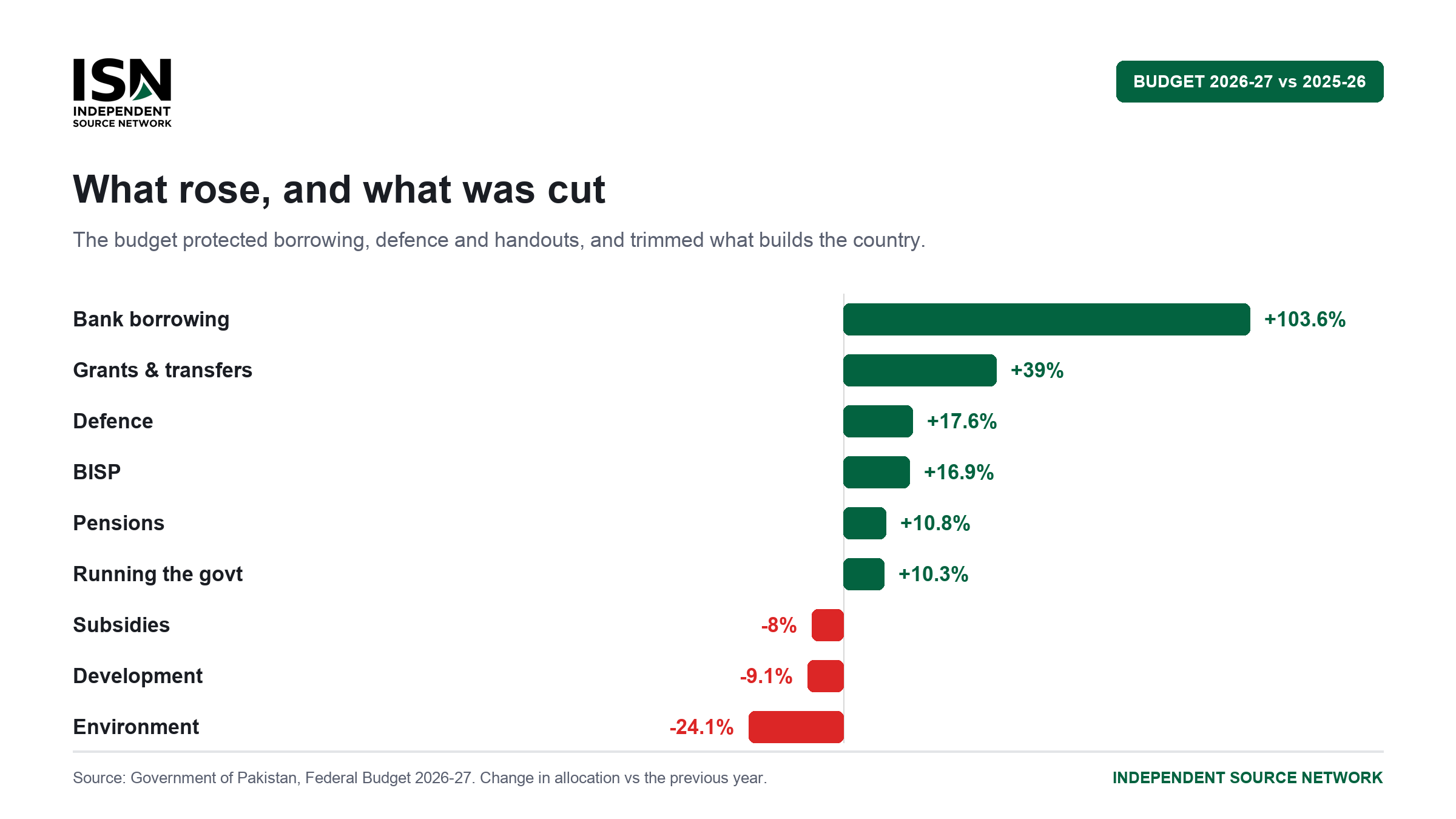
What rose, and what was cut, year on year.
What rose
The fastest-growing lines relate to financing and fixed obligations. Bank borrowing more than doubled, from Rs 1,971 billion to Rs 4,012 billion, the clearest sign of the gap between what the centre keeps and what it spends, examined in bank borrowing doubled, the 103 percent jump. Grants and transfers rose close to two fifths, and both defence and pensions grew faster than ordinary inflation. On the development side, federal education and training nearly doubled and the Higher Education Commission rose about a sixth, so the federal contribution to education grew even as the totals stayed modest.
What was cut
The lines that fell are, with one exception, those meant to build or to cushion. The development programme was cut about 9 percent and subsidies about 8 percent. The environment protection line was cut about 24 percent. Debt interest dipped about 2 percent, but on the assumption that interest rates will ease rather than because the debt itself shrank. The State Bank's profit transfer fell about 40 percent, which contributed to the heavier reliance on fuel and excise revenue this year.
The drivers behind the moves
Several of the largest changes share a common cause. The doubling of bank borrowing, the rise in grants and transfers, and the continued weight of interest all follow from the same gap between what the centre retains after paying the provinces, about Rs 11,751 billion, and what it spends, with current expenditure alone at about Rs 17,495 billion. That gap has to be financed, and a rising share of the financing now comes from domestic banks.
The cuts have their own logic. Development and subsidies are among the most discretionary lines in the budget, meaning they can be reduced more easily than fixed obligations such as interest, pensions and salaries. When a government needs to contain the deficit without touching those obligations, the development programme and subsidies are typically where the reductions fall. The fall in the State Bank's profit transfer, meanwhile, is a revenue change rather than a policy choice, and it left a hole that was partly filled by higher fuel and excise charges.
What the year-on-year view does not show
A year-on-year comparison captures direction but not adequacy. A line that rose may still be too small to meet need, and a line that fell may have been generous to begin with. The near-doubling of federal education and training, for instance, is a large percentage increase on a very small base, so the rupee effect is modest. Reading the changes alongside the absolute figures in where every hundred rupees goes gives the fuller picture.
What the comparison shows
Read together, the year-on-year changes describe a budget that guarded its obligations and its transfers, defence, pensions, grants and cash support, while trimming the development programme, subsidies and the environment. Because the overall increase of 6.8 percent is close to inflation, much of the growth is nominal rather than real. The budget is not one of uniform retreat, since several development and social lines rose, but the clearest single pattern is protection of fixed and financing costs alongside cuts to the items that are easiest to reduce.
The deficit target behind the changes
Many of the year's moves make more sense when read against the government's deficit objective. The overall fiscal deficit is targeted at about 3.6 percent of gross domestic product, down from 3.9 percent the previous year, and the government also aims to maintain a primary surplus, the balance before interest is counted, of about Rs 2,828 billion.
Holding the deficit down while interest remains the largest line forces a particular pattern: protect the obligations that cannot be cut, and trim the discretionary lines that can. That is why development and subsidies fall even as defence, pensions and cash support rise. The improvement in the deficit ratio is real but modest, and it depends partly on the assumption that interest rates will ease over the year, which would lower the cost of refinancing the short-dated domestic debt. If that assumption holds, next year's interest line eases; if it does not, the same pressures return. The mechanics of this are set out in the debt trap and the primary surplus.
Frequently asked questions
What rose the most in Pakistan's 2026-27 budget? Planned bank borrowing rose the most in percentage terms, about 104 percent, from Rs 1,971 billion to Rs 4,012 billion. Federal education and training also nearly doubled, and grants and transfers rose about 39 percent.
What was cut in the budget? The development programme was cut about 9 percent, subsidies about 8 percent, and the environment protection line about 24 percent. The State Bank profit transfer fell about 40 percent.
Did the budget grow in real terms? Only modestly. The 6.8 percent rise in total spending is close to the rate of inflation, so much of the increase reflects higher prices rather than more real spending.
Did defence and BISP rise? Yes. Defence rose about 17.6 percent and the Benazir Income Support Programme about 16.9 percent, both faster than ordinary inflation.
Why did bank borrowing rise so much? Because the centre spends far more than the revenue it keeps after paying the provinces, and it fills the gap by borrowing, increasingly from domestic banks. The mechanism is explained in bank borrowing doubled.
Is Pakistan's fiscal deficit falling? Modestly. The overall fiscal deficit is targeted at about 3.6 percent of GDP, down from 3.9 percent the previous year. The improvement is real but small and depends partly on the assumption that interest rates will ease over the year.
Why were development and subsidies cut rather than other lines? Because they are among the most discretionary lines in the budget. Fixed obligations such as interest, pensions and salaries cannot be reduced quickly, so when a government needs to contain the deficit, the reductions tend to fall on development and subsidies.
Sources and notes
- Government of Pakistan, Federal Budget 2026-27 and 2025-26: Budget in Brief and major spending heads. All figures are Budget Estimates in billions of rupees, rounded for readability.


 ISN MEDIA