The Exporter's Retention Quota account, allowing up to 100 percent retention for Bangladeshi exporters
By Asad Baig · Lahore · May 2026 · Approx. 4-min read
The short answer
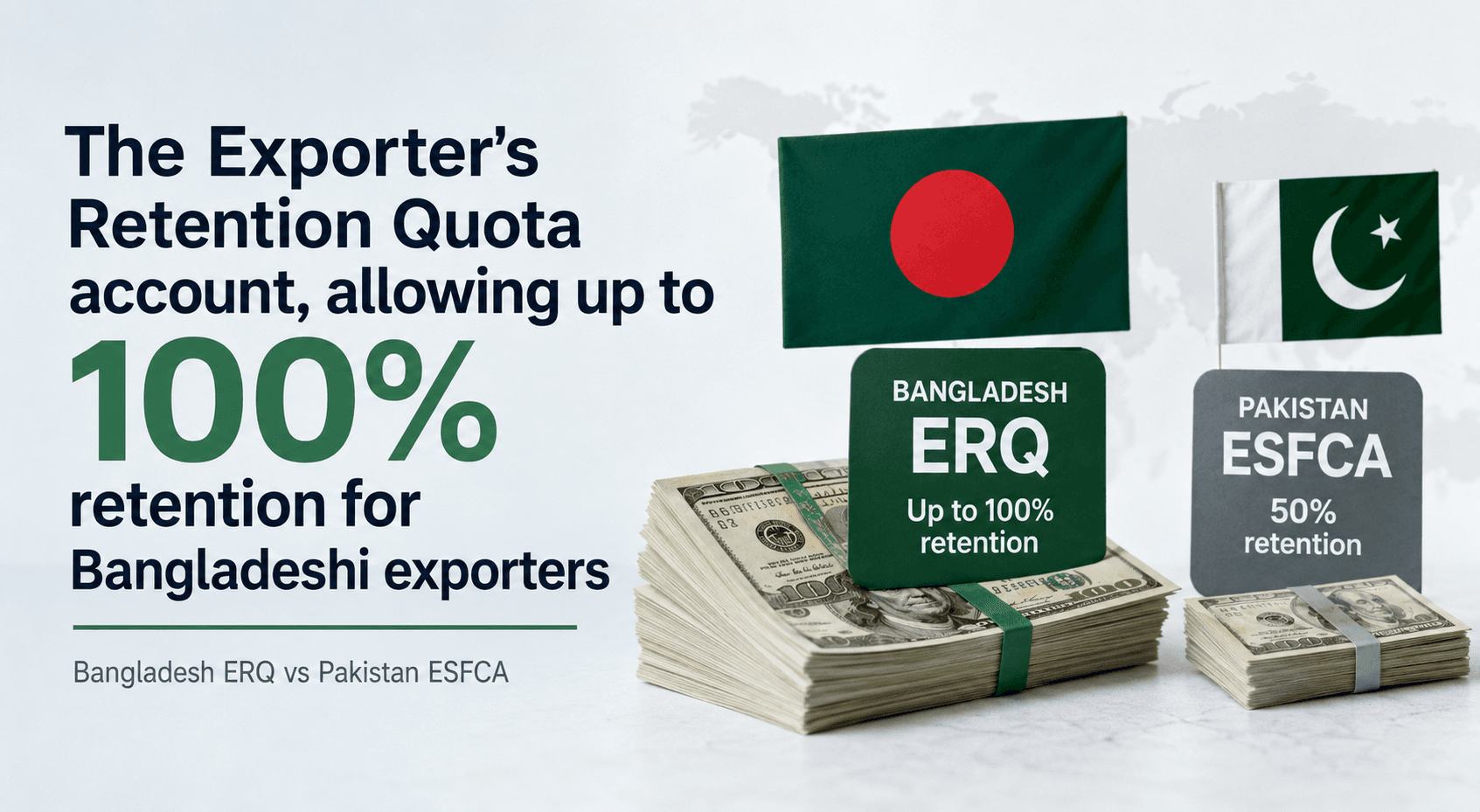
The Exporter's Retention Quota (ERQ) account in Bangladesh allows up to 100 percent retention of export earnings depending on sector and purpose. The funds can be used for international payments to foreign vendors, foreign travel for business purposes, operational expenses abroad, and limited foreign investment. The framework supports multi-currency holdings (USD, GBP, EUR, JPY). Bangladesh's IT industry has grown faster than Pakistan's in part because Bangladeshi IT entrepreneurs are not punished for repatriating their earnings. Bangladesh is FATF-compliant and runs an active $4.7 billion IMF programme alongside the ERQ framework.
This is a Tier 3 long-tail spoke under Bangladesh and Pakistan: two neighbours, two FCY outcomes and parent pillar what India, Singapore, UAE, Malaysia and Bangladesh do that Pakistan refuses to.
ERQ vs Pakistani ESFCA
Bangladesh ERQ Vs Pakistan Esfca
Feature | Bangladesh ERQ | Pakistan ESFCA |
|---|---|---|
Maximum retention | Up to 100% | 50% |
Forced conversion | None | 50% mandatory |
Cash currency withdrawal | Limited but allowed | Prohibited |
Multi-currency holdings | Yes | Limited |
Per-transaction approval | Streamlined | Required |
FATF compliance | Yes | Yes |
IMF programme | Yes ($4.7B) | Yes ($7B) |
Bangladesh shares almost every constraint Pakistani policymakers cite as reasons reform is impossible: developing economy status, IMF programme, comparable political instability, FATF compliance, similar reserve adequacy challenges. Yet Bangladesh operates the more liberal framework. The variable producing different outcomes is not external constraint but internal policy choice.
Why this matters for Pakistan
The Pakistan-Bangladesh comparison is the most uncomfortable peer comparison Pakistan has. Both countries have:
Comparable GDP per capita
Similar reserve adequacy challenges
Active IMF programmes
FATF compliance
Garment and textile-driven export profiles
Growing IT sectors
Comparable diaspora populations
Yet Bangladesh's ERQ delivers 100 percent retention while Pakistan's ESFCA caps at 50 percent. Bangladesh permits limited cash withdrawal while Pakistan prohibits it entirely. Bangladesh actively courts IT exporters; Pakistan punishes them with offshore-migration-inducing friction.
For the deeper structural comparison, see Bangladesh and Pakistan: two neighbours, two FCY outcomes.
Frequently asked questions
What is Bangladesh's ERQ account? The Exporter's Retention Quota account, a Bangladesh Bank scheme allowing exporters to retain up to 100 percent of foreign exchange earnings in foreign currency. The funds can be used for international payments, foreign travel, operational expenses, and limited foreign investment.
What is the maximum retention under ERQ? Up to 100 percent depending on sector and purpose. IT exporters and many service exporters qualify for the highest retention rates.
How does ERQ compare to Pakistan's ESFCA? ERQ offers 100 percent retention versus ESFCA's 50 percent. ERQ permits limited cash withdrawal versus ESFCA's prohibition. ERQ has lower per-transaction friction. Both frameworks are FATF-compliant.
Is Bangladesh's ERQ FATF-compliant? Yes. Bangladesh is FATF-compliant under the same standards Pakistan must meet. The ERQ framework operates alongside FATF compliance and an active $4.7 billion IMF programme.
Has Bangladesh's IT industry benefited from the ERQ? Yes. Bangladesh's IT industry has grown faster than Pakistan's in part because Bangladeshi IT entrepreneurs are not punished for repatriating their earnings. The Bangladesh government actively courts IT exporters with banking flexibility, tax incentives, and regulatory support.
Could Pakistan adopt ERQ-style framework? Yes. The Productive Capital Account proposal is closer to the Bangladesh ERQ model than to any other comparable framework. The PCA's 100 percent retention for IT exporters mirrors ERQ. The PCA's permission for documented foreign payments mirrors ERQ operational practice.
Sources
Bangladesh Bank, Foreign Exchange Regulations and ERQ guidelines
World Bank Bangladesh Development Update 2024
IMF Article IV consultation reports for Bangladesh and Pakistan
FATF mutual evaluation reports for Bangladesh and Pakistan



 ISN MEDIA