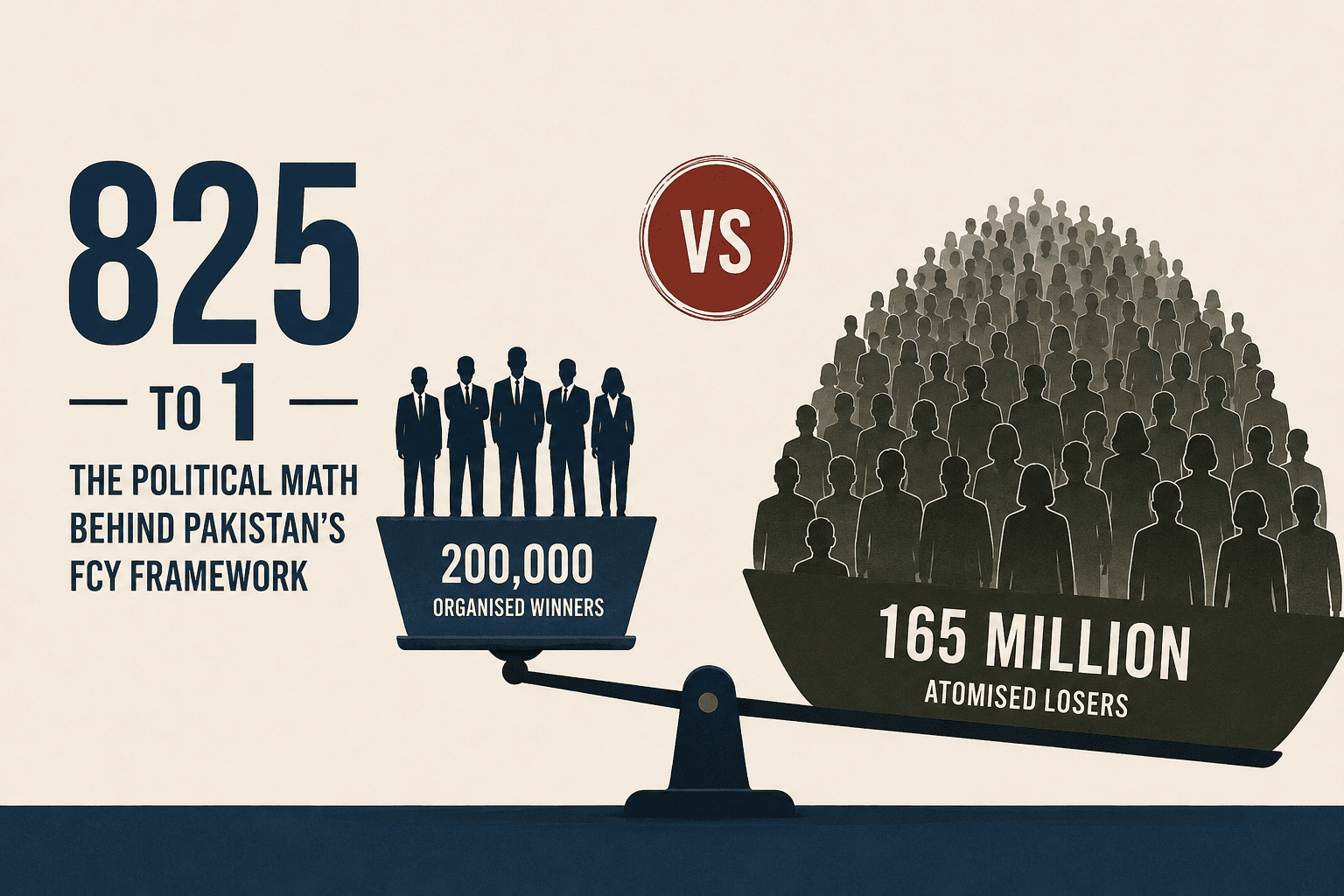
200,000 organised winners against 165 million atomised potential reform beneficiaries
By Asad Baig · Lahore · May 2026 · Approx. 4-min read
The short answer
The 825-to-1 ratio describes the political math at the heart of Pakistan's foreign currency framework. Approximately 200,000 organised beneficiaries earn $8 to 21 billion annually from the current system: bank executives (~5,000), bank shareholders (~50,000), senior bureaucracy (~50,000-100,000), elite families with offshore wealth (~10,000-50,000), politically connected industrialists (~5,000-20,000), and exchange company owners (~5,000-10,000). Approximately 165 million potential reform beneficiaries are atomised: IT companies (~600,000-800,000 employees), freelancers (2.37 million), goods exporters (~3-5 million), importers (~500,000-1 million), overseas Pakistani diaspora (~9 million), and working-class affected by inflation (~150 million+). That is approximately 825 losers for every winner. Despite the disparity in headcount, the 200,000 win because they are organised; the 165 million lose because they are not.
This is a Tier 3 long-tail spoke under why FCY reform has not happened in 33 years.
The math in one paragraph
The system is sustainable as long as the productive and working classes do not recognise their shared interests against the elite class. The moment they do, the political math changes dramatically.
Why 200,000 win
Five reasons documented in political economy:
Organisation versus atomisation, Winners have industry associations, lobbying networks, political donations
Concentrated costs versus diffuse benefits, Winners have strong individual incentive to fight reform
Visibility problem, Reform produces diffuse delayed benefits; status quo produces concentrated immediate harms if changed
System opacity, Most Pakistanis don't connect FCY to inflation or banking fees to underdevelopment
Distrust cycle, Government-business mutual distrust prevents coordination
For the deeper analysis, see why FCY reform has not happened in 33 years.
Frequently asked questions
What is the 825-to-1 ratio in Pakistani FCY policy? Approximately 200,000 organised beneficiaries of the current FCY framework against approximately 165 million potential reform beneficiaries. The ratio is approximately 825 atomised losers for every organised winner.
Who are the 200,000 organised beneficiaries? Bank executives (~5,000 senior positions), bank shareholders (~50,000 with concentrated wealth), senior bureaucracy benefiting (~50,000-100,000), elite families with offshore wealth (~10,000-50,000 individuals), politically connected industrialists (~5,000-20,000), and exchange company owners and operators (~5,000-10,000).
Who are the 165 million potential reform beneficiaries? IT companies (~600,000-800,000 employees), freelancers (2.37 million), goods exporters and employees (~3-5 million), importers (~500,000-1 million), overseas Pakistani diaspora (~9 million), and working class affected by inflation (~150 million+).
What does each side earn or lose annually? Beneficiaries earn $8 to 21 billion annually. Potential reform beneficiaries lose $11 to 20 billion annually. The country itself is approximately neutral or net negative on the redistribution.
Why do 200,000 win against 165 million? Because the 200,000 are organised through industry associations, lobbying, political donations, and direct policymaker access. The 165 million are atomised, individually frustrated, and lack class consciousness as a shared-interest group.
What would change the math? If even 10 percent of the 165 million atomised losers organised politically (16.5 million people), they would outnumber organised beneficiaries decisively. Productive class organisation, articulated through industry bodies and amplified through media, is what changes the math.
Is the 825-to-1 ratio inevitable? No. Every successful political reform in modern history has involved atomised losers organising into a class with shared interests. The Pakistani FCY framework is the same problem in a different domain. Reform requires the productive class to organise.
Sources
Position Paper: The Foreign Currency Account Problem in Pakistan, May 2026, Section 7
Asian Development Bank verification of 2.37 million Pakistani freelancers
Pakistan IT exports data: SBP and Pakistan Software Export Board
OCCRP "Dubai Unlocked" investigation, May 2024


 ISN MEDIA