



Direct vs Indirect Taxes in Pakistan: Who Really Pays?
Why the way Pakistan raises tax falls more heavily on consumption than on income
By the ISN Media desk • June 2026 • Approx. 5-min read
This is a short, factual answer about how Pakistan's tax system divides between direct and indirect taxes, and why the distinction matters for who bears the burden. The figures are Budget Estimates from the Government of Pakistan, in billions of rupees. For the wider picture, see how Pakistan raises its money.
What is the difference between direct and indirect taxes in Pakistan?
Direct taxes, chiefly income tax, are paid out of what people and companies earn, so they rise with income; indirect taxes, such as sales tax, customs and excise, are folded into the price of goods, so they are paid by everyone who buys, regardless of income. In Pakistan's 2026-27 budget, income tax raises about Rs 7,481 billion, while the combined indirect taxes, sales tax (Rs 4,927 billion), customs (Rs 1,651 billion) and federal excise (Rs 1,073 billion), together raise more.
Why the distinction matters
The distinction matters because it determines who carries the burden of funding the state. A direct income tax rises with the ability to pay: higher earners pay more. An indirect tax is the same for everyone who buys the good, so a daily-wage worker and a wealthy household pay the same charge on a litre of fuel or a bar of soap. When a tax system leans on indirect taxes, the burden falls relatively more heavily on lower-income households, which is what economists mean when they call a system regressive.
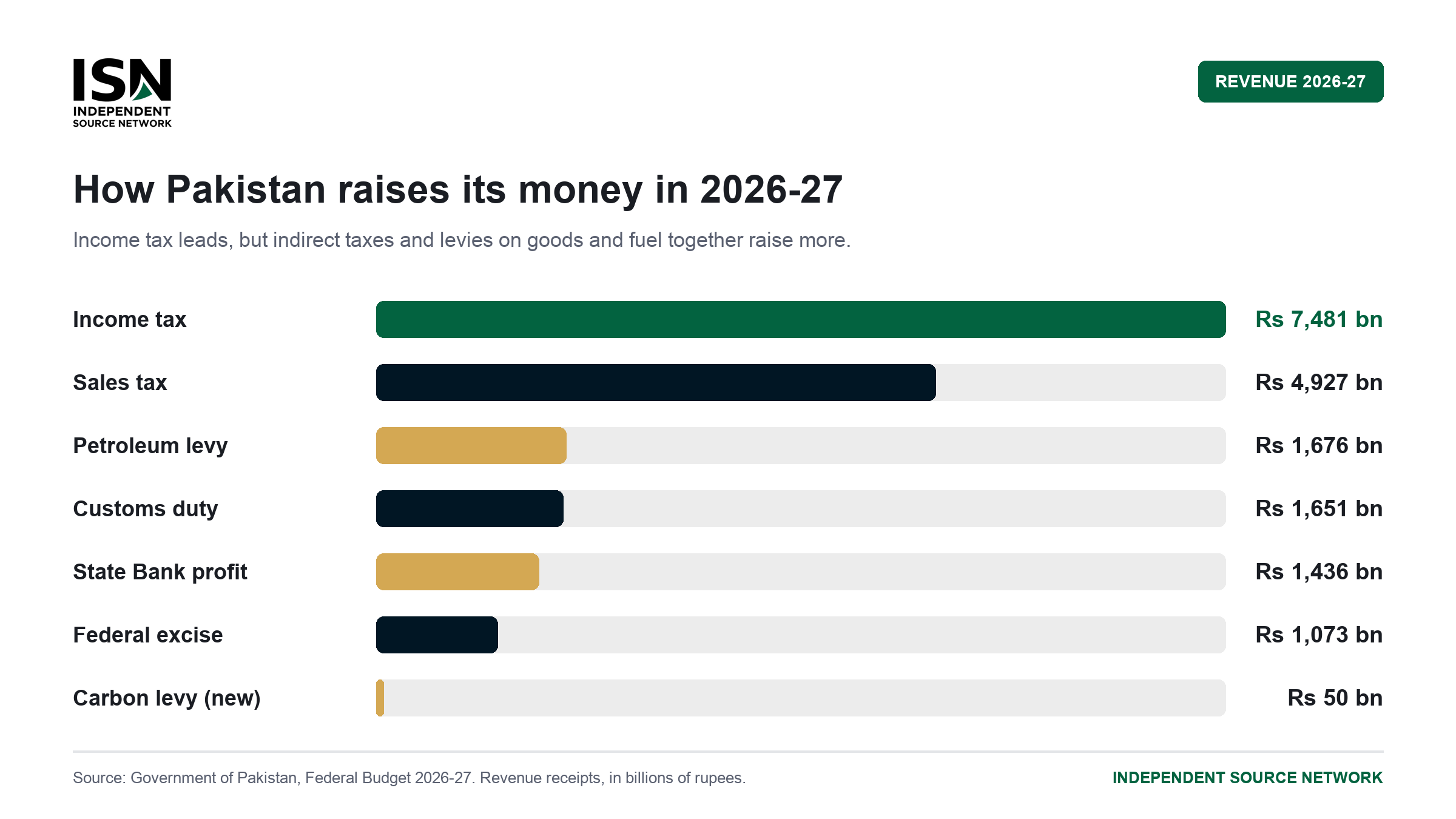
Income tax is the largest single line, but indirect taxes together raise more.
Pakistan's tilt toward indirect taxes
Although income tax is the single largest line, the combined weight of indirect taxes plus the petroleum levy means a large share of federal revenue is raised through prices rather than incomes. This is a long-standing feature of Pakistan's tax system, not the choice of a single year, and it is one reason the International Monetary Fund and the World Bank consistently recommend broadening the direct-tax base, bringing untaxed sectors into the net, and reducing reliance on consumption charges.
Why the base stays narrow
Part of the reason Pakistan leans on indirect taxes is that the direct-tax base is narrow. Large parts of the economy operate in cash or are formally exempt, so they contribute little in direct terms, and the shortfall is made up through indirect taxes that are easier to collect at the point of sale. Widening the direct-tax net is therefore central to making the system fairer, but it is administratively and politically difficult.
Frequently asked questions
What is the difference between direct and indirect taxes? Direct taxes, mainly income tax, are paid out of earnings and rise with income. Indirect taxes, such as sales tax, customs and excise, are included in the price of goods and are paid by everyone who buys, regardless of income.
Which raises more in Pakistan, direct or indirect taxes? Income tax is the single largest line at about Rs 7,481 billion, but the combined indirect taxes, sales tax, customs and excise, together raise more.
Why is Pakistan's tax system called regressive? Because it leans on indirect taxes that fall on everyone equally regardless of income, so the burden is relatively heavier on lower-income households.
Why does Pakistan rely on indirect taxes? Because the direct-tax base is narrow, with large parts of the economy in cash or exempt, so the shortfall is made up through indirect taxes that are easier to collect.
What reform is recommended? Broadening the direct-tax base, bringing untaxed sectors into the net, and reducing reliance on consumption charges, as recommended by the IMF and World Bank.
Sources and notes
- Government of Pakistan, Federal Budget 2026-27: revenue figures are Budget Estimates in billions of rupees, rounded for readability.


 ISN MEDIA