By a concerned citizen | May 2026
---
The Uncomfortable Truth No One Wants to Discuss
Let's be honest. When was the last time you drove through Lahore, Faisalabad, or Multan and didn't get stopped by a traffic warden looking for an "adjustment"? When was the last time a neighbour called the police and felt genuinely helped — rather than threatened or ignored?
This is the reality of Punjab in 2025–2026. And it's getting worse — not better.
Under the PML-N government led by Chief Minister Maryam Nawaz, Punjab has seen a massive and systematic expansion of police powers. New agencies. New laws. New uniforms. Bigger fines. And, unfortunately — the same old corruption.
Before we dive into politics, let's look at what independent data says.
According to Transparency International Pakistan's National Corruption Perception Survey 2025, *24% of all Pakistanis* identified police as the single most corrupt institution in the country — and the perception of corruption was highest in Punjab at a staggering 34%.
Let that sink in. More than 1 in 3 Punjab residents believe their police is the most corrupt institution around them. Not the tax department. Not the judiciary. The police.
And around 39% of respondents in Punjab said they felt forced to offer a bribe when accessing public services — and 77% of citizens expressed low satisfaction with the government's anti-corruption efforts.
These are not opposition numbers. These are independent survey numbers.
So What Has PMLN Done? More Police, More Power
Instead of addressing the root causes of corruption — underpay, lack of accountability, political interference — the PMLN government has doubled down on expanding the coercive apparatus of the state.
Here is what has happened since 2024:
1. The Punjab Police (Amendment) Ordinance 2025 — Giving Police Even More Powers
In February 2025, Chief Minister Maryam Nawaz created the Crime Control Department (CCD) through an amendment to the Police Order 2002 via the Police (Amendment) Ordinance 2025. This new body has its own police stations, its own FIR powers, and operates independently — essentially creating a parallel police force within the police.
More bodies. More powers. But zero new accountability.
2. PERA Force — The New Enforcement Army
On October 17, 2024, the Punjab government established the *Punjab Enforcement and Regulatory Authority (PERA)* — a brand-new law enforcement agency with over 8,000+ employees and 154 enforcement stations across Punjab. It was created through the Punjab Enforcement and Regulation Act 2024, spearheaded directly by CM Maryam Nawaz.
On paper, PERA was supposed to tackle inflation, hoarding, and encroachments.
But here's what critics are saying. PERA has drawn substantial criticism for the concentration of executive power in bureaucrats rather than elected representatives, its authority to search, detain, and levy fines without prior judicial warrant, and for creating a *parallel enforcement structure that bypasses police jurisdiction and dilutes due-process safeguards*.
In plain Urdu: PERA officers can stop you, search you, fine you — without any court order or police procedure. And who do they answer to? PERA is headed by the *Chief Minister herself as Chairperson*, with the Chief Secretary as Vice Chairperson.
So effectively, Maryam Nawaz created a 8,000-person enforcement force that reports directly to her. Accountability? Very limited.
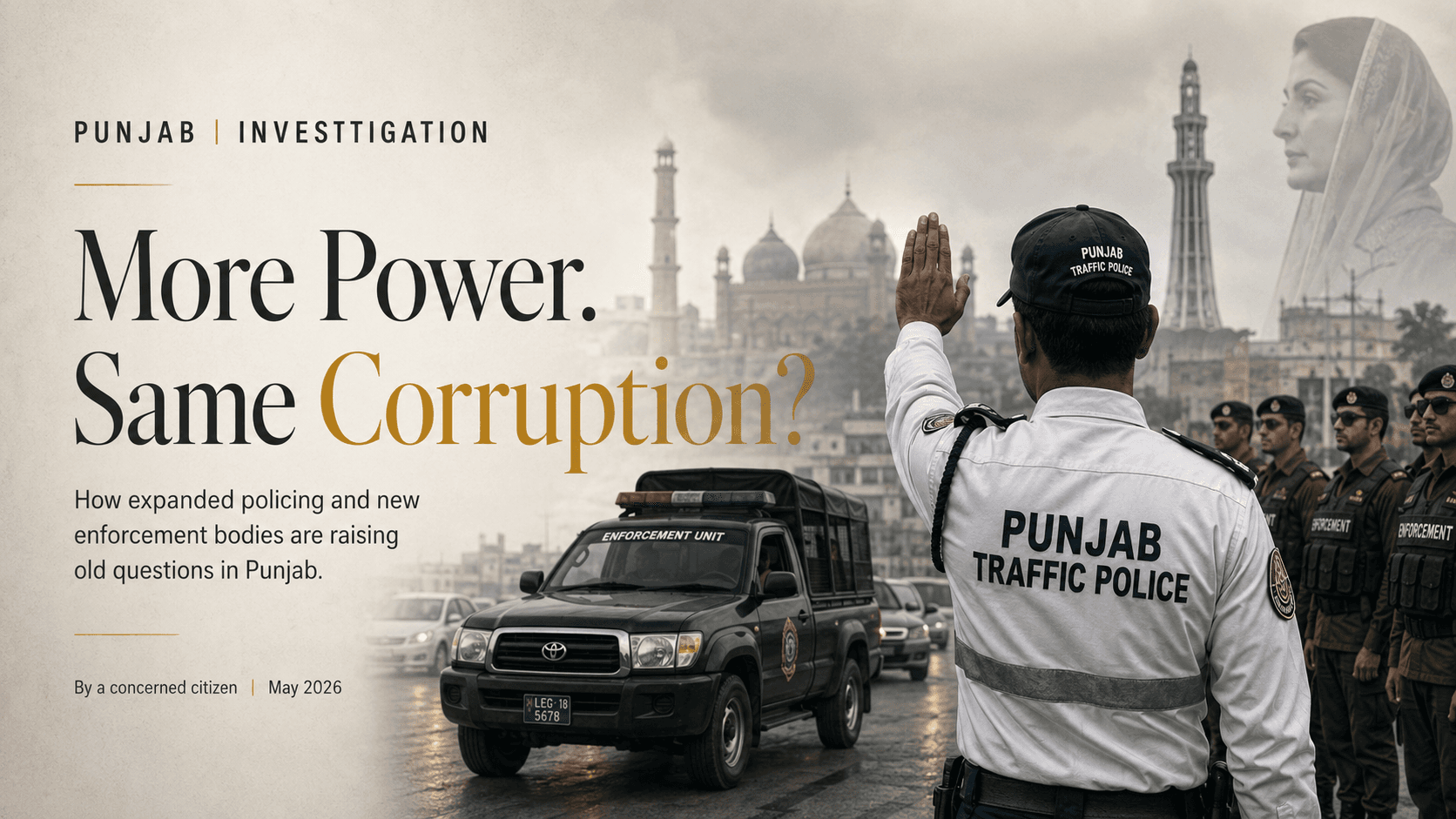
3. Traffic Police — Expanded Powers, Same Old Corruption
This is where most ordinary citizens feel the pinch directly.
The Punjab government has introduced 20 major reforms in the 60-year-old Traffic Act, including provisions to auction vehicles that are repeatedly fined for violations. Fines have been increased dramatically — a tenfold increase in traffic fines, combining stricter penalties, legal action against underage driving, and digital traffic management systems.
On paper: sounds responsible. On the ground: it's become a goldmine for bribery.
When a warden can now threaten you with a Rs. 15,000 fine for a minor violation — up from the old Rs. 200–500 — the "negotiation" power of that warden increases massively. The higher the official fine, the more room there is for an informal "settlement." And that is exactly what is happening on the roads of Punjab every single day.
Punjab Police's total annual budget is Rs. 187 billion — and 85 to 90% of it goes to paying salaries, leaving almost nothing for actual investigation or operational improvement. Underpaid officers with enormous discretionary power and no real supervision is a corruption scandal waiting to happen. And it has happened.
4. The Politics of Policing — Control, Not Service
This isn't just about traffic or markets. It's about political control.
After the elections of 2024, there is a PML-N-led government in both the Centre and Punjab, and the PML-N government is closely aligned with the military that helped bring the party to power. This means efforts by the PML-N government to reassert partisan control over the Punjab Police may be harder to resist.
Academic research on Pakistani policing has shown for years that parties in power use police forces not as neutral institutions serving citizens, but as tools for political enforcement. When the government is strong, the police enforces for the party. When the opposition gets bold, the police is deployed — not to protect, but to suppress.
The Reform Announcements — All Talk?
To be fair, the PMLN government has announced reforms. In February 2026, CM Maryam Nawaz launched a three-month plan to reform Punjab Police, including 14,000 body cameras, 700 panic buttons, online FIR tracking systems, and a goal to resolve minor complaints within 2–3 hours.
These are good announcements. But here is the problem.
Announcements are not implementation.
Punjab has seen police reform announcements for decades. Every government — PPP, PMLN, PTI — has promised the same things: accountability, training, transparency, citizen-friendly policing. And every time, the result has been the same: expanding budgets, expanding powers, and the same ground-level corruption that the ordinary citizen faces every day.
Even the official reform plan itself acknowledged that "misconduct, corruption, misuse of authority, and immoral conduct will not be tolerated" — suggesting these problems are currently rampant enough to need a stated zero-tolerance policy. You don't write a zero-tolerance policy for problems that don't exist.
What This Means for You — The Ordinary Pakistani
If you live in Punjab, here is what this power expansion actually means for your daily life:
On the road: Traffic wardens now have more power to stop, fine, and threaten you. Fines are 10x higher. Cameras are everywhere. But instead of reducing bribery, this has increased the leverage of every warden on every chowk.
In market: PERA officers can now walk into any shop, seize goods, and impose penalties without a court order. The potential for shakedowns is enormous.
At thana: The CCD now has its own parallel stations and FIR powers. More entry points into the system means more opportunities for abuse.
In community: A police force that historically answered to politicians is now more embedded with the ruling party than ever before.
The Bigger Question: Is This Governance or Control?
Why does a government that wants to serve the public need this many enforcement agencies?
Good governance doesn't require a 8,000-person regulatory army that can arrest you without a warrant. It doesn't require overhauling a Traffic Act to multiply fines tenfold when the real problem is that wardens are already taking bribes on the old fines.
Good governance requires:
- Independent accountability mechanisms
- A police force free from political interference
- Proper salaries so officers don't need to take bribes to survive
- A judicial system fast enough that criminals actually fear it
None of these have been seriously addressed by the current PMLN government in Punjab.
Instead, what we have is more power concentrated in fewer hands — and those hands all trace back to the Chief Minister's office.
Conclusion: Power Without Accountability Is Tyranny in Disguise
The PMLN government in Punjab will tell you that PERA is protecting consumers, that the new Traffic Act is saving lives, and that the CCD is fighting organized crime. And maybe, in some narrow sense, some of that is true.
But when Transparency International tells us that 34% of Punjab residents see their police as the most corrupt institution in the country, something is fundamentally broken. And the solution to broken, corrupt enforcement is not more enforcement with less accountability.
History — in Pakistan and around the world — teaches us one lesson consistently: giving more power to a corrupt system does not fix it. It expands it.
The people of Punjab deserve better. They deserve a police force that serves them — not a political machine that rules them.
Until that changes, every new law, every new agency, and every new uniform is just another tool of control dressed up as public service.


 Muqaddas Babbar