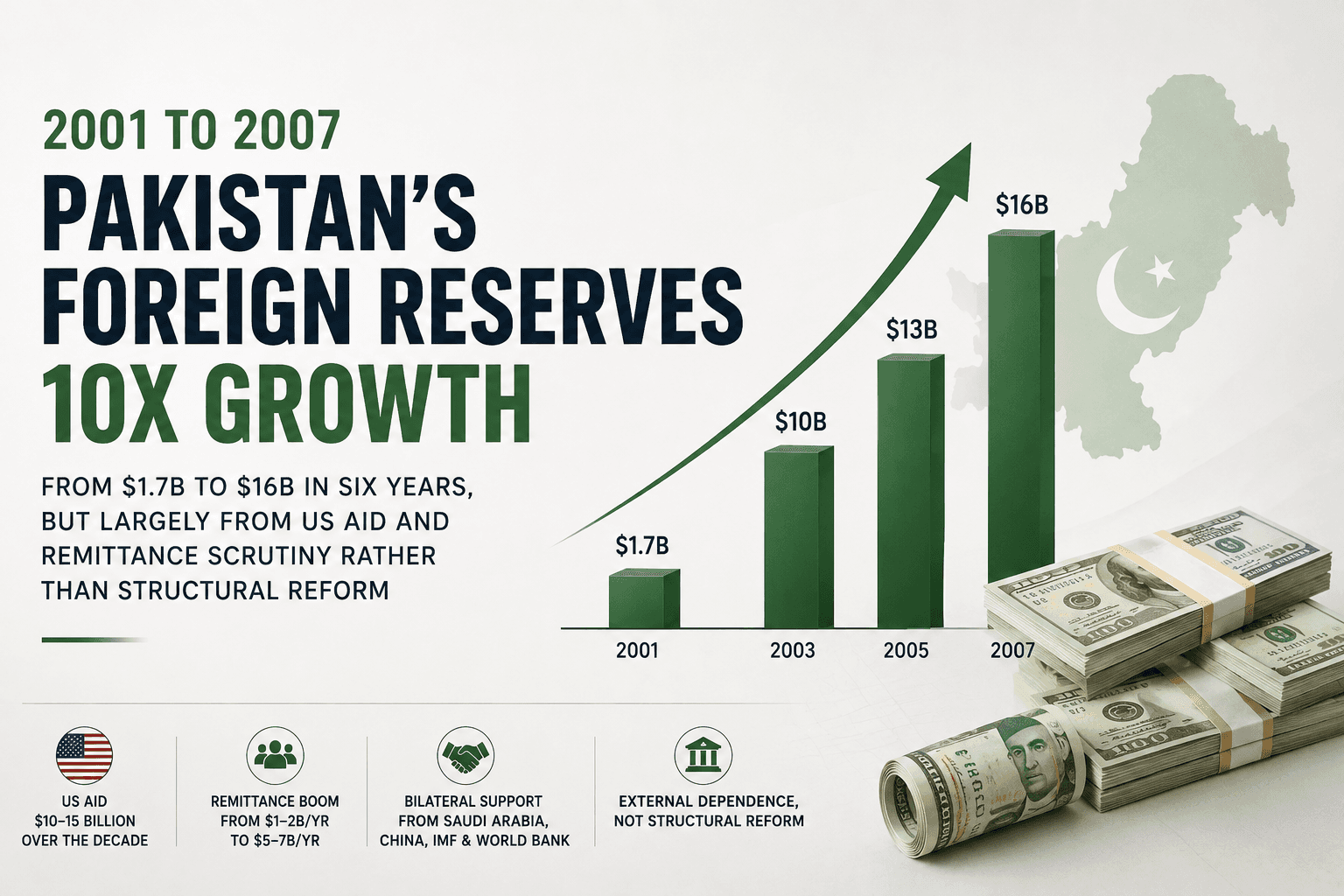
A 10x reserves growth from $1.7B to $16B in six years, but largely from US aid and remittance scrutiny rather than structural reform
By Asad Baig · Lahore · May 2026 · Approx. 5-min read
The short answer
Pakistani foreign reserves grew from approximately $1.7 billion in 2001 to approximately $16 billion in 2007, a 10x increase in six years. This growth was driven primarily by post-9/11 geopolitical developments rather than structural reform. Three factors converged: $10 to 15 billion in US military and economic aid over the decade, remittances pushed into formal banking channels by FATF-driven scrutiny on hawala (jumping from $1-2 billion/year to $5-7 billion/year), and bilateral support from Saudi Arabia, China, IMF, and World Bank. Per State Bank of Pakistan analysis, "the excess liquidity in the foreign exchange market following the post-September 11 surge in workers' remittance into the formal banking channel induced SBP to purchase US$8.2 billion from October 2001 to March 2004."
This is a Tier 3 long-tail spoke under the foreign currency account in Pakistan: a 76-year history (1947 to 2026).
The reserves growth trajectory
Pakistani Reserves, Post-9/11 Growth
Year | Reserves | Growth factor |
|---|---|---|
2001 | ~$1.7 billion | Pre-9/11 baseline |
2003 | ~$10 billion | 5x in 2 years |
2005 | ~$13 billion | Continued growth |
2007 | ~$16 billion | Decade peak |
The reserves at $16 billion in 2007 were impressive on paper. But examined closely, the composition was largely external dependence:
~$5 billion was IMF/World Bank/ADB borrowing
~$3-4 billion was direct US aid impacts
~$3-4 billion was bilateral support (Saudi, China)
~$2-3 billion was genuine remittance growth
~$1-2 billion was actual export earnings retention
The "earned" portion of reserves was small. Most of the $16 billion was external dependence in various forms.
The triple effect of 9/11
After September 11, 2001, three things happened simultaneously to Pakistan's foreign exchange position:
1. US aid resumed and expanded. Pakistan, as the frontline state in the "War on Terror", received $10 to 15 billion in US military and economic aid over the decade, debt rescheduling at favourable terms, removal of sanctions, and reactivation of IMF and World Bank programmes.
2. Remittance boom through formal channels. Counter-intuitively, the increased scrutiny on hawala (suspected of being used for terror financing) pushed remittances into formal banking. Remittances jumped from $1-2 billion/year to $5-7 billion/year. The Pakistani diaspora was forced into formal channels. The banking system gained a massive deposit base.
3. Reserve currency liquidity. The combined effect was unprecedented liquidity in Pakistan's foreign exchange market. The SBP purchased $8.2 billion from October 2001 to March 2004 alone.
Why the post-9/11 boom was misleading
The 1999-2007 period set patterns that have persisted. External-dependence model: Pakistani reserves growth came from US aid, not structural exports. Borrowed prosperity: much of the reserves were debt or aid, not earned. Vulnerability hidden: the system would fail again when external conditions changed. Elite continuity: the same families that had been moving wealth out continued doing so, just through new channels.
When US aid declined post-Bush administration and global conditions changed, the borrowed prosperity proved fragile. The 2008-2018 decade was defined by repeated crises and IMF programmes.
Frequently asked questions
How much did Pakistani reserves grow after 9/11? From approximately $1.7 billion in 2001 to approximately $16 billion in 2007, a 10x increase in six years. The decade peak was $16 billion in 2007.
What drove the post-9/11 reserves growth? Three factors: $10-15 billion in US military and economic aid over the decade, remittances pushed into formal banking by FATF-driven scrutiny on hawala (jumping from $1-2B/year to $5-7B/year), and bilateral support from Saudi Arabia, China, IMF, and World Bank. The State Bank of Pakistan purchased $8.2 billion in foreign exchange from October 2001 to March 2004 alone.
Was the post-9/11 growth from structural reform? No. The growth was largely from external geopolitical developments, not structural reform. Approximately $5 billion was IMF/World Bank/ADB borrowing, $3-4 billion was US aid impacts, $3-4 billion was bilateral support, $2-3 billion was genuine remittance growth, and $1-2 billion was actual export earnings retention.
How did 9/11 affect Pakistani remittances? Counter-intuitively, the increased scrutiny on hawala (suspected of terror financing) pushed Pakistani diaspora remittances into formal banking channels. Remittances jumped from $1-2 billion/year to $5-7 billion/year. The Pakistani banking system gained a massive deposit base it had not had before.
Did the post-9/11 reserves growth stabilise Pakistani FCY policy? No. The borrowed prosperity proved fragile. When US aid declined post-Bush administration and global conditions changed, Pakistan entered the 2008-2018 decade defined by repeated crises and multiple IMF programmes.
Sources
State Bank of Pakistan Annual Report 2003-04 on the post-9/11 remittance surge
State Bank of Pakistan, Foreign Exchange Reserves Series
IMF and World Bank programme records 2001-2007
Position Paper: The Foreign Currency Account Problem in Pakistan, May 2026


 Admin
Admin