The most economically irrational feature of Pakistani banking, explained directly
By Asad Baig · Lahore · May 2026 · Approx. 4-min read
The short answer
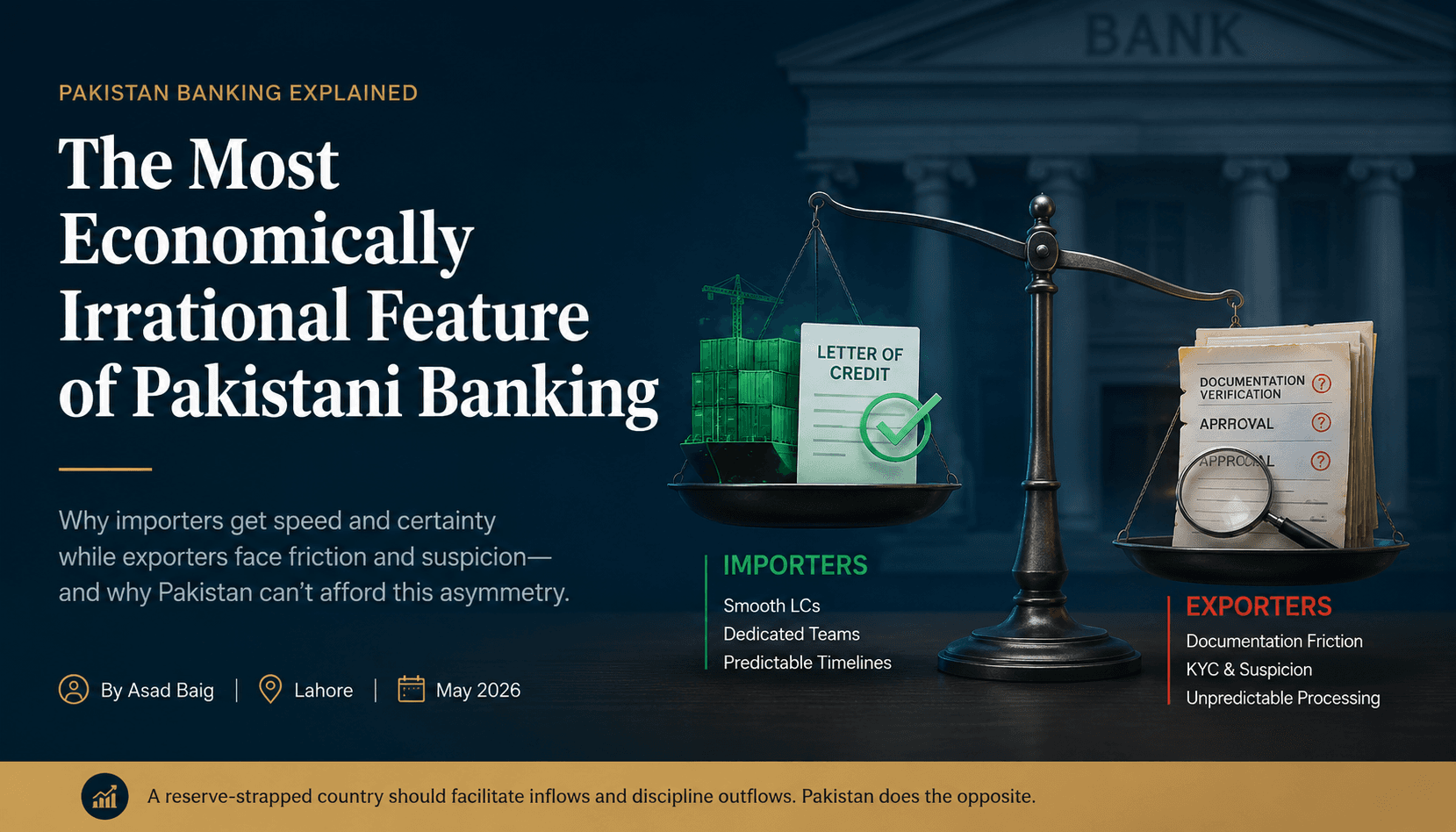
A Pakistani importer can move dollars out of Pakistan with smooth Letter of Credit processing, dedicated trade finance teams, and predictable timelines. A Pakistani exporter who brings dollars into Pakistan faces documentation friction, suspicious-treatment KYC, and unpredictable processing that varies by branch officer. A reserve-strapped country should facilitate the people who bring foreign currency in and discipline the people who send it out. Pakistan does the opposite. The asymmetry reflects whose political power built the Pakistani banking system: textile barons, machinery importers, and politically connected industrialists whose business model depended on imports paid in dollars and final products sold in rupees in a captive domestic market.
This is a Tier 3 long-tail spoke under the importer-exporter asymmetry: my position.
Frequently asked questions
What is the Pakistan importer-exporter asymmetry? Pakistani importers receive smooth LC processing, dedicated trade finance teams, and predictable timelines. Pakistani exporters face documentation friction, source-of-funds verification, branch officer discretion, and unpredictable processing. The same banks operate both functions but with substantially different operational quality.
Why does Pakistan favour importers over exporters? The Pakistani banking architecture was shaped by import-substitution industrialists from the 1950s onwards. Textile barons, machinery importers, and politically connected industrial families designed the framework around their needs. The export constituency, especially modern IT and services exports, is a recent addition that has not yet shaped the framework comparably.
Did the April 2026 reforms address this asymmetry? The April 2026 reforms eliminated Form R for IT exporters and introduced same-day processing of export proceeds. These are real improvements. The underlying asymmetry of operational quality between import and export handling remains.
How does the Productive Capital Account address this asymmetry? The PCA framework gives exporters a banking experience that mirrors what importers enjoy. Designated AD banks. Direct integration with Stripe, PayPal, Wise, Payoneer. No per-transaction approval theatre. The PCA also includes importers as eligible holders to prevent the framework from becoming an exporter privilege at importer expense.
Is this asymmetry economically rational? No. A reserve-strapped country should facilitate inflows of foreign currency and discipline outflows. Pakistan facilitates outflows (imports) and disciplines inflows (exports). This is the opposite of what the country's reserve position requires.
How much does this asymmetry cost Pakistan annually? Approximately $1.1 to 2.4 billion in goods exporter losses and $0.8 to 1.8 billion in IT sector losses, primarily attributable to the asymmetric framework. The cumulative cost is part of the broader $25 to 36 billion annual destroyed value.
Sources
State Bank of Pakistan, Foreign Exchange Manual
State Bank of Pakistan, EPD Circular Letter No. 17 (October 2023)
Position Paper: The Foreign Currency Account Problem in Pakistan, May 2026



 ISN MEDIA