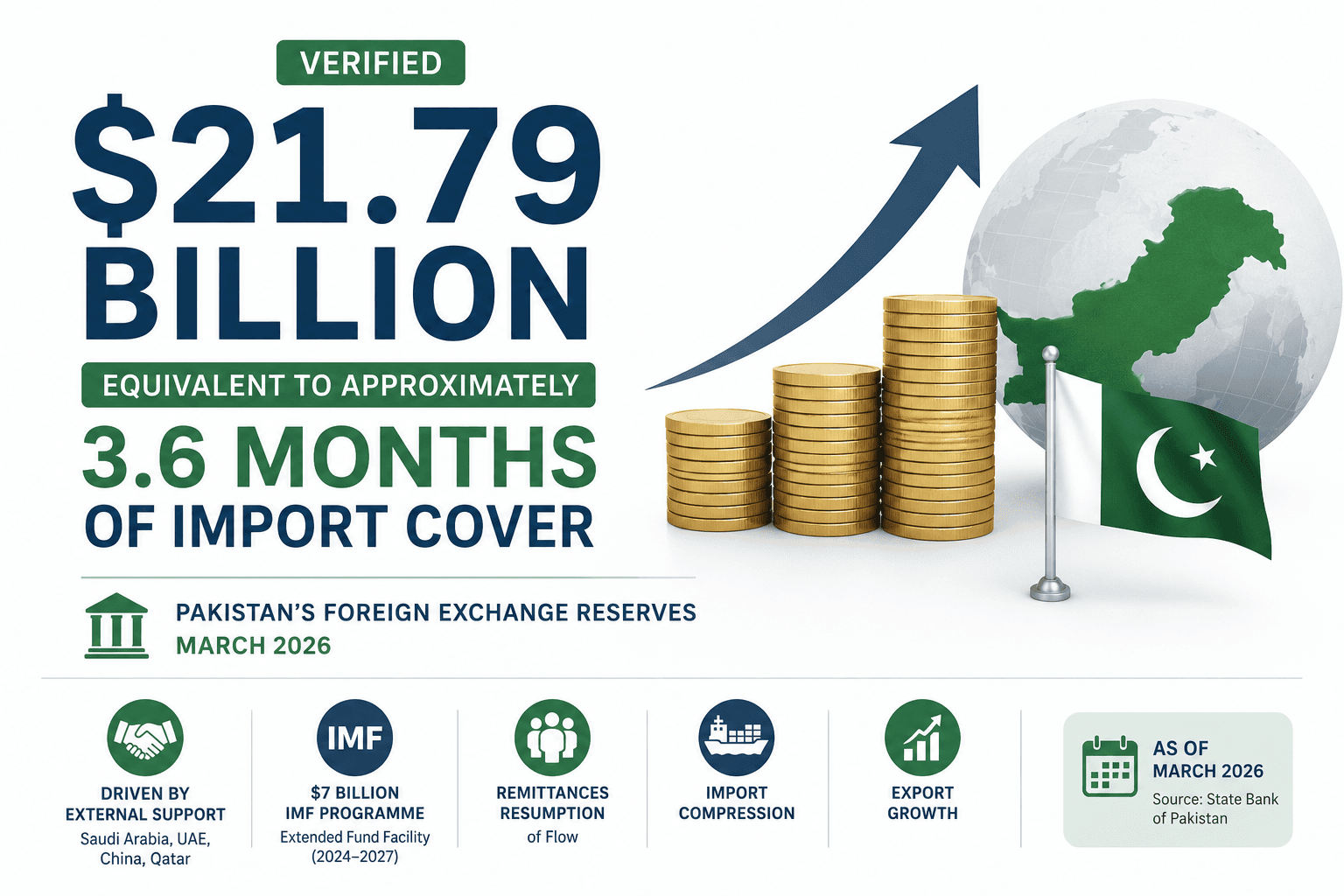
$21.79 billion verified, equivalent to approximately 3.6 months of import cover
By Asad Baig · Lahore · May 2026 · Approx. 4-min read
The short answer
Pakistan's foreign exchange reserves stood at $21.79 billion in March 2026 per State Bank of Pakistan figures, equivalent to approximately 3.6 months of import cover. This represents a recovery from the January 2023 crisis low of below $3 billion (less than 3 weeks of import cover). The recovery has been driven by continued bilateral support rollovers from Saudi Arabia, UAE, China, and Qatar, the new $7 billion IMF Extended Fund Facility (2024-2027), resumption of remittance flow, some import compression, and modest export growth. The recovery is not driven by structural reform of the FCY framework that contributed to the crisis.
This is a Tier 3 long-tail spoke under the foreign currency account in Pakistan: a 76-year history (1947 to 2026).
Recent reserves trajectory
Pakistan Reserves, Recent Years
Date | Reserves | Notes |
|---|---|---|
August 2021 | $27.2 billion | Recent peak |
August 2022 | $13.4 billion | -50% in one year |
January 2023 | Below $3 billion | Crisis low (<3 weeks) |
March 2026 | $21.79 billion | Current verified figure |
The recovery from January 2023 to March 2026 has been substantial in absolute terms. The composition of the reserves remains heavily dependent on external support rather than earned reserves.
Frequently asked questions
What is Pakistan's current foreign exchange reserves figure? $21.79 billion as of March 2026, per State Bank of Pakistan figures. This is equivalent to approximately 3.6 months of import cover.
How does Pakistan's reserves position compare to historical levels? The current $21.79 billion is below the August 2021 peak of $27.2 billion but substantially above the January 2023 crisis low of below $3 billion. Pakistan has had higher reserves in 2007, 2016, and 2021 (the post-9/11 boom, CPEC era peak, and pandemic recovery respectively).
What drives Pakistan's current reserves? Continued bilateral support rollovers (Saudi Arabia $3 billion, UAE $2 billion, China multiple rollovers $4-5 billion, Qatar $3 billion package), the new $7 billion IMF Extended Fund Facility (2024-2027), resumption of remittance flow, import compression, and modest export growth.
Are Pakistan's reserves earned or borrowed? Mostly borrowed. The composition includes IMF programme borrowing, bilateral support rollovers, and Eurobond issuances. The "earned" portion (genuine export retention plus net remittance growth) is the smaller part of the total.
What is import cover and what is Pakistan's current? Import cover measures how many months of imports a country's reserves can fund. Pakistan's current import cover is approximately 3.6 months, an improvement from the less-than-3-weeks crisis level of January 2023 but below the IMF-recommended minimum of 3 months for emerging economies.
How does the Productive Capital Account proposal affect Pakistan's reserves? The PCA framework is projected to add $25 to 35 billion in reserves over 5 years through productive class repatriation, $5 to 10 billion through reduced offshore migration of ongoing flows, and $5 to 10 billion through RDA growth. Combined, the PCA could push reserves to $47 to 57 billion by 2031.
Is Pakistan's reserves position sustainable? The current position depends on continued bilateral support and the IMF programme. When external support reduces or external conditions change (as happened in 2018-2019 and 2022-2023), reserves can crash within months. The position is fragile rather than sustainable in current configuration.
Sources
State Bank of Pakistan, Foreign Exchange Reserves Series (March 2026)
World Bank Pakistan Country Update 2025
IMF Article IV consultation reports for Pakistan
Position Paper: The Foreign Currency Account Problem in Pakistan, May 2026


 Admin
Admin