The terror financing and money laundering concerns that triggered the listing, and the four-year compliance journey
By Asad Baig · Lahore · May 2026 · Approx. 5-min read
The short answer
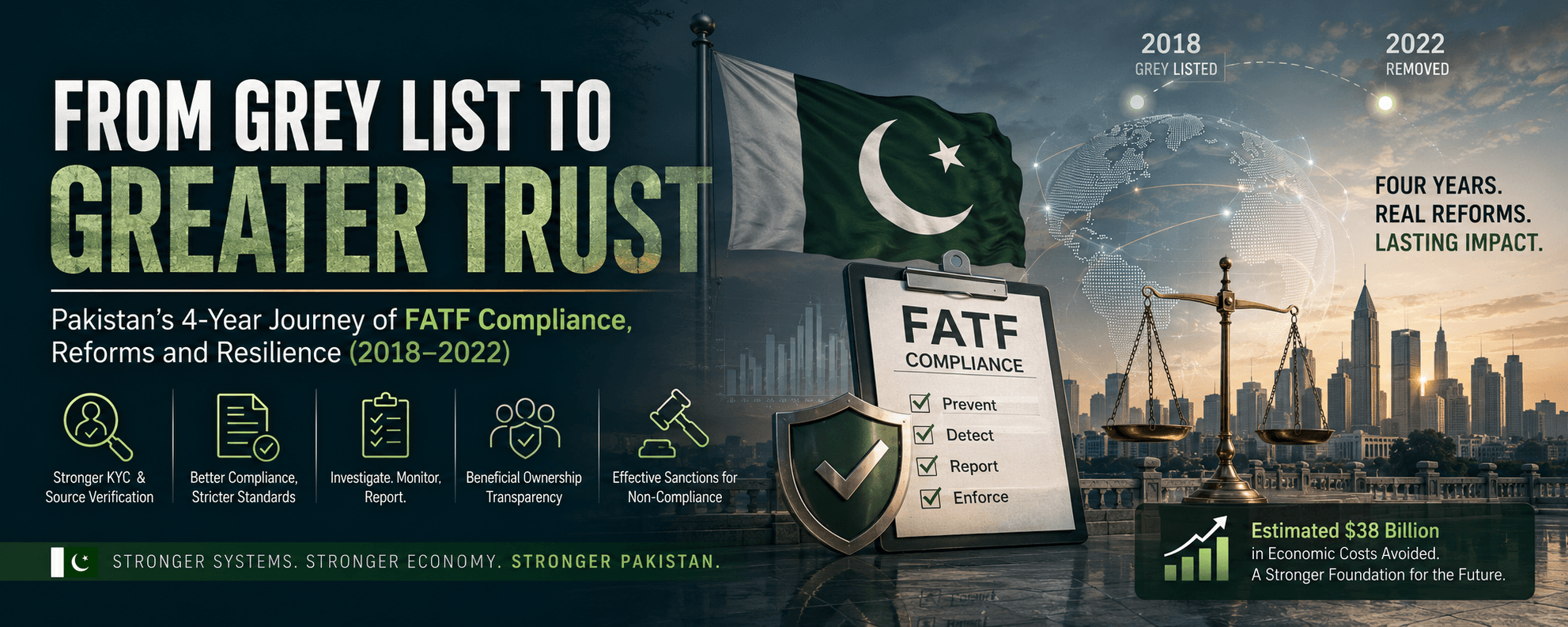
Pakistan was placed on the FATF grey list in June 2018 due to terror financing and money laundering concerns. The required compliance measures included stricter source-of-funds verification, better KYC requirements, cross-checking with tax records, investigation of suspicious transactions, beneficial ownership tracking, and effective sanctions for non-compliance. The grey list cost Pakistan an estimated $38 billion in lost GDP, reduced FDI inflows, higher international borrowing costs, and disrupted correspondent banking relationships. Pakistan was removed from the grey list in October 2022 after four years of compliance work.
This is a Tier 3 long-tail spoke under the foreign currency account in Pakistan: a 76-year history (1947 to 2026).
What FATF compliance Pakistan was required to deliver
The compliance work was substantial. Pakistan implemented many of these reforms during the 2018 to 2022 period. The reforms hit small users (KYC documentation, source verification on every export receipt) hard. The reforms that would have hit elite wealth (offshore disclosure, beneficial ownership transparency that crossed jurisdictional lines, serious enforcement against trade mis-invoicing) were implemented superficially.
The economic cost
Estimated Cost Of Grey List Period
Lost GDP | ~$38 billion |
|---|---|
Reduced FDI inflows | Significant |
Higher international borrowing costs | 1-3% premium |
Banking restrictions in correspondent relationships | Substantial |
Lost trade opportunities | Significant |
Various analyses estimated approximately $38 billion in lost GDP over the grey list period. The cost fell across multiple channels: reduced FDI as international investors avoided grey-listed jurisdictions, higher Eurobond pricing as international borrowing premium widened, and disrupted correspondent banking as foreign banks reduced exposure to Pakistani institutions.
The 2020 SRO
The most significant FCY-specific reform during the grey list period was the federal government's 2020 SRO on FCY accounts. Per the document issued by the finance ministry: "A foreign currency account of an individual may be credited with the remittances received from abroad through banking channel except payment for goods exported from Pakistan."
This effectively ended the rupee-to-dollar conversion pipeline that had enabled the worst money laundering through PERA's original framework. It was a real structural reform.
However, several PERA-era loopholes survived the grey list period intact:
Section 111(4) tax immunity for foreign remittances
Banking secrecy provisions
Discretionary approval systems
Two-tier implementation patterns
Asymmetric treatment of importers versus exporters
The reforms that hurt small users were implemented thoroughly. The reforms that would have exposed elite wealth were implemented superficially.
Why Pakistan came off the grey list
Pakistan was removed from the FATF grey list in October 2022 after four years of compliance work. The removal was significant because it:
Restored some banking relationships
Reduced international scrutiny
Marginally improved investor perception
Ended the explicit cost of grey-listing
But it also meant that some compliance pressure relaxed. Several reforms began being quietly de-emphasised after Pakistan came off the list. The pattern is consistent: Pakistan implements compliance reforms when forced by external pressure and resists structural reforms that would expose its own elite.
Frequently asked questions
Why was Pakistan placed on the FATF grey list in 2018? Pakistan was placed on the FATF grey list in June 2018 due to terror financing and money laundering concerns. The listing required Pakistan to implement specific compliance measures including stricter source-of-funds verification, better KYC, cross-checking with tax records, beneficial ownership tracking, and effective sanctions enforcement.
How much did the FATF grey list cost Pakistan? Estimates suggest approximately $38 billion in lost GDP over the four-year grey list period. The cost fell across reduced FDI inflows, higher international borrowing costs (1-3 percent premium), banking restrictions in correspondent relationships, and lost trade opportunities.
When did Pakistan come off the FATF grey list? Pakistan was removed from the FATF grey list in October 2022 after four years of compliance work.
What was the most significant FCY-specific reform during the grey list period? The 2020 SRO from the federal government, which limited FCY account credits to remittances received from abroad through banking channels (except export proceeds). This effectively ended the rupee-to-dollar conversion pipeline that had enabled the worst PERA-era money laundering.
Did the grey list compliance fix the AML-PERA contradiction? No. Several PERA-era loopholes survived the grey list period intact, including Section 111(4) tax immunity for foreign remittances, banking secrecy provisions, discretionary approval systems, and asymmetric treatment of importers versus exporters. The reforms that hurt small users were implemented thoroughly while reforms that would have exposed elite wealth were implemented superficially.
Could Pakistan be placed back on the FATF grey list? Yes, if Pakistan fails to maintain the compliance reforms or if new concerns emerge. The FATF mutual evaluation process is ongoing, and grey listing is a recurring possibility for jurisdictions where compliance enforcement weakens.
Sources
FATF mutual evaluation reports for Pakistan
Federal government FCY rules issued by Ministry of Finance (2020 SRO)
Position Paper: The Foreign Currency Account Problem in Pakistan, May 2026
World Bank Pakistan Country Update 2025
Various analyses of grey list economic cost (referenced in Pakistani financial press)


 Admin
Admin