



Pakistan's Education Budget 2026-27: 63 Paisa in Every 100 Rupees
What the federal government spends on schooling, and why the figure understates the total
By the ISN Media desk • June 2026 • Approx. 8-min read
Education is among the smallest lines in Pakistan's federal budget, but reading it correctly requires understanding both the figure and a large caveat. This explainer sets out what the federal government allocates to education in 2026-27, what that covers, and why the federal number understates national spending. The figures are Budget Estimates from the Government of Pakistan, in billions of rupees. It sits under the pillar education, health and the smallest shares of Pakistan's budget.
How much does Pakistan spend on education in 2026-27?
At the federal level, education receives about Rs 118 billion in current spending in 2026-27, roughly 0.6 percent of the budget, or 63 paisa in every 100 rupees. Adding development allocations such as the Higher Education Commission brings the federal contribution to around Rs 200 billion. The crucial qualification is that under the eighteenth amendment most schools are funded by the provinces, so the federal figure understates what the country spends in total, though even the national figure remains low by international standards.
That is the number and the caveat together. The detail follows.
What the federal education figure covers
The current education line of about Rs 118 billion rose modestly this year, from about Rs 112.7 billion, an increase of about 4.5 percent. On the development side, two lines rose more sharply. The Higher Education Commission allocation rose from about Rs 39.5 billion to Rs 46.0 billion, an increase of about 16.5 percent, and the development line for federal education and training almost doubled, from about Rs 18.6 billion to Rs 36.3 billion.
| Education line | FY 2025-26 | FY 2026-27 | Change |
|---|---|---|---|
| Education, current | 112.7 | 117.7 | +4.5% |
| Higher Education Commission (dev.) | 39.5 | 46.0 | +16.5% |
| Federal education and training (dev.) | 18.6 | 36.3 | +95.4% |
Figures in billions of rupees. (dev.) marks a development allocation.
So the federal picture is genuinely mixed. The contribution grew faster than inflation this year, and two of its development lines rose sharply. Yet even the enlarged total stays modest, because the base is small to begin with. The federal lines mainly fund higher education, federal training institutions, and education in the territories the federation administers directly, rather than the bulk of the country's schools.
Why the federal figure understates spending
The single most important fact for reading the education budget is the eighteenth amendment. Passed in 2010, it devolved most responsibility for school education to the provinces, which fund their schools from the share of national revenue the centre transfers to them, about Rs 8,848 billion in 2026-27. A large part of the country's education spending therefore appears in the four provincial budgets, not the federal one.
This means a small federal education line is not, on its own, evidence that the country neglects schooling; much of the money simply sits in the provincial accounts. The mechanism is explained in the 18th amendment, why these figures understate spending. The honest question is always what the provinces add to the federal figure.
The national picture
Allowing fully for devolution, what does Pakistan spend on education as a country? For many years the combined federal and provincial figure has stayed below 2 percent of gross domestic product. That is beneath the level of about 4 percent recommended by international bodies such as UNESCO, and beneath the spending of several comparable countries, including regional neighbours.
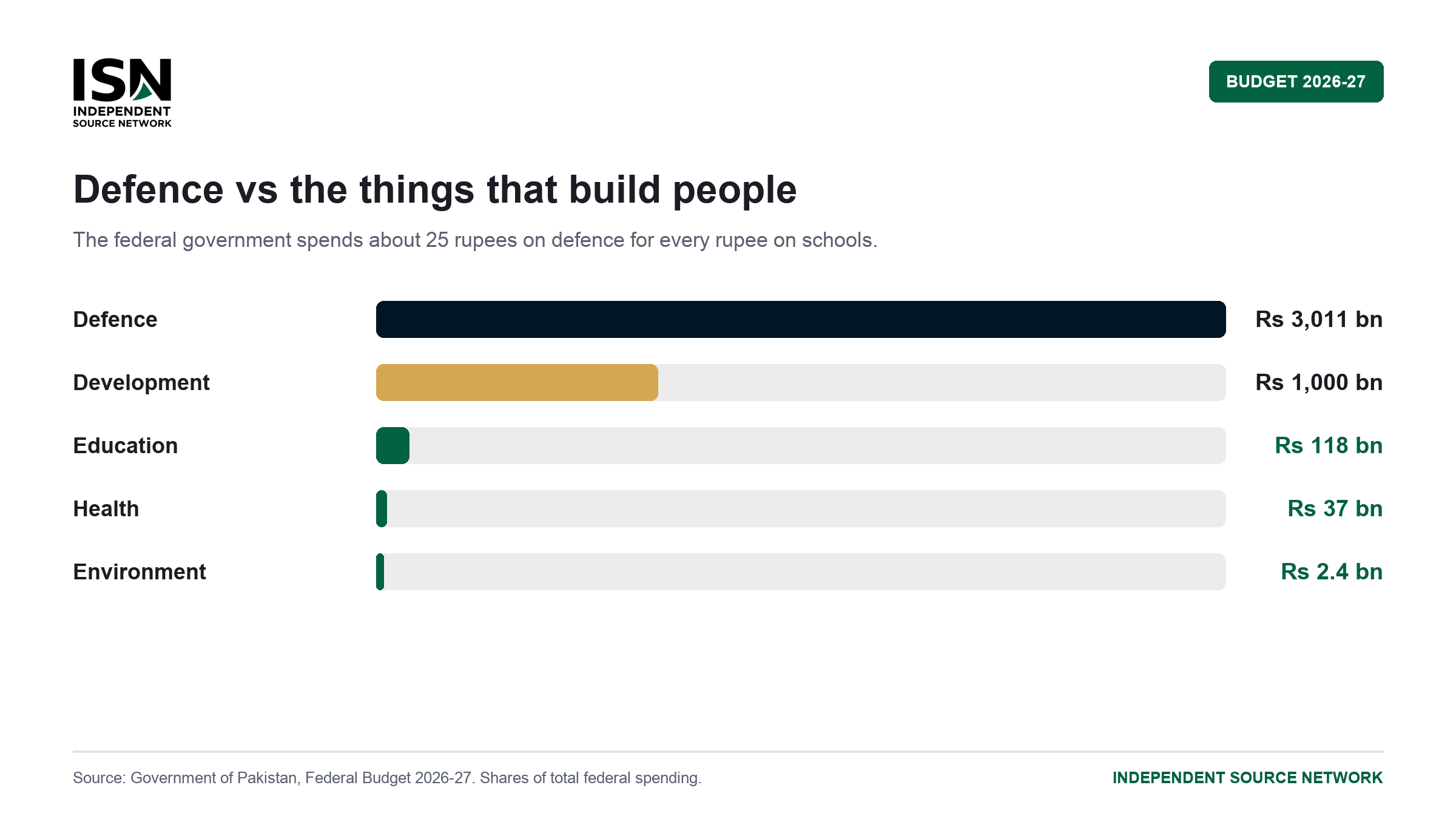
Federal education beside defence and the other social sectors.
So two things are true at once. The federal figures understate national spending because of devolution, and the national figures still show a country committing a low share of its economy to education. A serious reading holds both.
What the low spending produces
A budget share is an input; what it produces is what citizens experience. Pakistan has one of the largest populations of out-of-school children in the world, estimated in the tens of millions by UNICEF and other bodies, concentrated among the poorest families and among girls. Learning outcomes lag the region even for enrolled children, with a large share unable to read a simple sentence at the expected age. These outcomes have many causes beyond money, including the quality of provincial delivery, but they are the reason the budget debate matters beyond the accounting.
Pakistan beside its neighbours
The clearest way to judge whether Pakistan's commitment is low is to set it beside comparable countries. On education, both India and Bangladesh have for years devoted a higher share of their economies to schooling than Pakistan, and some smaller regional states higher still. The international benchmark most often cited, around 4 to 6 percent of GDP, sits roughly two to three times above Pakistan's combined federal and provincial effort of under 2 percent.
The comparison matters for outcomes, not only pride. Bangladesh, which began poorer than Pakistan, has translated sustained social spending into gains in literacy, female education and school completion that now run ahead of Pakistan on several measures. Money alone does not explain the difference, since governance and delivery matter as much, but a country cannot reach its neighbours' outcomes while spending a neighbour-low share of its economy. The same comparison runs through our colleagues' work on why Pakistan's textile industry fell behind Bangladesh's.
The link to emigration
There is a further dimension the education budget does not capture. Even when Pakistan educates people to a professional level, many emigrate, so part of the investment benefits foreign labour markets. The scale of that departure is documented in the brain-drain reporting, including the brain drain and the graveyard of remittancers and Pakistani doctors leaving in the last five years. This does not argue for spending less, but it complicates any simple measure of the return on education spending, since a trained doctor or engineer who emigrates represents both a public investment and a public loss.
What could change
Because most school money is provincial, the most direct lever is the efficiency and transparency of provincial spending, where outcomes have lagged the amounts spent. Other reforms commonly proposed include protecting and compounding the federal development increases to higher education and training, and reporting education spending against outcomes, such as enrolment and learning, rather than only against rupees allocated. The deeper constraint, that the budget as a whole is dominated by debt and defence, is examined in the 43 percent.
Frequently asked questions
How much does Pakistan spend on education in 2026-27? About Rs 118 billion in federal current spending, roughly 0.6 percent of the budget or 63 paisa in every 100 rupees. With development lines such as the Higher Education Commission, the federal total is around Rs 200 billion. Most school funding, however, is provincial.
Did the education budget rise this year? Yes, in parts. Current education rose about 4.5 percent, the Higher Education Commission about 16.5 percent, and federal education and training almost doubled. The rises are real but small in rupees because the base is low.
Why is the federal education figure so small? Because the eighteenth amendment devolved most school education to the provinces in 2010. They fund schools from the roughly Rs 8,848 billion the centre transfers, so the federal line understates national spending.
Does Pakistan spend 4 percent of GDP on education? No. Combined federal and provincial education spending has for years stayed below 2 percent of GDP, beneath the roughly 4 percent recommended by bodies such as UNESCO and beneath several comparable countries.
How many children are out of school in Pakistan? One of the largest numbers in the world, estimated in the tens of millions by UNICEF and others, concentrated among the poorest families and among girls. It reflects low and unevenly delivered spending, not a single budget line.
What does the federal education budget actually fund? Mainly higher education through the Higher Education Commission, federal training institutions, and education in the territories the federation administers directly, rather than the bulk of the country's schools, which are provincial.
Sources and notes
- Government of Pakistan, Federal Budget 2026-27: education and development figures are Budget Estimates in billions of rupees, rounded for readability.
- Education spending below 2 percent of GDP and the UNESCO benchmark of about 4 percent reflect long-standing national accounts and UNESCO Institute for Statistics guidance.
- Out-of-school and learning figures reflect estimates by UNICEF and similar bodies.


 ISN MEDIA