Up to 100 percent retention of foreign earnings, multi-currency, free for foreign payments
By Asad Baig · Lahore · May 2026 · Approx. 4-min read
The short answer
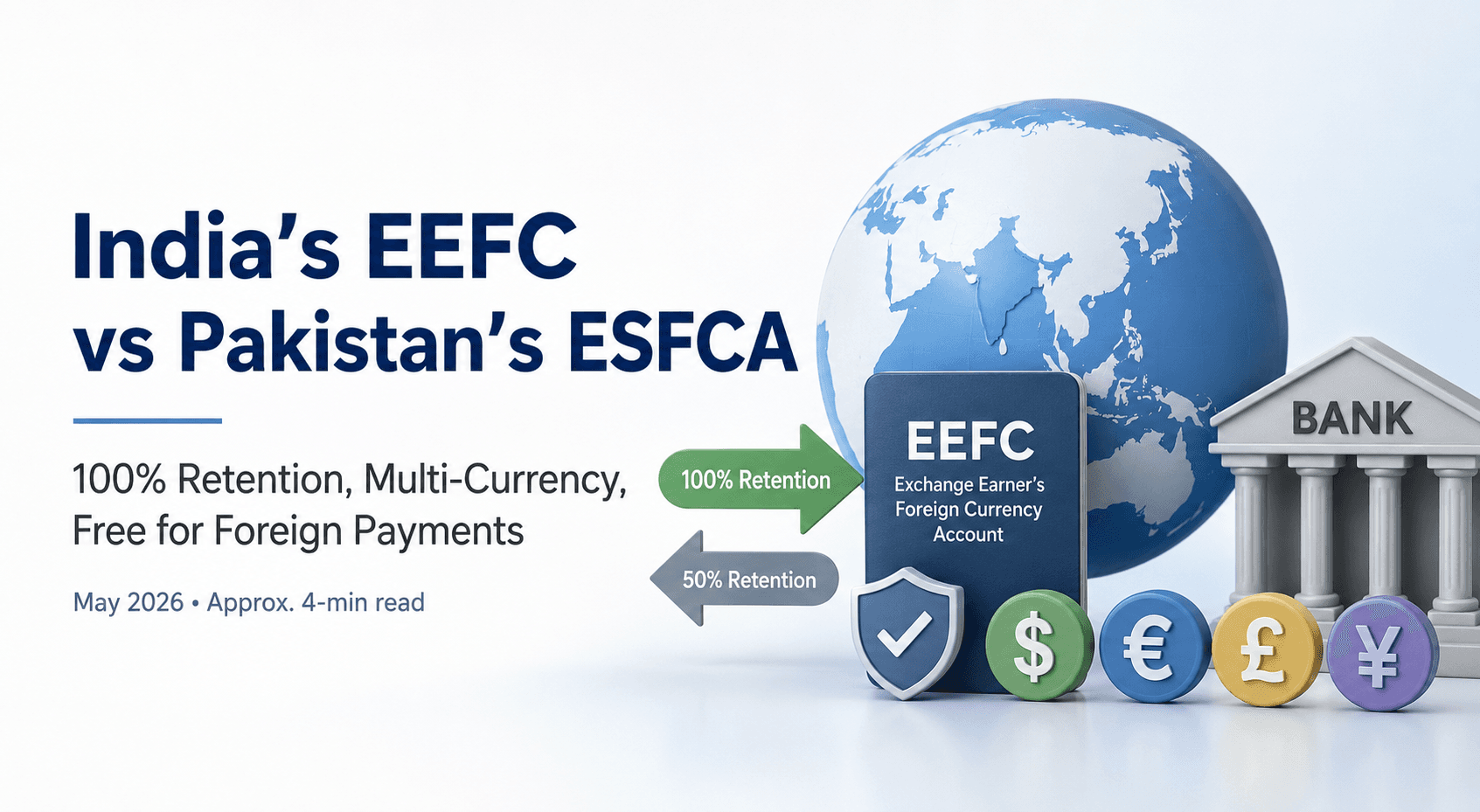
The Exchange Earner's Foreign Currency (EEFC) account is a Reserve Bank of India scheme that allows Indian exporters to credit up to 100 percent of their foreign exchange earnings to a foreign currency account in any major currency, with no compulsory conversion to Indian rupees. The retained funds can be used for foreign payments for imports, foreign travel, operational expenses abroad, and foreign investments. By contrast, Pakistani IT exporters under the ESFCA framework can retain only 50 percent of earnings, with the rest force-converted to PKR upon receipt, and cannot withdraw cash USD within Pakistan.
This is a Tier 3 long-tail spoke under India's liberalised foreign currency framework explained and parent pillar what India, Singapore, UAE, Malaysia and Bangladesh do that Pakistan refuses to.
EEFC vs Pakistani ESFCA
India EEFC Vs Pakistan Esfca
Feature | India EEFC | Pakistan ESFCA |
|---|---|---|
Maximum retention | 100% | 50% |
Forced PKR/INR conversion | None | 50% mandatory |
Cash currency withdrawal | Permitted | Prohibited |
Multi-currency holdings | USD, GBP, EUR, JPY | USD only |
Per-transaction approval | Not required | Required |
FATF compliance | Yes | Yes |
The EEFC framework is more liberal at every productive-class touch point. Both countries are FATF-compliant. The constraint that produces different outcomes is not international rules. It is domestic policy choice.
How EEFC works in practice
Indian exporters credit their foreign currency receipts to an EEFC account at any Authorised Dealer bank. The full receipt can be held as foreign currency (no compulsory conversion to INR). The funds can be deployed for:
Foreign payments for imports of goods and services
Foreign travel for business or personal purposes
Operational expenses abroad
Foreign investment within prescribed limits
Repayment of foreign currency loans
The Indian Liberalised Remittance Scheme (LRS) operates alongside the EEFC, allowing any Indian resident (not just exporters) to remit up to $250,000 per financial year for any permitted current or capital account transaction.
For more detail on the broader Indian framework, see India's liberalised foreign currency framework explained.
Frequently asked questions
What is India's EEFC account? The Exchange Earner's Foreign Currency account is an RBI scheme allowing Indian exporters to retain up to 100 percent of foreign exchange earnings in foreign currency, with no compulsory conversion to INR. The funds can be used for foreign payments, travel, operational expenses, and investments.
What is the maximum retention under EEFC? Up to 100 percent of declared foreign exchange earnings. The cap automatically grows with the business, allowing growing exporters to retain growing FCY balances.
Can EEFC holders withdraw cash foreign currency? Yes, for legitimate purposes including foreign travel. The framework permits cash withdrawal of foreign currency, unlike Pakistan's ESFCA which prohibits cash USD withdrawal within Pakistan.
How does EEFC compare to Pakistan's ESFCA? EEFC offers 100 percent retention versus ESFCA's 50 percent. EEFC permits cash withdrawal versus ESFCA's prohibition. EEFC supports multi-currency versus ESFCA's primary USD focus. EEFC has lower per-transaction friction.
Is EEFC FATF-compliant? Yes. India's EEFC framework operates alongside FATF compliance, demonstrating that productive-class FCY access and FATF rules are compatible. The compliance architecture (KYC, source verification, beneficial ownership, FIU-IND monitoring) is integrated into the operational design.
Could Pakistan adopt EEFC-style framework? Yes. The Productive Capital Account proposal is essentially an adaptation of the EEFC model for Pakistani conditions, with additional safeguards. PCA's 100 percent retention, multi-currency support, and elimination of FED/SST/advance tax mirror EEFC operational practice.
Sources
Reserve Bank of India, EEFC account guidelines
RBI Master Direction on Foreign Exchange Management
FATF mutual evaluation reports for India
Position Paper: The Foreign Currency Account Problem in Pakistan, May 2026



 ISN MEDIA