



How Much Does It Cost to Run Pakistan's Federal Government?
Rs 1,071 billion to operate the state, more than it spends on building the country
By the ISN Media desk • June 2026 • Approx. 4-min read
This is a short, factual answer about the cost of running Pakistan's federal government in the 2026-27 budget. The figures are Budget Estimates from the Government of Pakistan, in billions of rupees. For the full explainer, see the cost of governing.
How much does it cost to run Pakistan's federal government?
Running Pakistan's federal government, the line recorded as the running of civil government, costs about Rs 1,071 billion in 2026-27, an increase of about 10 percent on the year. That is more than the entire federal development programme of about Rs 1,000 billion, which was cut about 9 percent. So the state will spend more on operating itself than on the new assets, roads, dams, schools and hospitals, that it builds.
What the figure covers
The running of civil government covers the operating cost of the federal administration: the salaries and allowances of federal civil servants, the running of ministries and federal departments, and establishment costs. It is distinct from development, which funds new assets, and from large transfers such as pensions, subsidies and grants, which are counted separately.
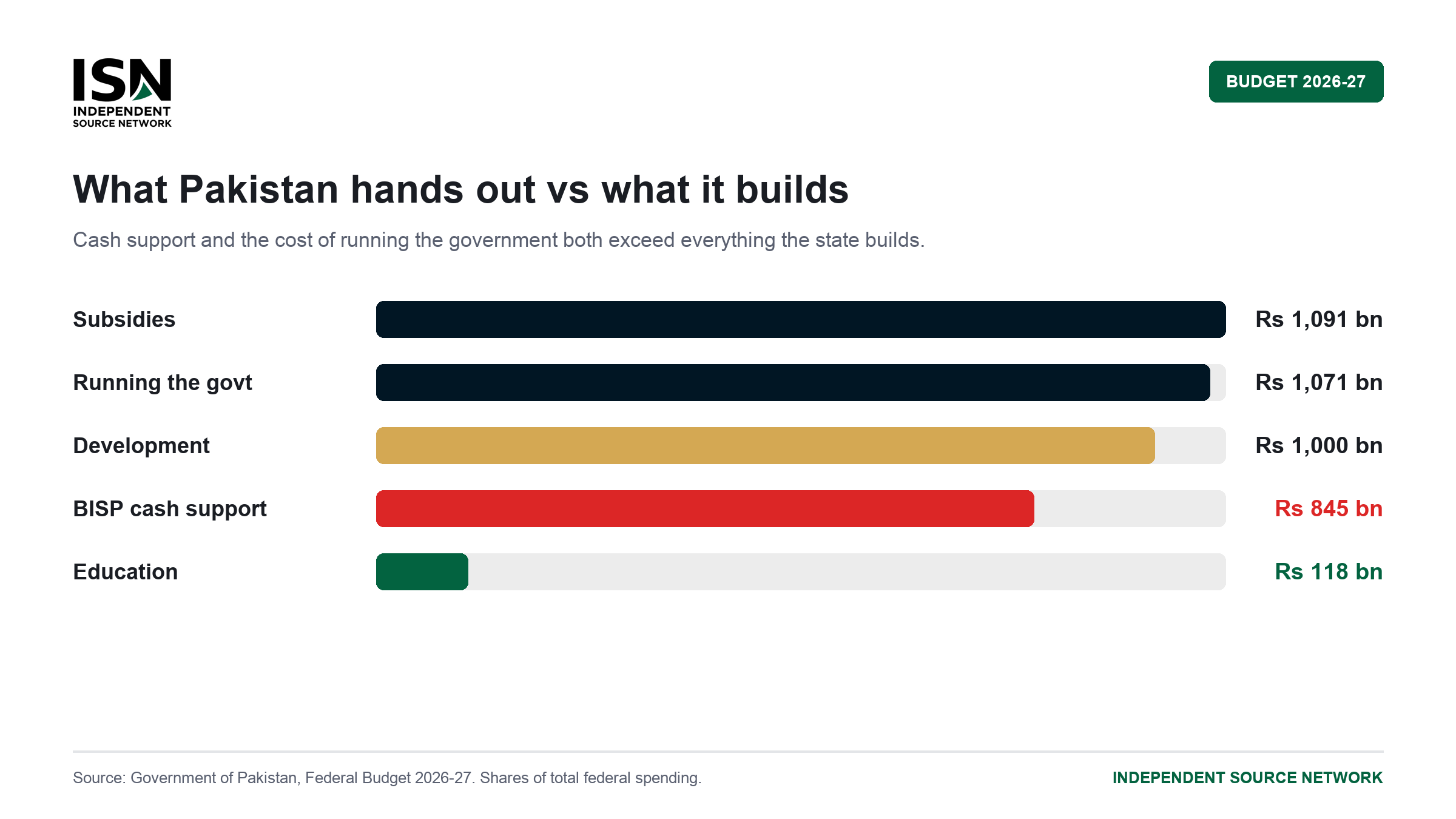
The cost of running the government, beside development and other transfers.
Why it draws scrutiny
Three facts make the line notable. First, administration now costs more than development, which economists treat as a warning sign when it persists. Second, running costs rose while development fell, so the gap is widening. Third, the eighteenth amendment devolved many functions to the provinces, yet the federation still maintains structures in some devolved areas, which critics cite as a reason central costs keep rising. A further concern is transparency: the line appears as a single block, so a reader cannot see which ministries account for the increase.
Frequently asked questions
How much does it cost to run Pakistan's federal government? About Rs 1,071 billion in 2026-27, up about 10 percent. This is more than the entire federal development programme of about Rs 1,000 billion, which was cut about 9 percent.
What does the running of civil government cover? The operating cost of the federal administration: salaries and allowances of civil servants, the running of ministries and departments, and establishment costs. It excludes development and transfers such as pensions.
Why is it significant that it exceeds development? Because it means the state spends more keeping itself running than on the new assets it builds, a pattern economists treat as a warning sign about the use of public resources.
Why did the cost of government rise while development fell? Running costs rose about 10 percent while development was cut about 9 percent to help contain the deficit. Fixed operating costs are harder to reduce than discretionary development spending.
What is the transparency concern? The line appears as a single large block, so a reader cannot see which ministries account for the rise, or how much is unavoidable pay inflation versus genuine expansion. A ministry-by-ministry breakdown is the common reform request.
Is the rise linked to the 18th amendment? Critics argue so: many functions were devolved to the provinces, yet the federation still maintains structures in some devolved areas, which they cite as a reason central government costs keep rising.
How does the cost of governing compare with the pension bill? The running of civil government is about Rs 1,071 billion, while federal pensions are counted separately at about Rs 1,169 billion. Together, pay and pensions are a large and growing claim on the budget that is difficult to reduce.
Sources and notes
- Government of Pakistan, Federal Budget 2026-27: running of civil government and development figures are Budget Estimates in billions of rupees, rounded for readability.
Related reading
- The full explainer: the cost of governing
- The 18th amendment explained, the development budget (PSDP), the pillar BISP, subsidies and the politics of cash support


 Admin
Admin