



What Is the New Carbon Levy in Pakistan?
A first-time charge in the 2026-27 budget, expected to raise about Rs 50 billion
By the ISN Media desk • June 2026 • Approx. 4-min read
This is a short, factual answer about the carbon levy introduced in Pakistan's 2026-27 budget. The figures are Budget Estimates from the Government of Pakistan, in billions of rupees. For the wider revenue picture, see how Pakistan raises its money.
What is the carbon levy in Pakistan?
The carbon levy is a charge introduced for the first time in Pakistan's 2026-27 budget, expected to raise about Rs 50 billion. It is classified as a non-tax revenue line, joining the petroleum levy on that side of the budget. A carbon levy is, in principle, a charge linked to the carbon content or emissions of fuels, intended both to raise revenue and to discourage high-emission consumption, though its design and scope in Pakistan's budget are modest in this first year.
Where it fits
At about Rs 50 billion, the carbon levy is one of the smallest revenue lines, far below the petroleum levy of about Rs 1,676 billion or income tax of about Rs 7,481 billion. Its significance in 2026-27 is less about the amount it raises than about its introduction: it is a new instrument, and a small first step toward the kind of carbon pricing that many countries use.
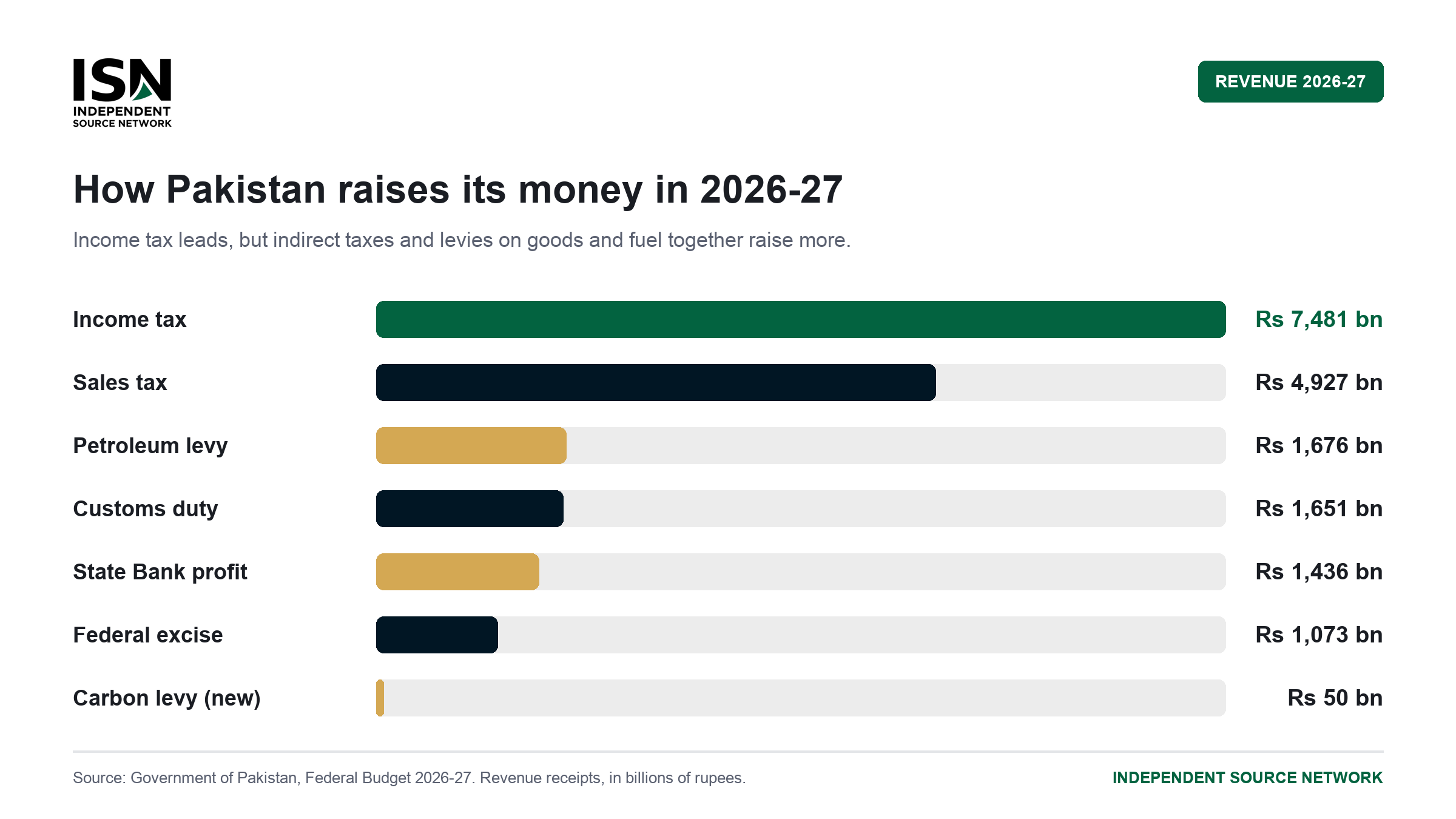
The carbon levy, the smallest of the main revenue lines, at the bottom of the chart.
Why introduce it now
Pakistan is among the countries most exposed to climate change, and a carbon levy aligns, at least in form, with international moves toward pricing emissions. It can also be presented to international lenders and climate-finance institutions as a step toward environmental policy. Whether it grows into a meaningful instrument, or remains a small line, will depend on future budgets. For context on Pakistan's climate position, see the environment gets one paisa.
Frequently asked questions
What is the carbon levy in Pakistan? A charge introduced for the first time in the 2026-27 budget, expected to raise about Rs 50 billion. It is a non-tax revenue line linked in principle to the carbon content of fuels.
How much will the carbon levy raise? About Rs 50 billion in 2026-27, one of the smallest revenue lines, far below the petroleum levy or income tax.
Why was the carbon levy introduced? Partly to raise revenue, partly to align with international moves toward pricing emissions, and partly as a signal of environmental policy to lenders and climate-finance institutions.
Is the carbon levy significant? Its significance in 2026-27 is more about its introduction than its size. It is a new instrument and a small first step toward carbon pricing.
Is it the same as the petroleum levy? No. The petroleum levy is a long-standing, much larger charge on fuel volume, raising about Rs 1,676 billion. The carbon levy is new and small, and is framed around emissions.
Is the carbon levy a tax? It is classified as a non-tax revenue line in the budget, alongside the petroleum levy, rather than as a tax collected by the Federal Board of Revenue.
Will the carbon levy grow in future budgets? That will depend on future policy. In 2026-27 it is a small first step at about Rs 50 billion; whether it expands into a meaningful carbon-pricing instrument remains to be seen.
Why does a climate-exposed country introduce only a small carbon levy? The modest first-year scope reflects the difficulty of adding charges in a period of high inflation and political sensitivity over fuel prices. Supporters see it as a foundation to build on; critics note it is small relative to Pakistan's climate exposure and its tiny dedicated environment budget.
Sources and notes
- Government of Pakistan, Federal Budget 2026-27: the carbon levy is a Budget Estimate of about Rs 50 billion. Figures rounded for readability.


 ISN MEDIA