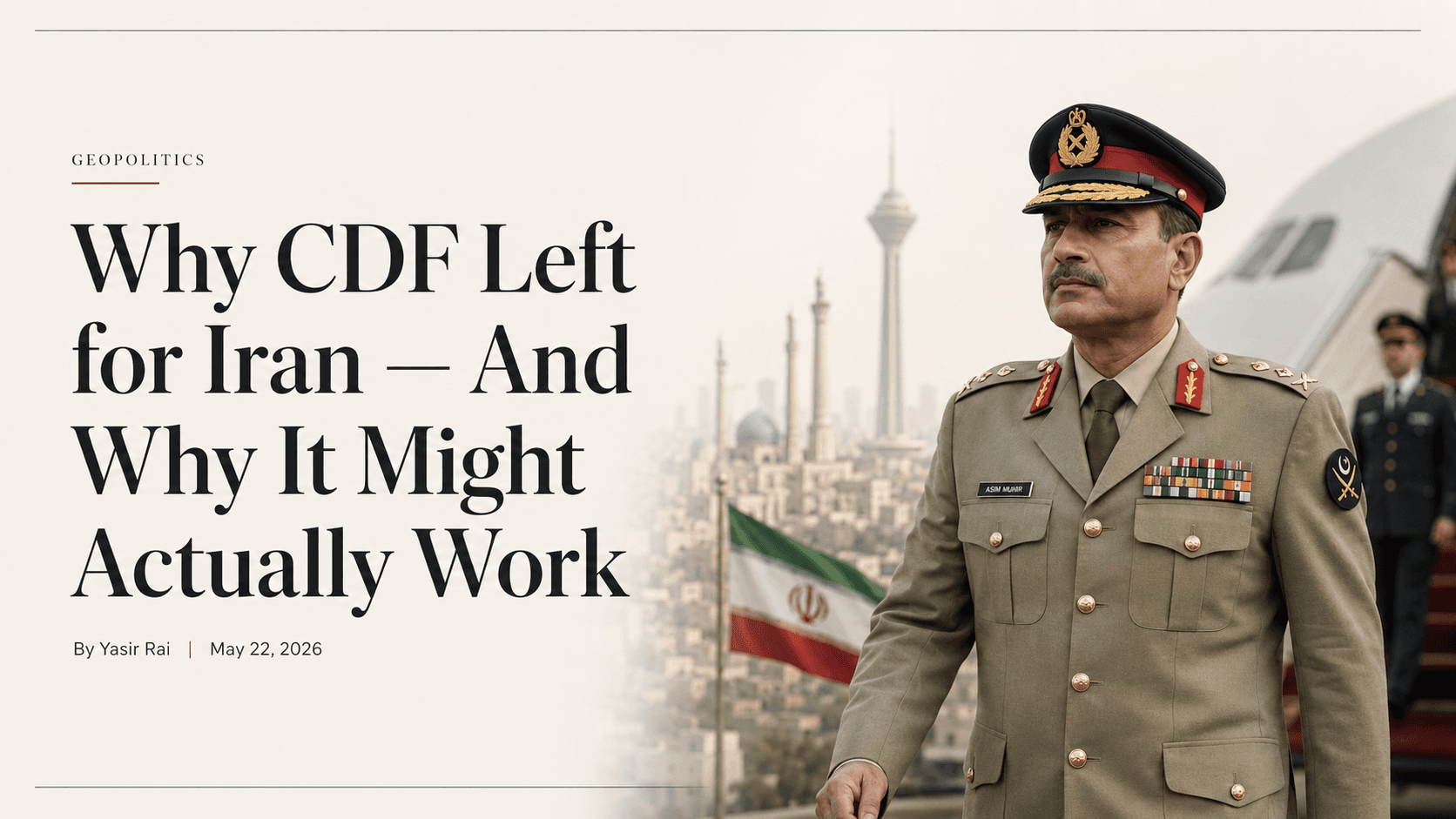
Why CDF has Left For Iran All of a Sudden— And Why It Might Actually Work
General Munir is in Tehran. Trump is threatening renewed strikes. China gave Washington words but not leverage. Here is the full geopolitical picture behind the most consequential diplomacy of 2026.
By Yasir Rai | May 22, 2026 | Geopolitics, Middle East, Pakistan Foreign Policy
On May 22, 2026, Pakistan's Army Chief General Asim Munir boarded a flight to Tehran on what U.S. Secretary of State Marco Rubio publicly called a 'final push' for a ceasefire deal. Hours earlier, President Donald Trump had warned that talks were on the 'borderline' between a negotiated peace and a second wave of American air strikes on Iran.
The question that has puzzled analysts across Washington, Beijing, and Riyadh is the same: why Pakistan? Why is a nuclear-armed South Asian country — one that has spent decades managing its own internal crises — now holding the most critical diplomatic brief of the post-Khamenei era?
The answer is not simple, and it reveals a great deal about how geopolitical power actually works in 2026: not through the largest economies or the most powerful militaries, but through personal relationships, geographic proximity, and the ability to give both sides a face-saving way out.
"Pakistan still matters because in this very specific keyhole moment — post-Trump-Xi rhetorical alignment, pre-Stage-2 negotiations, with Russia held in reserve and Europe locked out — Pakistan is the only country whose army chief Donald Trump trusts personally and the only one Iran will let through its door."
What Is Actually Happening: The Brute Facts
On February 28, 2026, the United States and Israel launched coordinated strikes on Iran, killing Supreme Leader Ali Khamenei and targeting Iranian military and nuclear infrastructure. A ceasefire followed on April 8, halting weeks of active war — but peace negotiations have repeatedly collapsed.
Iran accused Washington of 'excessive demands' when the two sides met in Islamabad in April for their only direct talks since the war began. Those talks failed. Now Pakistan is attempting a final push: a letter of intent that would formally end the war and open a 30-day window to negotiate the harder questions, including Iran's nuclear program, sanctions architecture, and the future of the Islamic Revolutionary Guard Corps.
That is the immediate picture. But to understand why it matters, you have to understand the layers beneath it.
The Four-Part Test: Why Pakistan Fits a Keyhole No Other Country Can Fill
Mediation in a conflict of this scale and sensitivity requires four things simultaneously. Almost no country on earth has all four. Pakistan, improbably, does.
1. Trusted by Both Tehran and Washington
China is too closely aligned with Iran for the Trump administration's comfort. Russia is viewed as Iran's protector and remains mired in Ukraine. Israel will not accept Qatar as a mediator after Gaza. Turkey has burned its bridges with Israel. That leaves a very short list of countries Iran will talk to and Washington will work through simultaneously.
Pakistan sits on that list — not because it is neutral in the ideological sense, but because it has actively cultivated relationships on both sides of this conflict.
2. A Leader Trump Personally Likes — and Cultivated
This dimension is underrated and possibly decisive. Over the past year, Pakistan has nominated Trump for the Nobel Peace Prize, joined his Board of Peace initiative, and launched a cryptocurrency collaboration linked to World Liberty Financial, a Trump family-associated venture. Munir secured something no Pakistani military chief had previously achieved: a one-on-one lunch at the White House.
Trump runs foreign policy through personal chemistry. Munir spent two years engineering that chemistry, and is now spending it in Tehran.
3. Real Leverage With Iran
Pakistan shares a 900-kilometer border with Iran. It has deep cross-cutting Shia-Sunni religious ties with the Iranian establishment. And crucially, it is a nuclear-armed state that Iran respects as a peer in ways it does not respect Western intermediaries.
When Pakistan tells Tehran that the next American strike is coming unless an agreement is signed, it carries a different weight than the same warning delivered by a U.S. envoy.
There is also a harder piece of evidence for why Iran trusts Munir specifically. CBS News reported that Pakistan allowed Iranian military aircraft to park on its airfields during the war, protecting them from U.S. air strikes. Islamabad framed this as logistics support for ceasefire talks — hosting aircraft from both sides. Whether one reads this as treachery toward Washington or skillful dual-sided positioning, it is precisely why Iran trusts Pakistan's army chief enough to let him through its door today.
4. Plausible Deniability for Both Sides
Iran cannot be seen capitulating to Washington. Washington cannot be seen begging Tehran. A Pakistani field marshal walking sealed messages between capitals gives both governments a story to tell their domestic audiences: we did not negotiate with the enemy; a third party negotiated on our behalf.
China and Russia each fail at least two of these four tests. That is why Pakistan — not despite being smaller than either, but because of the specific combination of assets it brings — has become the operational fulcrum of this diplomacy.
The Trump-Xi Summit: What Beijing Gave Washington — and What It Didn't
The May 14-15 Trump-Xi summit in Geneva produced two outcomes that look different depending on your vantage point.
What was important: China publicly agreed that Iran can never possess a nuclear weapon. That is Beijing aligning itself with Washington's core red line — a significant diplomatic signal.
What was underwhelming: the summit ended without any substantive agreements on operational pressure. Xi did not commit to pressing Iran to reopen the Strait of Hormuz. China gave Trump rhetorical cover, not leverage.
China gave Trump the words. Pakistan has to deliver the deal.
The sequencing of the days that followed is not coincidental:
• May 14-15: Trump-Xi summit produces rhetorical alignment on Iranian nukes
• Following week: Lower-level US-Iran exchanges intensify
• May 21: Trump publicly issues 'borderline' ultimatum on renewed strikes
• May 22: Munir departs for Tehran
This is a coordinated diplomatic squeeze, not a series of unrelated events. Beijing's public endorsement of the 'no Iranian nukes' position gave Trump domestic cover to threaten. Pakistan's relationship gives Iran a face-saving channel to accept those terms without appearing to fold to Washington.
Notably, China is also reportedly encouraging Pakistan to assume the mediating role. Pakistan is not only America's operational tool here — it is a channel acceptable to Beijing, which is part of why Iran trusts it. When all major powers are pointing at the same door, it tends to open.
Where Is Russia? The Most Underestimated Player in This Crisis
Russia's absence from the front lines of this negotiation is not an accident. It is strategy.
Moscow's calculation is that military non-intervention preserves its role as a regional mediator while the conflict depletes U.S. resources and redirects Western attention away from Ukraine. Russia benefits from prolonged instability in the Middle East: energy prices rise, American attention fragments, and Moscow's leverage as the eventual 'adult in the room' grows.
Russia did meet with Iran's foreign minister in late April, and Moscow has pledged to assist Washington in managing Iran's nuclear program. But Russia is playing a longer game than Pakistan. Pakistan wants the war to end now — refugees, oil prices, and border instability are immediate problems. Russia wants the war to end on terms that are favorable to a Russia-Iran axis, and is willing to wait.
Why Isn't the U.S. Leaning on Russia Harder?
Three reasons, all politically structural. First, Trump cannot be seen relying on Putin while Ukraine remains unresolved — the domestic political cost is prohibitive. Second, Russia's price for helping with Iran would be Ukraine concessions, and Trump is not yet positioned to deliver those. Third, while Russia's leverage with Iran is real, it is limited — the 2025 strategic partnership between Moscow and Tehran is not a mutual defense pact, and neither side was ever willing to bleed for the other.
Russia is therefore being kept as a backup channel. It is useful later, particularly for the enforcement phase of any deal: custody of enriched uranium, international monitoring architecture, sanctions relief sequencing. Washington is not exhausting the Russia option — it is holding it in reserve.
The Two-Stage Design: What Is Actually Being Negotiated
Understanding what Pakistan is trying to deliver tonight requires understanding the structure of the deal being sought. There are two stages, and they require different coalitions.
Stage 1 — Stop the Shooting (Pakistan's Brief)
The immediate deliverable is a letter of intent: a formal agreement to end hostilities, plus a commitment to 30 days of substantive negotiations. Both sides can claim victory. Iran gets relief from the threat of renewed strikes. The United States gets a frozen Iran without having to choose between escalation and retreat. Pakistan gets to present itself as the country that ended the first major U.S.-Iran war.
Stage 2 — The Hard Questions (Requires a Broader Coalition)
The next 30 days, if Stage 1 succeeds, will require negotiating the substance: what happens to Iran's enriched uranium stockpile, who monitors compliance, how the sanctions architecture is reformed, what role the IRGC plays in the post-war Iranian state, and how the Strait of Hormuz returns to normal transit.
Pakistan cannot deliver Stage 2 alone. Russia, China, Gulf states — Saudi Arabia, Qatar, Egypt — and probably Turkey will all want seats at that table. Stage 2 is where the real geopolitical negotiation happens. But it can only happen if Stage 1 succeeds first.
This is why Munir's trip tonight matters so much: it is not about solving the nuclear question. It is about buying enough of a pause that the nuclear question can be addressed at all.
Four Scenarios: What Happens in the Next 72 Hours
Scenario A: The Deal Lands (~40% Probability)
Munir delivers a softened U.S. position — likely on sanctions relief timelines or enrichment verification procedures. Iran signs the letter of intent. The ceasefire hardens into a formal pause. Thirty days of harder negotiations begin, with Russia and Saudi Arabia joining the table. Pakistan's regional standing surges. Trump claims a Nobel-worthy diplomatic victory. The Iranian regime survives but enters a long monitoring-and-sanctions regime.
Scenario B: Talks Stall, No Immediate Strike (~30% Probability)
Iran reviews but does not sign — and does not formally refuse. Trump's 'borderline' rhetoric continues. Qatar and Oman become more visibly involved in the mediation. A cold-war phase of periodic flare-ups and sporadic diplomacy stretches into the summer. Oil prices remain elevated. No one wins.
Scenario C: Iran Refuses, U.S. Strikes Again (~20% Probability)
This is the scenario Trump signaled when he said 'if we don't get the right answers, it goes very quickly. We're all ready to go.' Pakistan's mediation collapses publicly. Russia steps forward as the only remaining channel, because China will not and Europe cannot. Oil spikes. This is the scenario Vladimir Putin is quietly hoping for — it elevates Moscow's indispensability and validates the reserve strategy.
Scenario D: Internal Iranian Fracture (~10% Probability)
Khamenei is dead. The current Iranian leadership is less consolidated than it appears. If IRGC hardliners override the diplomatic faction before Munir can close a deal, he comes home empty-handed — and Iran enters the next round of negotiations more internally divided, less coherent, and less capable of honoring any agreement it signs. This is the most dangerous scenario: not because Iran refuses, but because there may not be a unified Iran capable of agreeing.
The Deeper Pattern: What This Moment Actually Reveals
Strip away the news cycle and a structural shift becomes visible.
The post-1979 American playbook on Iran — sanctions, containment, hope for regime change — ended on February 28, 2026, when the United States chose kinetic strikes over continued diplomacy. Everything since is the world feeling its way toward a new equilibrium: one where Iran has been militarily defeated but not regime-changed, where China has publicly signed onto the 'no Iranian nukes' principle, and where any lasting settlement requires Muslim-world legitimacy that Washington cannot supply for itself.
The coalition delivering that legitimacy looks like this:
• Pakistan: operational mediation and Muslim-world legitimacy
• China: great-power rhetorical cover and economic backstop
• Russia: held in reserve for enforcement architecture
• Gulf states (Saudi Arabia, Qatar, Egypt): financial and regional buy-in
• Turkey: sidelined by its unresolved feud with Israel
What is absent from that list is equally revealing: Europe, international institutions, and any multilateral framework. This is bilateral diplomacy conducted through a chain of personal relationships, moving faster and less transparently than the international community is comfortable with.
The Bottom Line
Did Trump specifically ask Munir to fly to Tehran? Almost certainly yes — or he signaled clearly that it would be welcome. When a U.S. Secretary of State publicly announces another country's army chief's travel itinerary — as Rubio did when he said 'I believe the Pakistanis will be travelling to Tehran today, so hopefully that'll advance this further' — that is not coincidence. That is coordination.
General Munir is in Tehran today because he spent two years positioning Pakistan at exactly this intersection: trusted by a mercurial American president who responds to personal relationships, respected by an Iranian leadership that needs a face-saving exit, acceptable to a Chinese government that wants the war to end without losing influence, and geographically and religiously rooted in the neighborhood in ways no outside power can replicate.
It is a freakishly rare combination. And for the next 72 hours, the trajectory of one of the most consequential conflicts of the decade runs through it.


 Yasir Rai