



Why Did Bank Borrowing Double in the 2026-27 Budget?
Planned borrowing from domestic banks rose about 104 percent to Rs 4,012 billion
By the ISN Media desk • June 2026 • Approx. 5-min read
This is a short, factual answer about the sharp rise in bank borrowing in Pakistan's 2026-27 budget. The figures are Budget Estimates from the Government of Pakistan, in billions of rupees. For the full analysis, see bank borrowing doubled, the 103 percent jump.
Why did Pakistan's bank borrowing double in 2026-27?
Planned bank borrowing in Pakistan's 2026-27 budget rose about 104 percent, from Rs 1,971 billion to Rs 4,012 billion, because the federal government plans to spend far more than the revenue it keeps after paying the provinces, and it fills the gap by borrowing, increasingly from domestic banks. The centre retains about Rs 11,751 billion of its own revenue while its current spending alone is about Rs 17,495 billion, so the difference must be financed.
The gap that has to be filled
A budget deficit is the amount a government must borrow to cover the difference between what it spends and what it raises. For Pakistan this gap is large, mainly because interest alone claims about two-thirds of the centre's retained revenue before any service is funded. The government meets the gap from several sources, but a rising share now comes from the domestic banking system, which is why the bank-borrowing line nearly doubled.
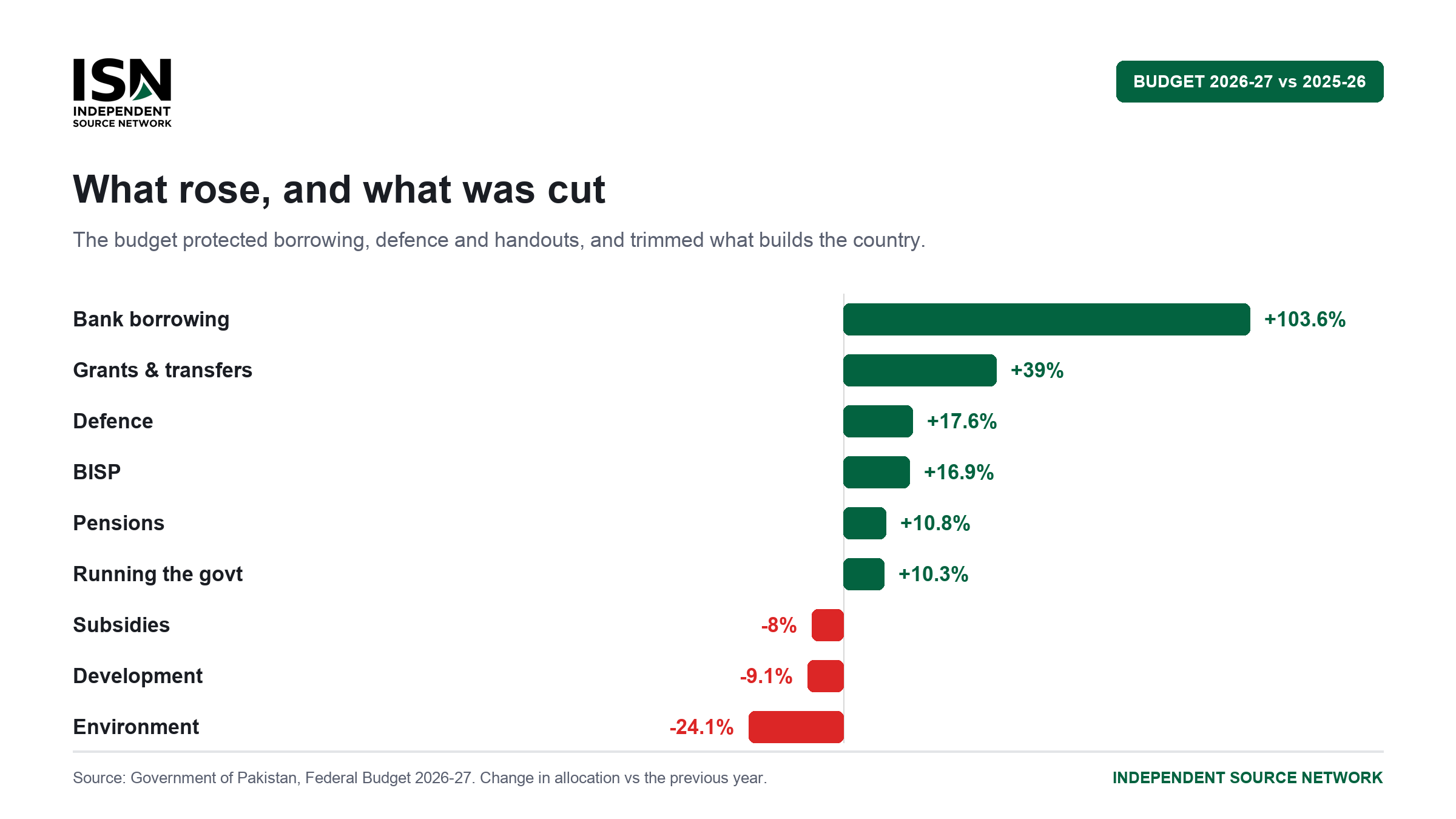
Bank borrowing rose more than any other line, year on year.
What it means for the economy
A large rise in government bank borrowing tends to keep interest rates high, because the state competes for the available pool of savings and credit. It also crowds out private credit: banks that can earn a safe return lending to the government have less incentive to lend to businesses, and tend to charge them more. And it adds to the debt stock, which raises next year's interest bill and widens next year's gap.
Why it is a recurring pattern
Heavy reliance on bank borrowing is not a one-year event. As long as the gap between what the centre keeps and what it spends remains large, driven mainly by the interest bill, the government must keep borrowing to fill it. Reducing that reliance depends on narrowing the gap, through higher revenue, lower interest costs or a larger primary surplus, none of which works quickly.
Frequently asked questions
Why did Pakistan's bank borrowing double in 2026-27? Because the government plans to spend far more than the revenue it keeps after paying the provinces, and fills the gap by borrowing, increasingly from domestic banks. The line rose from Rs 1,971 billion to Rs 4,012 billion.
What is bank borrowing in the budget? It is the amount the government plans to raise from commercial banks to finance its deficit, by selling them treasury bills and bonds.
How does heavy bank borrowing affect the economy? It tends to keep interest rates high, crowds out credit for private businesses, and adds to the debt stock, which raises future interest costs.
Is this a one-off rise? No. Heavy reliance on bank borrowing persists as long as the gap the government must finance remains large, driven mainly by the interest bill.
What would reduce bank borrowing? Narrowing the gap it finances, through higher revenue, lower interest costs or a larger primary surplus, none of which works quickly.
Where else does the government borrow? From external lenders such as the IMF and World Bank, through international bonds, and from non-bank domestic sources such as the National Savings Schemes.
Does heavy bank borrowing affect inflation? It can, particularly when borrowing is ultimately financed by creating new money, which adds to the money supply. Even when financed from existing savings, it tends to keep interest rates high, which is its more direct effect.
Sources and notes
- Government of Pakistan, Federal Budget 2026-27: bank borrowing figures are Budget Estimates in billions of rupees, rounded for readability.


 ISN MEDIA