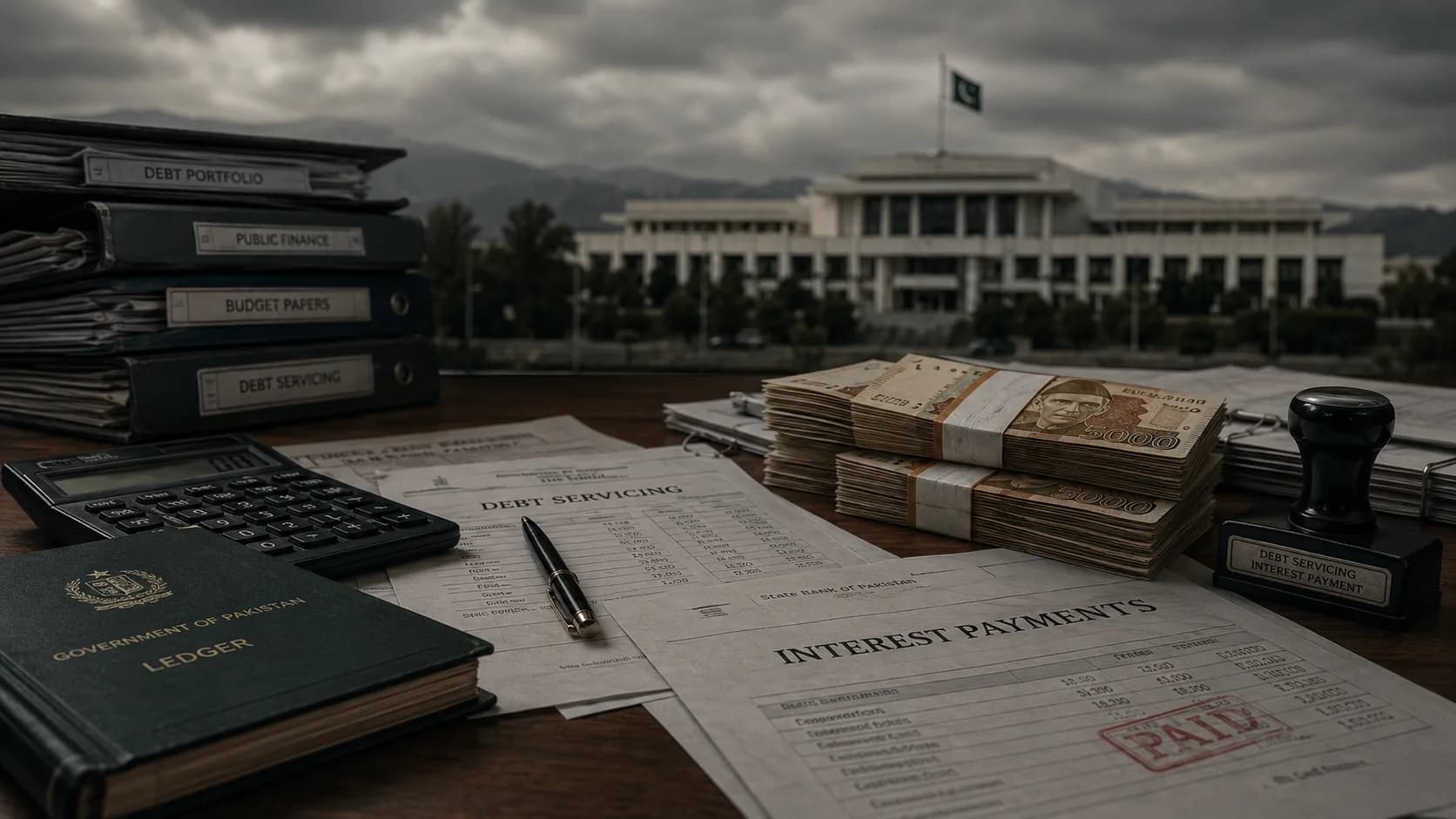
Pakistan's two laws say opposite things, and the elite has spent thirty-three years using the gap
By Asad Baig · Lahore · May 2026 · Approx. 10-min read
What this cluster post is part of
This is one of four cluster posts under my position on Pakistan's foreign currency account problem. The companion posts are the importer-exporter asymmetry: my position, why I refuse the "money laundering" excuse, and why the productive class must organise.
This post focuses on the specific legal contradiction at the heart of Pakistan's FCY framework. Two laws. Opposite requirements. Thirty-three years of operational coexistence. A 2018 academic legal analysis concluded the contradiction defeats the very objective of one of the laws.
The contradiction in one paragraph
Pakistan maintains the Anti-Money Laundering Act 2010 alongside the Protection of Economic Reforms Act 1992. The AMLA requires source verification, beneficial ownership disclosure, and suspicious transaction reporting. The PERA Section 5 explicitly prohibits inquiry into the source of foreign currency deposits. Section 111(4) of the Income Tax Ordinance makes inward remittances tax-immune regardless of source. Together, these provisions create a legal corridor through which Pakistani black money has been laundered for thirty-three years. A 2018 legal analysis published in Pakistani academic journals concluded that "the objective of the AMLA to prevent money laundering is clearly defeated with the existing provisions of the PERA contained in sections 4, 5, and 9 of the PERA". This is not interpretation. This is published legal analysis.
The two laws side by side
The Legal Contradiction
Anti-Money Laundering Act 2010 | Protection of Economic Reforms Act 1992 |
|---|---|
Requires source-of-funds | Section 5 prohibits |
verification | source inquiry |
──────────────────────────────────┼── | ──────────────────────── |
Requires beneficial ownership | Banking secrecy |
disclosure | guaranteed |
──────────────────────────────────┼── | ──────────────────────── |
Suspicious transaction reporting | Statutory protection from |
mandatory | future government interference (Sec. 9) |
──────────────────────────────────┼── | ──────────────────────── |
Penalties for non-compliance | Section 4: free movement of foreign exchange |
The two laws are operating in the same Pakistani legal system in 2026. They have not been reconciled in 16 years since AMLA was passed and 34 years since PERA was passed. The gap between them is the legal corridor through which elite wealth has moved.
How the gap works in practice
The gap operates through a sequence that has been documented across multiple investigations and academic analyses. The mechanism:
The Round-trip Mechanism
Step 1 | Domestic black money in PKR (industrialist) |
|---|---|
Step 2 | Convert to USD via PERA-permitted FCY account |
Step 3 | Wire offshore (Dubai, London, Singapore) |
Step 4 | Park in foreign assets (property, accounts) |
Step 5 | Send some back as "remittance" via formal banking |
Step 6 | Section 111(4) tax immunity applies |
Step 7 | PERA Section 5 prohibits source inquiry |
Step 8 | AMLA "violated" but not enforceable due to PERA |
Step 9 | Money is now legally documented, tax-immune |
Step 10 | Counted as remittance/FDI in Pakistani statistics |
The same money may be counted multiple times in Pakistani statistics: as an FCY deposit, as a remittance, sometimes as FDI when routed through Dubai shell companies. The 2020 SRO from the federal government partially closed the original PKR-to-USD conversion pipeline. Section 111(4) tax immunity remained intact. PERA Section 5 remained intact.
What the regulators say
In October 2013, then-State Bank of Pakistan Governor Yaseen Anwar publicly stated that over $9 billion is illegally remitted outside Pakistan annually. This figure, announced by Pakistan's own central bank governor, has become the standard reference point for capital flight estimates.
A 2018 tax compliance analysis estimated that approximately one-fifth of $19 billion in annual Pakistani remittances, or roughly $3.8 billion a year, is domestically generated black money being whitewashed under Section 111(4). These are figures from Pakistani sources. The State Bank's own governor said one of them on the record.
The implication of these figures is straightforward. The legal corridor produced by the AML-PERA-111(4) contradiction has been moving billions of dollars annually for decades. The flow is not theoretical. It is operational, documented, and substantial.
The hypocrisy
This is the part that, when I first understood it, made me angriest.
The same government that maintains this legal corridor for elite black money laundering simultaneously cites "money laundering concerns" as the reason it refuses to let an IT entrepreneur with PSEB registration, tax filer status, and a documented foreign client invoice hold his own legitimately earned dollars in a Pakistani bank account.
The laundering happens through elite channels that remain protected. The restrictions fall on productive citizens who have nothing to launder. This is what I mean by hypocrisy. It is not a strong word in this context. It is the precise description.
When a regulator tells me that source verification, KYC, and tax filer linkage are necessary for me to hold my own foreign earnings, I do not disagree with the principle. I support source verification. I support KYC. I am a tax filer. I have nothing to hide. What I object to is being asked to undergo verification that the actual money launderers are, by statute, exempted from.
THE TEST FOR HYPOCRISY
If a regulator cites money laundering concerns to deny productive earners FCY access, ask the regulator: do you also support repealing PERA Section 5 and Section 111(4), the two provisions that protect actual large-scale money laundering channels? If the answer is "yes, those should be repealed", then the concern is genuine. If the answer is "those are different", then the concern is hypocritical.
What honest reform would do
The Productive Capital Account proposal directly addresses this contradiction. The PCA framework requires source verification more strictly than the current PERA framework. Every deposit must arrive with documentation: wire transfer record, foreign client invoice, platform earnings statement, foreign employer payslip. FATF-compliant. Mandatory. No exceptions.
The PCA does not weaken anti-money-laundering controls. It applies them honestly to the people who can be verified, while withdrawing the elite's special exemptions from them.
If the reaction to this reform from the people currently citing "money laundering" turns out to be opposition, you will have learned everything you need to know about whose interests the current framework actually protects.
For the broader anti-laundering case, see why I refuse the "money laundering" excuse. For the operational mechanics of the round-trip, see Section 111(4) of the Income Tax Ordinance: the whitewashing mechanism.
In closing
A country that is serious about preventing money laundering passes laws that work together. A country that is not serious passes laws that contradict each other and lets the contradiction decide who gets caught and who walks. Pakistan has the second kind of system, by design.
The contradiction is fixable. PERA Section 5 can be repealed. Section 111(4) can be revised to require source documentation rather than blanket immunity. AMLA enforcement can be applied uniformly to all account holders, including those currently exempted by elite-protective provisions.
What is missing is not the legal solution. The legal solution is technical and well-known. What is missing is the political will to apply the solution to the people who currently benefit from the contradiction.
That political will, as I have argued elsewhere, has to come from the productive class organising itself.
Thank you for reading.
, Asad Baig, Lahore, May 2026
Frequently asked questions
What is the AML-PERA contradiction in Pakistani law? The Anti-Money Laundering Act 2010 requires source-of-funds verification and beneficial ownership disclosure. PERA Section 5 explicitly prohibits inquiry into the source of foreign currency deposits. Section 111(4) of the Income Tax Ordinance makes inward remittances tax-immune. The three provisions operate simultaneously despite directly contradicting each other.
What did PERA Section 5 do? PERA Section 5, passed in 1992, granted complete immunity from source-of-funds inquiry for foreign currency account holders, tax immunity covering income tax and wealth tax, and banking secrecy guarantees. These provisions enabled large-scale legalised money laundering through PKR-to-USD round-tripping during the 1991-1998 PERA era.
What is Section 111(4) of the Income Tax Ordinance? Section 111(4) grants tax immunity to inward foreign remittances regardless of source. Combined with PERA Section 5's prohibition on source inquiry, it creates a legal corridor for whitewashing domestically generated black money through offshore round-tripping. A 2018 tax compliance analysis estimated approximately $3.8 billion a year is whitewashed through this mechanism.
Who said $9 billion leaves Pakistan illegally each year? SBP Governor Yaseen Anwar stated in October 2013 that over $9 billion is illegally remitted outside Pakistan annually. The figure has become the standard reference point for capital flight estimates and has been broadly consistent with subsequent OCCRP and Atlas of Offshore World investigations.
Did the 2020 SRO close the AML-PERA contradiction? Partially. The 2020 SRO from the federal government, issued under FATF pressure, ended the rupee-to-dollar conversion pipeline that had been the most damaging mechanism. Foreign currency accounts can now only be credited with remittances received from abroad through banking channels (except export proceeds). However, PERA Section 5 and Section 111(4) tax immunity remain intact.
How does the Productive Capital Account address this contradiction? The PCA framework requires source verification on every deposit, exceeding both AMLA requirements and current PERA practice. PERA Section 5 would be repealed for PCA purposes. Section 111(4) would be revised to require source documentation rather than blanket immunity. The PCA applies anti-money-laundering controls honestly to all account holders.
What does the 2018 legal analysis say? A 2018 academic legal analysis published in Pakistani journals concluded: "The objective of the AMLA to prevent money laundering is clearly defeated with the existing provisions of the PERA contained in sections 4, 5, and 9 of the PERA." This is published legal analysis, not interpretation, that the contradiction structurally undermines anti-money-laundering enforcement.
Sources
Anti-Money Laundering Act 2010
Protection of Economic Reforms Act 1992, Sections 4, 5, and 9
Income Tax Ordinance, Section 111(4)
Yaseen Anwar, Governor State Bank of Pakistan, statement on illegal remittances (October 2013)
2018 academic legal analysis of the AMLA-PERA contradiction (Pakistani academic journals)
2018 tax compliance analysis on Section 111(4) whitewashing
Federal government FCY rules issued by Ministry of Finance (2020 SRO)
Position Paper: The Foreign Currency Account Problem in Pakistan, May 2026, Section 2



 ISN MEDIA