



The Rs. 2,640 billion problem nobody can fully explain in one sentence, explained in five minutes
By Asad Baig · Lahore · April 2026 · Approx. 5-min read
Circular debt in one paragraph
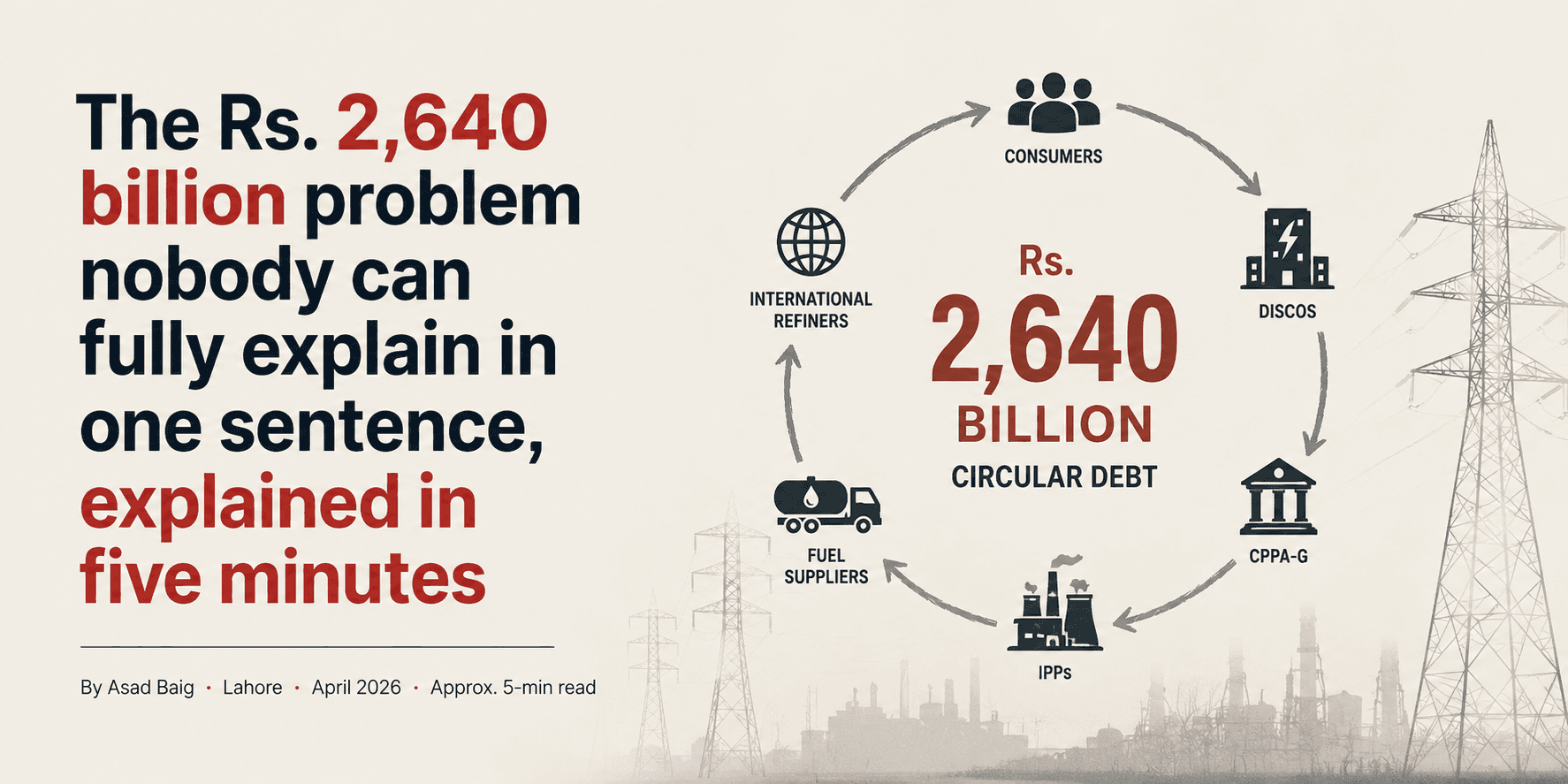
Circular debt is the amount of money owed by Pakistan's power sector to itself, in a chain that nobody can fully break. Distribution companies (DISCOs) cannot collect enough from consumers to pay the Central Power Purchasing Agency (CPPA-G) the full amount they owe. CPPA-G cannot pay the IPPs the full amount they are owed. The IPPs cannot pay the fuel suppliers the full amount they are owed. The chain of unpaid obligations grows. Today it is approximately Rs. 2,640 billion. In 1994 it did not exist.
That is circular debt, in one paragraph. The rest of this article unpacks why it is so hard to solve.
Why the debt is "circular"
It is called circular because every entity in the chain owes money to the entity above it and is owed money by the entity below it.
Consumers owe money to DISCOs (uncollected bills, theft, technical losses)
DISCOs owe money to CPPA-G (because they did not collect enough from consumers)
CPPA-G owes money to IPPs (because DISCOs did not pay it enough)
IPPs owe money to fuel suppliers (because CPPA-G did not pay them enough)
Fuel suppliers owe money to international refiners (because IPPs did not pay them enough)
And around it goes
Each entity is, in some sense, both a debtor and a creditor. Each is waiting to be paid before it can pay the next link in the chain. Each has unpaid bills that are not being addressed.
How big is it
The headline figure as of recent estimates is approximately Rs. 2,640 billion. That is more than Pakistan's annual federal defence budget. It is roughly 4 percent of Pakistan's GDP.
The figure has grown from essentially zero in 1994. The growth is not linear. It accelerates whenever IPP capacity payments rise faster than DISCO collection rates, which is essentially every year.
The Pakistani government has periodically settled portions of the circular debt through cash payments and bond issuances. The 2021 settlement, for example, included Rs. 23.2 billion to HUBCO alone, divided into cash, 5-year bonds, and 10-year bonds. I have written about that settlement at The Dawood Story: HUBCO, Engro, and the Thar Coal Plants.
These settlements reduce the headline circular debt figure temporarily. They do not solve the underlying problem. The chain of obligations resumes accumulating immediately after each settlement.
Why it keeps growing
Three structural reasons.
One. IPP capacity payments are fixed by contract. Approximately Rs. 2 trillion per year is owed regardless of consumption. CPPA-G must pay this whether or not it can collect the equivalent from DISCOs.
Two. DISCO collection rates are below 100 percent. Some Pakistani consumers do not pay their bills. Some bills are challenged. Some are written off. Technical losses (electricity that disappears in transmission and distribution) and commercial losses (theft, billing errors) compound the gap.
Three. The tariff structure is politically constrained. When tariffs would otherwise need to rise to fully fund the chain, governments often hold them down for political reasons. The shortfall flows into circular debt rather than into consumer bills.
The combination produces a structural deficit that grows every year. No government in thirty years has been able to halt the growth, let alone reverse it.
WHY THIS MATTERS
Circular debt is not the cause of Pakistan's electricity crisis. It is a symptom of the cause. The cause is the IPP capacity payments that exceed what Pakistani consumers can sustainably afford. As long as the underlying capacity payment structure remains in place, circular debt will continue growing regardless of any intermediate "settlements."
Why it cannot be solved without confronting the IPP contracts
The standard policy response to circular debt has been to issue bonds, raise tariffs, and pursue DISCO collection improvements. None of these have worked at the scale needed.
Bond issuances transfer the debt to the federal government balance sheet but do not eliminate it. Future taxpayers pay through general revenues. The IPP capacity payments continue. The cycle restarts.
Tariff increases transfer more of the burden to consumers but compound the affordability crisis that produced the problem. Higher tariffs accelerate the solar exodus and the closure of price-sensitive industries (textiles), reducing the consumer base further. The cycle accelerates.
DISCO collection improvements work at the margin. They do not change the gap between Rs. 2 trillion in IPP obligations and what consumers can sustainably pay.
The only structural solution is to reduce the IPP capacity payments themselves. This requires conversion from take-or-pay to take-and-pay, forensic recovery of excess profits, renegotiation of CPEC IPP terms, and the broader reform agenda I outline in my pillar on the IPP system.
Without that, circular debt will continue growing. With it, the cycle becomes manageable.
What you should take away
Two things.
Circular debt is a symptom, not the disease. The disease is the structural mismatch between IPP contractual obligations and consumer affordability. Treating the symptom with bond issuances and tariff increases does not cure the disease.
The cure requires structural IPP reform. Without conversion of take-or-pay contracts and recovery of excess profits, no policy intervention on circular debt will produce lasting results. Every "settlement" is a temporary pause in an ongoing accumulation.
Now you know what circular debt is. Pass it on.
Thank you for reading.
, Asad Baig, Lahore, April 2026
Frequently asked questions
What is the current circular debt in Pakistan? Approximately Rs. 2,640 billion as of recent estimates. The figure grows annually as IPP capacity payment obligations exceed DISCO collection rates.
Did circular debt exist before 1994? No. Pakistan's circular debt grew from essentially zero in 1994 to current levels following the 1994 Power Policy and its successors. The capacity payment structure introduced in 1994 is the underlying driver.
How is circular debt different from regular government debt? Regular government debt is owed by the federal government to bondholders or international creditors. Circular debt is owed within the power sector by entities to each other in a chain. When the federal government issues bonds to "settle" portions of circular debt, it converts circular debt into regular government debt. The total obligation does not shrink, only the location changes.
Sources and notes
Power Sector Inquiry Report 2020 (ARY News mirror)
IEEFA Reports on Pakistan Power Sector by Haneea Isaad (2024-2025)
CPPA-G Annual Reports (cppa.gov.pk)
State Bank of Pakistan quarterly reports on power sector
Pakistan Today / Profit, Demystifying Pakistan's high electricity prices (2022)


 Admin
Admin