



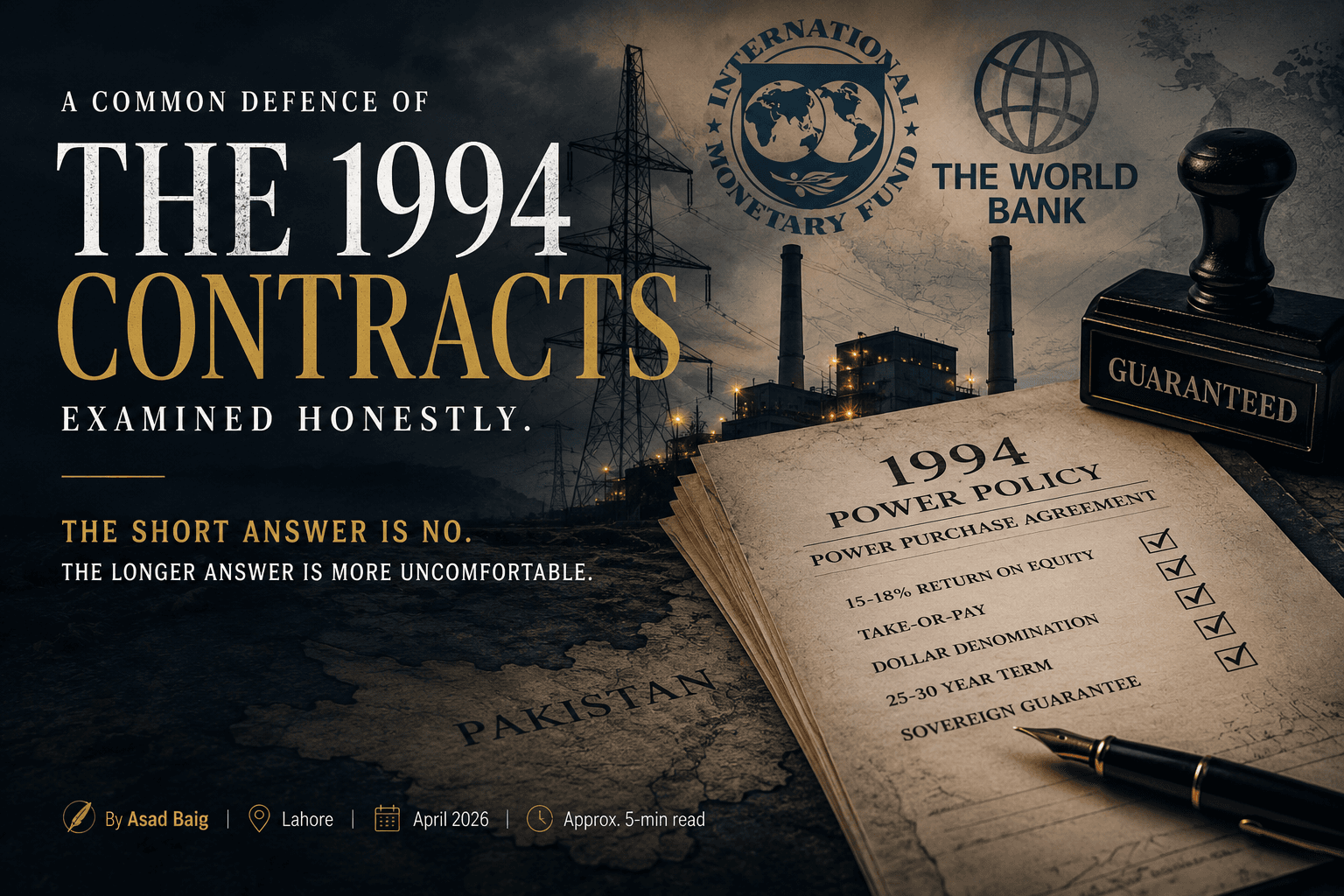
A common defence of the 1994 contracts examined honestly. The short answer is no. The longer answer is more uncomfortable.
By Asad Baig · Lahore · April 2026 · Approx. 5-min read
The defence
Whenever I write about the 1994 Power Policy, the most common defence offered by participants in the system or by their public defenders is some version of this: Pakistan was in crisis. The IMF was demanding policy reform. The World Bank was pushing the BOO/BOT model. Pakistan had no real choice. The terms were essentially imposed from outside.
This defence is partly true. Pakistan was in crisis. Western institutions were pushing the BOO/BOT model. Foreign technocrats were heavily involved in policy design.
But the defence overstates the degree of compulsion and understates the degree of Pakistani agency. After looking at this carefully, I do not believe the IMF or World Bank "forced" Pakistan to sign the specific terms that were signed. Pakistan made specific choices within the broader framework. Those choices could have been different.
This article walks through what is true and what is not in the "no choice" defence.
What the IMF and World Bank did push
The Western financial institutions were genuinely pushing for power sector liberalisation and private investment in developing-country energy infrastructure during the late 1980s and early 1990s. The general framework was:
Private investment in power generation rather than continued public-sector capital expenditure
Build-Own-Operate (BOO) and Build-Operate-Transfer (BOT) structures
Sovereign guarantees to attract foreign capital
Long-term Power Purchase Agreements with state buyers
Currency-protection clauses for foreign investors
This template was promoted by the World Bank, the Asian Development Bank, the International Finance Corporation, and other institutions. It was applied in the Philippines, Thailand, Indonesia, Mexico, Argentina, and other developing countries during the same period.
Pakistan adopted the template. The 1994 Power Policy was Pakistan's implementation of the BOO/BOT framework. To that extent, the "outside influence" defence has some truth.
What the IMF and World Bank did not impose
Within the broader BOO/BOT template, every country had latitude to negotiate specific terms. Pakistan's choices within that latitude were unusually generous to investors.
The 15-18 percent return on equity was negotiated by Pakistan, not imposed by the IMF. Other BOO/BOT-era contracts in comparable countries used returns in the 12-14 percent range. Pakistan's were higher.
The take-or-pay structure was a contractual choice. Some BOO/BOT contracts elsewhere used hybrid structures with partial demand-risk sharing. Pakistan opted for full take-or-pay.
The dollar denomination was negotiable. Other countries used partial rupee denomination, capped dollar exposure, or time-limited dollar indexation. Pakistan opted for full dollar denomination throughout the contract life.
The 25-30 year contract duration was longer than the international norm. Many comparable BOO/BOT contracts used 15-20 year terms. Pakistan opted for the longer end of the range.
The capital cost pass-through with limited regulatory verification was a Pakistani choice. The 2020 Power Sector Inquiry Report documented systematic over-statement of capital costs that NEPRA failed to challenge. This was a regulatory failure, not an IMF requirement.
The combination of these specific choices, all of which were available within the broader template, produced a structure where the investor took essentially no risk and the Pakistani consumer absorbed all of it for thirty years. Each individual choice was made by Pakistani officials. Each could have been different.
WHAT THE IMF DID AND DID NOT DO
The IMF and World Bank pushed Pakistan toward private power investment and the BOO/BOT framework. They did not dictate the specific 15-18 percent return on equity, the full dollar denomination, the 25-30 year contract terms, or the take-or-pay structure. Those specific choices were made by Pakistani negotiators, advised by foreign consultants, within an external framework that allowed for considerably more variation than was used.
Why the defence persists
The "no choice" defence is convenient for everyone involved.
For Pakistani officials of the period, it shifts responsibility outward. The decisions were not bad. The decisions were forced. There is no individual to hold accountable.
For successor governments, it provides a rationale for not reopening the contracts. The terms were imposed. Pakistan cannot unilaterally change them. The status quo must continue.
For foreign institutions, it preserves their role. The model was sound. Pakistan's specific implementation was suboptimal but the framework was not at fault. The institutions can continue promoting similar models elsewhere.
For the broader political class, it provides a convenient enemy. The IMF, the World Bank, the foreign technocrats. Blaming distant institutions is easier than confronting the specific Pakistani decisions that produced the current situation.
What this defence forgets
Other countries in the same BOO/BOT wave produced different outcomes. The Philippines, Thailand, Indonesia. Each negotiated its specific terms. Each adapted the template to local conditions. Each produced different long-term consequences. Some have managed their IPP frameworks better than Pakistan has. None operates under terms as generous to investors as Pakistan's.
The "no choice" defence requires you to believe that Pakistani officials in 1994 were uniquely powerless within an international framework that other comparable governments managed to negotiate more skilfully.
That is not a defence I find credible. The Pakistani officials of 1994 had access to the same information, the same legal advisers, and the same negotiating positions as their counterparts in comparable countries. The choices they made were specific Pakistani choices, made for specific Pakistani reasons, in a specific Pakistani political context.
I have written about this at greater length at The 1994 Power Policy: How One Year Locked Pakistan Into Thirty.
What you should take away
Two things.
The IMF did not "force" Pakistan to sign the specific 1994 contract terms. The general framework was pushed by external institutions. The specific terms were negotiated by Pakistani officials. The two should not be conflated.
The "no choice" defence is convenient but inaccurate. It allows the Pakistani officials and political class who produced the contracts to avoid accountability. The actual story involves specific decisions made by specific people for specific reasons, all of which could have been made differently.
If you encounter someone defending the 1994 contracts on "the IMF made us do it" grounds, this article gives you the facts to push back. The IMF pushed a framework. Pakistani officials chose the terms. The terms were unusually generous. They could have been different. They were not.
Now you know. Pass it on.
Thank you for reading.
, Asad Baig, Lahore, April 2026
Frequently asked questions
Did the IMF force Pakistan to sign the 1994 Power Policy? No. The IMF and World Bank pushed Pakistan toward private power investment and the BOO/BOT framework. The specific terms (15-18% return on equity, full dollar denomination, 25-30 year duration, take-or-pay structure) were negotiated by Pakistani officials within that broader framework. Other countries in the same wave negotiated different terms.
Were Pakistan's 1994 contract terms unusual by international comparison? Yes. Within the BOO/BOT template that was applied to multiple developing countries during the same period, Pakistan's specific terms were on the more generous end. Returns were higher, currency exposure was more complete, contract durations were longer.
Who is actually responsible for the 1994 Power Policy terms? A collective bureaucratic-political product. The Bhutto government cabinet that approved the policy. The Ministry of Water and Power. WAPDA leadership. The Privatisation Commission. Foreign consultants. Senior bureaucrats. Hundreds of officials over many years. The widely distributed responsibility is, paradoxically, why no individual has been held to account.
Sources and notes
World Bank PPP Knowledge Hub, Lessons from the Independent Private Power Experience in Pakistan
SDPI, History of Private Power in Pakistan (Fahd Ali and Fatima Beg)
Power Sector Inquiry Report 2020 (ARY News mirror)
IEEFA Reports on Pakistan Power Sector by Haneea Isaad (2024-2025)


 Admin
Admin