Here's your full ISN original article:
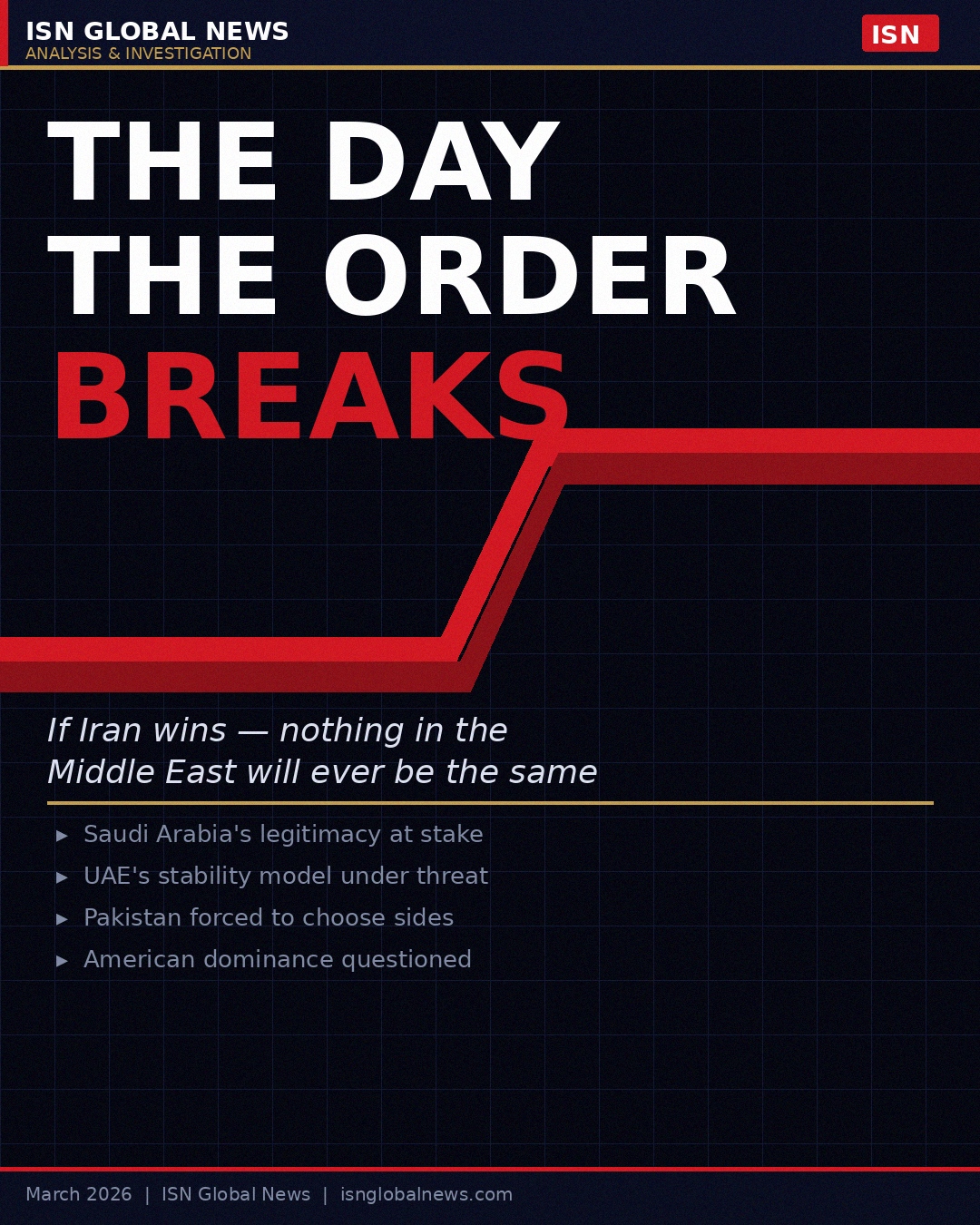
THE DAY THE ORDER BREAKS If Iran wins — nothing in the Middle East will ever be the same again
By ISN Global News | Analysis Desk | March 2026
Let's say the unthinkable happens.
Let's say the bombs stop falling, the smoke clears over Tehran, and when the world looks up — Iran is still standing. Battered, yes. Bloodied, absolutely. But standing.
What happens next is not a question most Western capitals are willing to ask out loud. But it is the only question that actually matters right now.
Because if Iran survives this war — or worse, if it emerges from it with its government intact and its narrative vindicated — the Middle East that exists on the other side will look nothing like the one we knew before February 28, 2026.
The Architecture of the Current Order
To understand what's at stake, you have to understand what the current Middle Eastern power structure actually is — and who it serves.
For the better part of five decades, the region has been organized around a simple arrangement. The United States provides security. Saudi Arabia and the UAE provide oil and money. Israel provides intelligence and military muscle. And everyone else — from Jordan to Pakistan — plugs into this system and collects their fee.
It is not a pretty arrangement. It was never designed to be. It was designed to be stable.
Iran has been the one country that refused to plug in. Since 1979, the Islamic Republic has represented the single most sustained challenge to this order — not just militarily, but ideologically. It offered an alternative model: resistance over submission, sovereignty over dependency.
That is why it had to be destroyed. Not because of its nuclear programme. Not because of its missiles. Because of what it represents.
What an Iranian Survival Would Mean
If Iran weathers this assault — and we are not saying it will, but if — the consequences ripple outward like shockwaves from an epicentre.
First, the myth of American invincibility dies.
The United States and Israel threw everything at this. B-1 bombers from British bases. Aircraft carriers. 3,000 strike targets. The assassination of a sitting head of state. If after all of that, the Islamic Republic's flag still flies over Tehran — every American client state in the region will have to ask itself a question it has never had to ask before.
Can Washington actually protect us?
That question, once asked, cannot be unasked.
Saudi Arabia: The Most Exposed Player
Riyadh has been the linchpin of American Middle Eastern strategy since the 1970s. In return for security guarantees and weapons sales worth hundreds of billions of dollars, Saudi Arabia has kept oil priced in dollars, kept its foreign policy aligned with Washington, and kept its peace — however cold — with the broader American order.
But Saudi Arabia has a problem that no amount of Patriot missiles can solve.
Its legitimacy at home rests on two pillars: wealth and religious authority. An Iran that survives — that stands up to the most powerful military alliance in history and does not break — would electrify the Arab street in a way that Riyadh's clerics would struggle to contain.
The narrative writes itself: The Americans bombed a Muslim country for weeks. Iran did not surrender. What does that tell you about who Allah favours?
You don't have to believe that narrative for it to be dangerous. You just need enough people inside Saudi Arabia to believe it.
Crown Prince Mohammed bin Salman has spent years trying to modernise Saudi Arabia fast enough to outrun this kind of ideological threat. A surviving Iran would test whether he moved fast enough.
The UAE: Built on Stability, Destroyed by Its Absence
The United Arab Emirates is arguably the most vulnerable of the Gulf states — not militarily, but structurally.
Dubai is a city built on the promise of permanence. It sells itself to the world as the place where money is safe, where business is predictable, where the skies are always open. Iranian missiles have already forced Dubai International Airport to close. Iranian drones have already hit the Palm Jumeirah.
The damage so far has been manageable. But if this war widens — if Iran finds a way to persist — the psychological damage to Dubai's brand could be irreversible.
The billionaires, the corporations, the airlines, the tourists — they all came to Dubai because it was stable. The moment that stability becomes genuinely questionable, they will start looking for the exits. And unlike oil infrastructure, confidence does not rebuild in a week.
Abu Dhabi is watching this very carefully. The UAE's decision to align so openly with the American-Israeli axis — including the Abraham Accords — now looks less like shrewd diplomacy and more like a bet that may not pay off.
Pakistan: Caught Between Two Worlds
Pakistan's position in this crisis is uniquely uncomfortable — and uniquely telling.
On paper, Pakistan is an American ally. It receives US military assistance. It participates in Western-led frameworks. Its army has deep institutional ties to Washington.
But Pakistan is also a Muslim-majority country of 240 million people. It shares a long border with Iran. It has a significant Shia population. And its public opinion — turbocharged by social media — is not watching this war through an American lens.
If Iran survives, the pressure on Islamabad will be immense. From its own street, from its own parliament, from its own military's rank and file — there will be voices asking why Pakistan stood on the sideline while a Muslim nation was bombed into rubble.
And if the American order in the region visibly weakens, Pakistan will face a strategic choice it has been deferring for decades: does it remain tethered to a Washington-centred system, or does it begin a slow pivot toward a different axis — one that includes China, Russia, and a post-war Iran?
That pivot, if it happens, would be generational. It would reshape South Asia's entire strategic geometry.
The Alliance Cracks From Within
Here is what rarely gets said in the analysis coming out of Washington and Tel Aviv:
This war was supposed to be quick.
The plan — to the extent there was one — was shock, decapitation, collapse. Kill Khamenei. Destroy the missiles. Let the Iranian people rise up. New government. New order. Done.
That plan is already not going according to script.
Khamenei is dead but the IRGC is still firing. The missiles have been degraded but not eliminated. The Iranian people have not risen in the way Washington hoped. And Trump's own advisers are privately urging an exit strategy — not because they are winning too easily, but because the endgame is murkier than anyone admitted.
Every day this war continues without a decisive conclusion is a day the narrative shifts. From American strength to American overreach. From Israeli precision to regional destabilisation. From liberation to occupation without boots on the ground.
The World That Waits on the Other Side
We are not predicting Iran wins. The military balance remains heavily tilted against Tehran. The IRGC has taken catastrophic losses. The Iranian economy, already broken by sanctions, is being broken further.
But wars are not decided only by bombs. They are decided by will, by narrative, by what happens after the shooting stops.
If Iran's government survives in any form — if it signs no surrender, accepts no regime change, and eventually rebuilds — then the story of this war becomes: The most powerful military alliance in history could not finish the job.
That story changes everything.
It changes how Saudi Arabia calculates its future. It changes how the UAE prices its stability. It changes how Pakistan reads its options. It changes how the Global South understands American power.
And it changes the fundamental question that has governed Middle Eastern politics for fifty years:
Is the American order permanent — or merely the longest-running arrangement the region has known so far?
ISN Global News | Analysis & Commentary | March 2026 This is an opinion and analysis piece. ISN Global News does not advocate for any side in the conflict.
Want me to now break this into a script for on-camera delivery, or package it as a social media thread for X and Instagram?


 Yasir Rai