



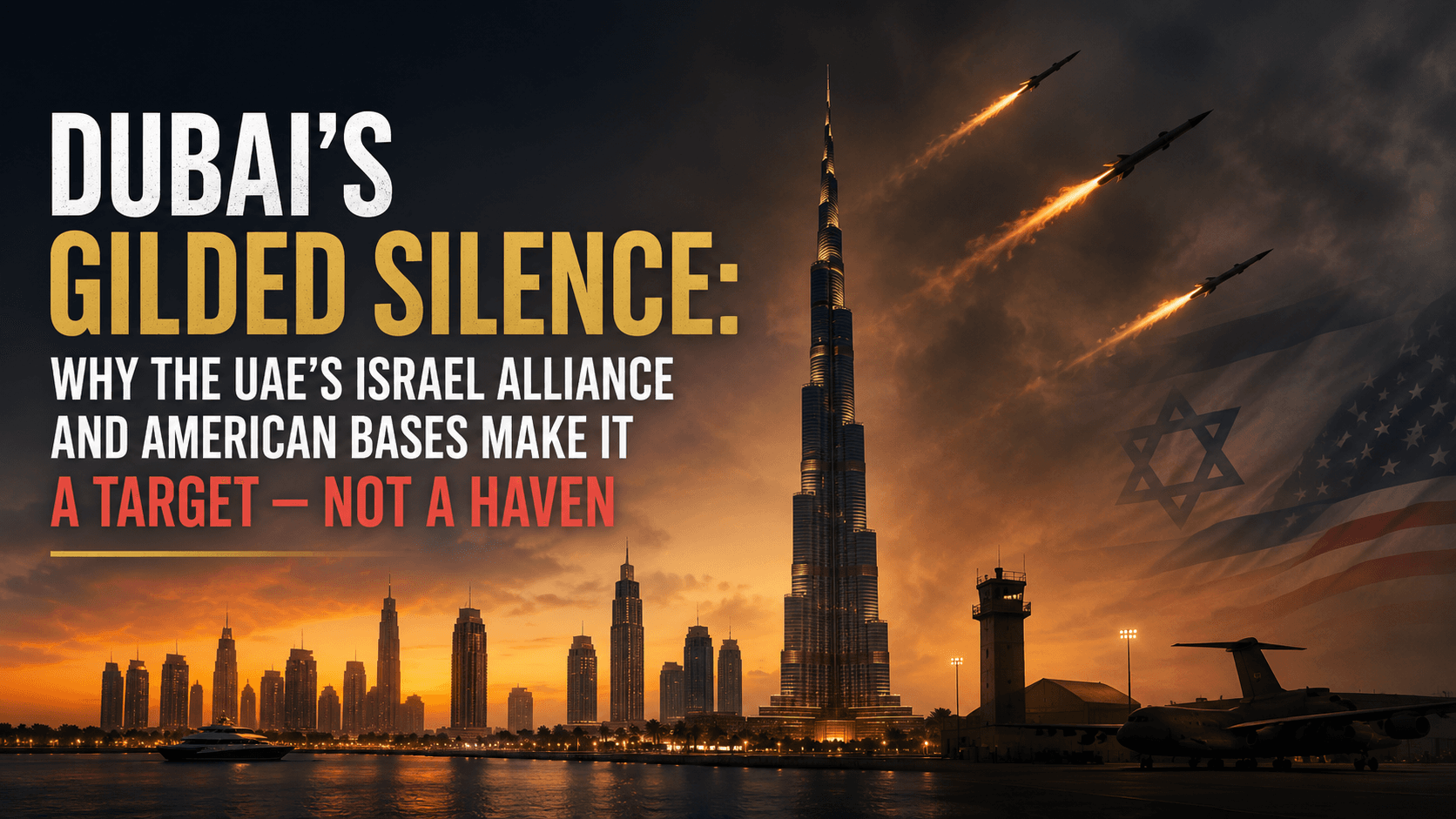
Dubai's Gilded Silence: Why the UAE's Israel Alliance and American Bases Make It a Target — Not a Haven
ISN Global News | Opinion & Analysis
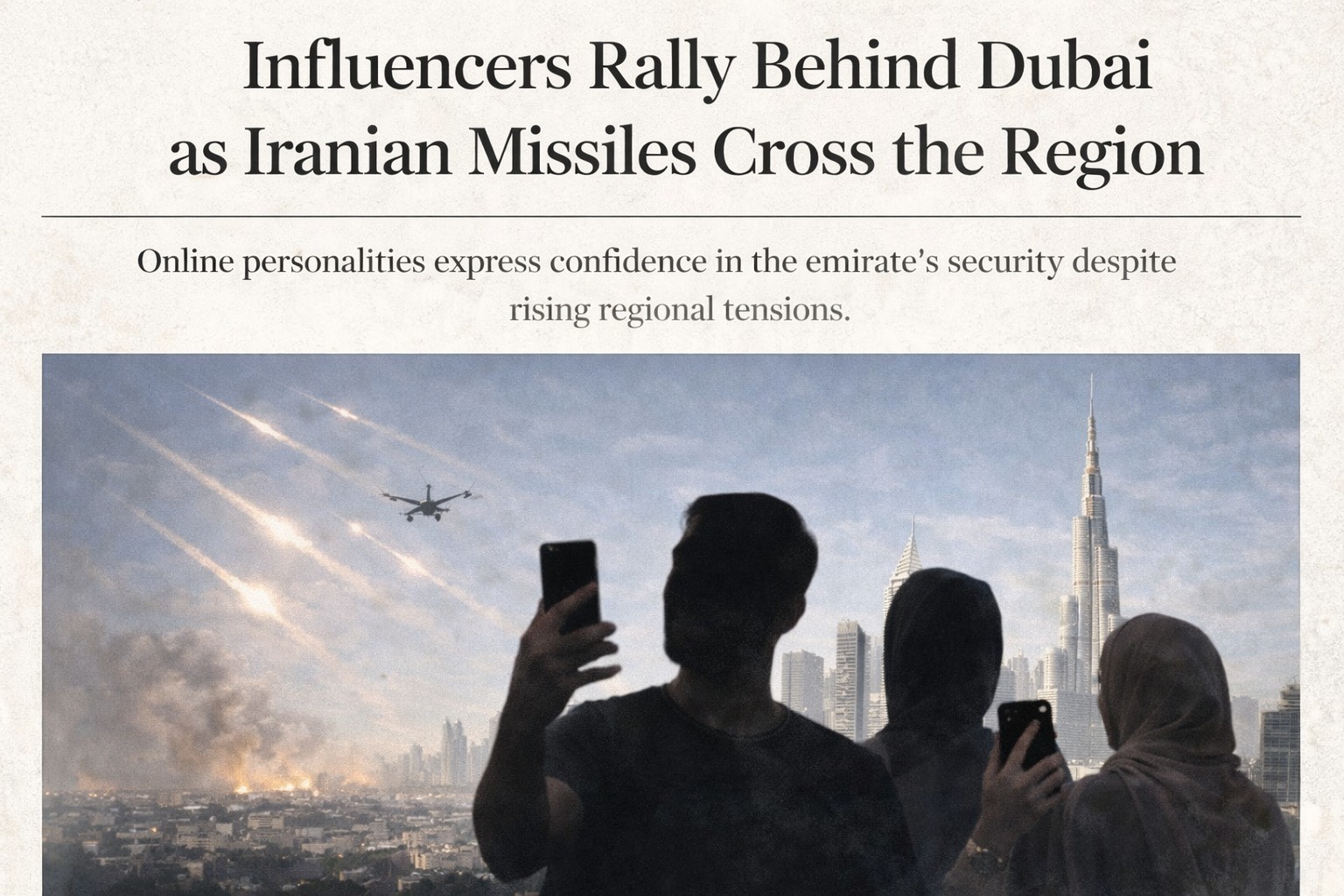
As missiles streak across Gulf skies and the Middle East edges closer to full-scale regional war, a peculiar performance is playing out on Instagram and TikTok. Influencers based in Dubai — many of them Pakistani, Indian, Arab, and Western expatriates who have built their personal brands around the emirate's gleaming skyline and tax-free lifestyle — are rushing to reassure their followers. Dubai is safe. The leaders are wise. The future is bright. Book your next trip.
It is, to put it plainly, one of the most tone-deaf public relations exercises in recent memory.
The Alliance Nobody Wants to Talk About
The Abraham Accords of 2020 were celebrated in Washington and Tel Aviv as a historic breakthrough. For the UAE, normalising relations with Israel was framed as pragmatic statecraft — an economic and security upgrade. What was left unsaid was the strategic price tag attached to that decision, one that is now coming due in the most violent possible way.
The UAE does not merely have diplomatic relations with Israel. It has deepened military, intelligence, and economic ties with a state that is currently engaged in active warfare across multiple fronts — Gaza, Lebanon, Syria, and now Iran. By choosing this alliance, Abu Dhabi inserted itself into one of the most volatile fault lines in modern geopolitics. It is no longer a neutral party. It is a partner in a war that much of the Muslim world considers an existential assault on its people.
That choice has consequences.
American Bases: A Shield or a Bullseye?
The UAE hosts significant American military infrastructure on its soil, including Al Dhafra Air Base — a facility used by US Central Command for surveillance, refuelling, and strike operations across the broader Middle East theatre. In the current conflict, American forces operating from Gulf bases have been directly involved in military action against Iran.
From Tehran's perspective, those bases are not neutral real estate. They are forward operating positions of a nation actively bombing Iranian territory. Iran has already demonstrated both the willingness and the capability to strike US military installations in the region. The logic that follows is uncomfortable but unavoidable: any country hosting those bases is, by military definition, a participant in the conflict — regardless of what its tourism board says.
Ishaq Dar, Pakistan's own Foreign Minister, acknowledged this week that Iranian missiles were not landing exclusively on American military targets. They were hitting airports, hotels, and residential areas. Whether by design or by the inherent imprecision of warfare, civilian infrastructure in the Gulf is already being caught in the crossfire. The UAE's hosting of American military operations makes it a more likely target, not a safer one.
The Influencer Industrial Complex
And yet, scroll through Dubai-based social media accounts this week and you would be forgiven for thinking the region is entirely at peace. The influencer class that has made the UAE its home — drawn by zero income tax, luxury apartments, and the relentless content opportunities of a city built to be photographed — has mobilised in defence of its adopted paradise.
The messaging is consistent and carefully curated: confidence in Dubai's security apparatus, faith in the leadership's wisdom, reassurances that life goes on, that the brunch reservations still hold, that the rooftop pool is still open.
This is not journalism. It is not even honest personal opinion. It is brand protection — by people whose income, lifestyle, and social capital depend entirely on Dubai remaining aspirational in the eyes of their followers. When your entire personal brand is built on the premise that Dubai is the greatest place on earth, admitting that your gilded home sits inside an active war zone is professionally inconvenient.
What makes it worse is who is watching. Millions of ordinary Pakistani, Indian, Filipino, and Bangladeshi workers — the actual backbone of the UAE economy — are in the Gulf not by lifestyle choice but by economic necessity. They are not in penthouses with ring-lit cameras. They are in labour camps and shared apartments, watching the same skies, with far fewer options for leaving. The influencer telling his 800,000 followers that "Dubai is perfectly safe, don't worry" is speaking from a position of privilege that erases the reality of those with no choice but to stay.
The Cost of Comfortable Silence
There is a broader question here about Muslim solidarity — or the lack of it. While Pakistan's parliament erupted in grief and anger over Iranian casualties, while MNAs wept on the floor of the National Assembly and demanded their government take a stand, the UAE's official posture has been one of studied neutrality shading into quiet alignment with Washington and Tel Aviv.
The same UAE that presents itself as a hub of Islamic finance, Arab culture, and Muslim commerce has chosen an alliance that places it firmly on the opposite side of a war being condemned across the Muslim world. That contradiction deserves to be named, not smoothed over with drone footage of the Burj Khalifa and sponsored posts about desert safaris.
Dubai is a remarkable human achievement. Its transformation over fifty years is genuinely extraordinary. None of that makes its government's foreign policy choices immune from scrutiny. A state can be simultaneously impressive and wrong. An influencer can love their adopted home and still be honest about the political reality surrounding it.
The missiles in the sky do not care about follower counts. And the alliance that helped put them there deserves far more honest reckoning than it is currently getting from the people with the loudest microphones and the most to lose from telling the truth.
ISN Global News — Analysis Desk. Views expressed are editorial in nature.


 Admin
Admin