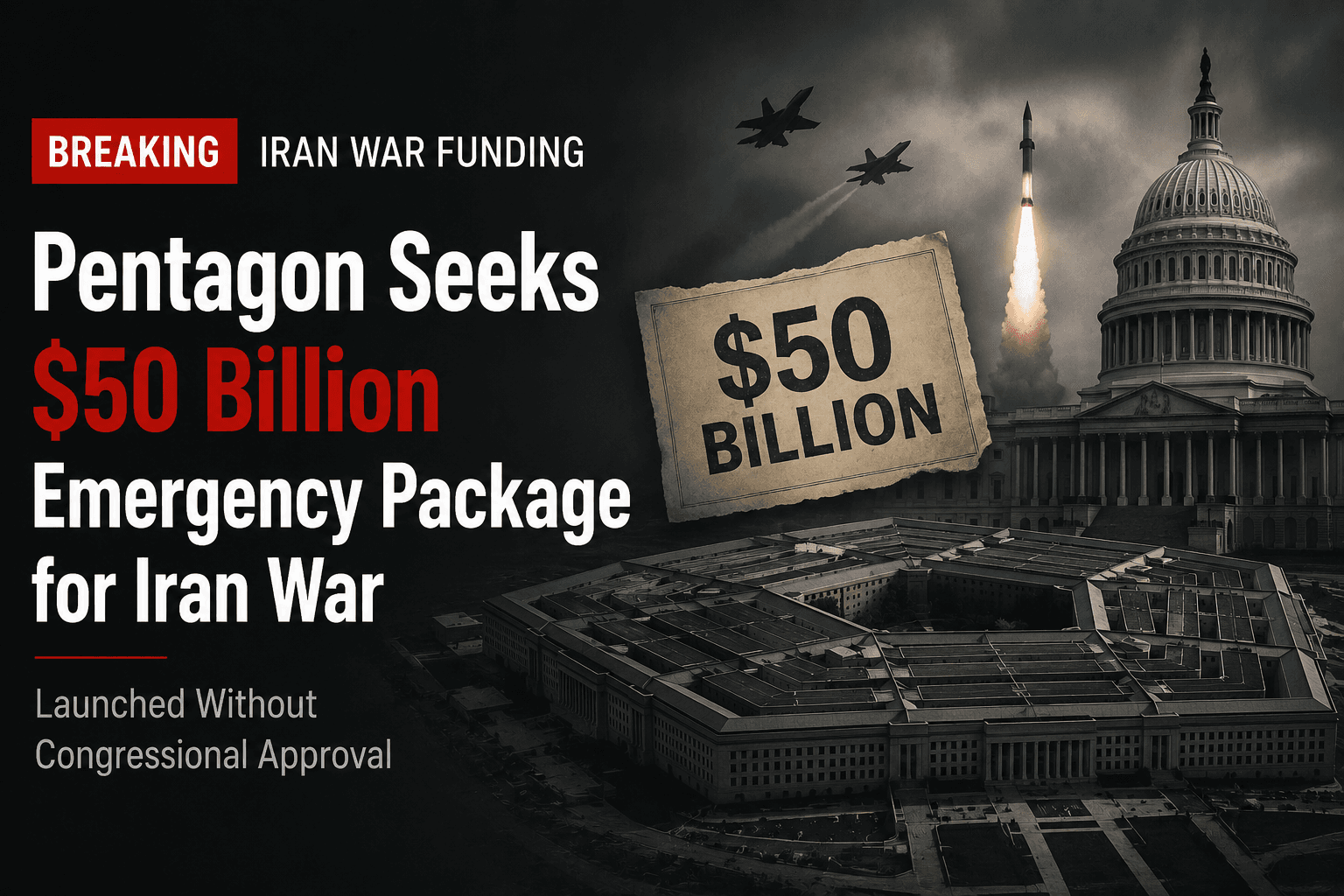
BREAKING · IRAN WAR FUNDING
Pentagon Seeks $50 Billion Emergency Package for Iran War — Launched Without Congressional Approval
A war that Congress never authorised is now draining America's $1 trillion defence budget, depleting missile stockpiles, and forcing cuts to domestic programmes — as lawmakers scramble for their last remaining leverage
By ISN Global News Desk | Washington Published: Friday, March 6, 2026 | Sources: Roll Call, Reuters, Common Dreams, Responsible Statecraft, MinnPost
■ TIER 1 — THE LEAD: What Is Happening
The United States Pentagon is preparing to request an emergency supplemental budget of approximately $50 billion from Congress to fund the ongoing war against Iran — a military operation that was launched without a formal congressional declaration of war and has already cost billions of dollars in its first week alone. The war, officially designated Operation Epic Fury, began on February 28, 2026, with joint US-Israeli strikes on Iran.
■ TIER 2 — KEY FACTS: How the War Is Being Funded Right Now
The war is currently being financed through the existing Pentagon budget, which was boosted to nearly $1 trillion for the current fiscal year. As part of last year's budget reconciliation package, lawmakers approved $153.3 billion in additional defence funding — money made available through fiscal 2029 but fast-tracked into 2026 spending as the conflict escalated.
House Appropriations Committee Chairman Tom Cole confirmed this week that "the Pentagon is working on" a supplemental appropriations request, though no formal ask had arrived at Congress at time of publication. Deputy Defence Secretary Steve Feinberg has been leading internal Pentagon work on the $50 billion figure, according to Reuters.
Defence Secretary Pete Hegseth has said the war could last up to eight weeks — a timeline that analysts warn would burn through resources at a rate that makes supplemental funding not optional, but inevitable.
■ TIER 3 — THE CONTROVERSY: A War Without Authorisation, Now Seeking a Blank Cheque
This is where the story becomes deeply controversial.
The war on Iran was launched by President Trump without a congressional declaration of war or an Authorisation for Use of Military Force (AUMF). Attempts in both the House and Senate to pass resolutions limiting Trump's war powers failed this week, largely along party lines — meaning Congress was unable to stop the war and is now being asked to fund it.
Critics across the political spectrum have reacted with fury. Representative Greg Casar, chair of the Congressional Progressive Caucus, said: "While they kick 17 million Americans off their healthcare, Republicans want to spend billions on Trump's reckless war of choice. Hell no."
Policy analysts at the Center for International Policy have urged Congress to approve "not one damn penny" for what they describe as an unauthorised war being conducted in violation of both domestic and international law.
■ TIER 4 — THE SLUSH FUND WARNING: History Repeating Itself
Perhaps the most alarming controversy raised by defence analysts is the historical parallel to the Iraq and Afghanistan wars.
After September 11, President George W. Bush used a near-identical mechanism — called the Overseas Contingency Operations budget, or OCO — to fund those wars outside of Congress's regular appropriations process and without the same oversight requirements. What began as emergency war funding rapidly became, in the words of budget experts, a "slush fund" for military pet projects having nothing to do with combat operations. By the time the Biden administration officially shut down the OCO account in 2021, Congress had poured more than $2 trillion into it — with minimal accountability, minimal transparency, and minimal oversight.
Analysts now warn the Iran war is following the exact same playbook, and that the $50 billion request is likely just the opening number.
■ TIER 5 — THE HUMAN COST ARGUMENT: Bombs vs. Healthcare
The funding debate is not just about war — it is about what gets sacrificed to pay for it.
Any supplemental spending request will need to pass the House and clear the Senate's 60-vote filibuster threshold — requiring at least seven Democrats to cross the aisle. To secure those votes, Republicans may be forced to offset the war spending with cuts elsewhere in the federal budget. Domestic programmes — healthcare, education, housing assistance — are the most likely targets.
Analysts at the Center for American Progress stated this week: "If this war continues at the same pace, Americans could see their government burn through tens of billions of dollars — funds that would amount to the cost of Medicaid for millions of United States citizens."
■ TIER 6 — THE WEAPONS CRISIS: America Weakening Itself
There is a military dimension to the funding crisis that receives far less attention but may carry the gravest long-term consequences.
The United States has already expended a quarter of its THAAD missile interceptors and large quantities of Patriot PAC-3 missiles in the first days of Operation Epic Fury. Defence analysts warn this is rapidly creating dangerous gaps in America's layered missile defence architecture — particularly in the Indo-Pacific, where deterring China and North Korea depends on those very same stockpiles.
In other words: the Iran war is not just expensive in dollars. It is expensive in strategic deterrence capacity — and those are assets that take years and billions to rebuild.
■ TIER 7 — POLITICAL LEVERAGE: The Money Is Democrats' Last Card
Congress's war powers resolutions failed. Diplomatic pressure has not slowed the strikes. But the $50 billion funding request may be the one remaining pressure point where opposition — from both Democrats and Republican fiscal hawks — can exert real influence over the direction and duration of the conflict.
Senate Minority Leader Charles Schumer stated this week: "Americans don't want a war that leads to lost American lives and that costs billions and billions of taxpayer dollars."
Whether that sentiment translates into votes — or whether it is drowned out by wartime political pressure — will define the next phase of this conflict.
KEY NUMBERS AT A GLANCE
$1 trillion — Current total Pentagon budget for fiscal year 2026
$50 billion — Emergency supplemental funding being prepared
$2 trillion+ — Total spent on Iraq/Afghanistan via the OCO "slush fund" model
25% — Share of US THAAD interceptor stockpile already expended
8 weeks — Estimated war duration per Defence Secretary Hegseth
7 — Number of Senate Democrats needed to pass any emergency war funding bill
0 — Number of formal congressional war authorisations granted before strikes began
⚠ Editorial Note: ISN Global News reports these figures and assessments in the public interest. Projections on war costs and duration remain fluid and subject to change as the conflict develops. All figures sourced from US congressional records, Reuters, Roll Call, and independent budget analysis institutions.
ISN Global News | isnglobalnews.com | © 2026



 Yasir Rai