



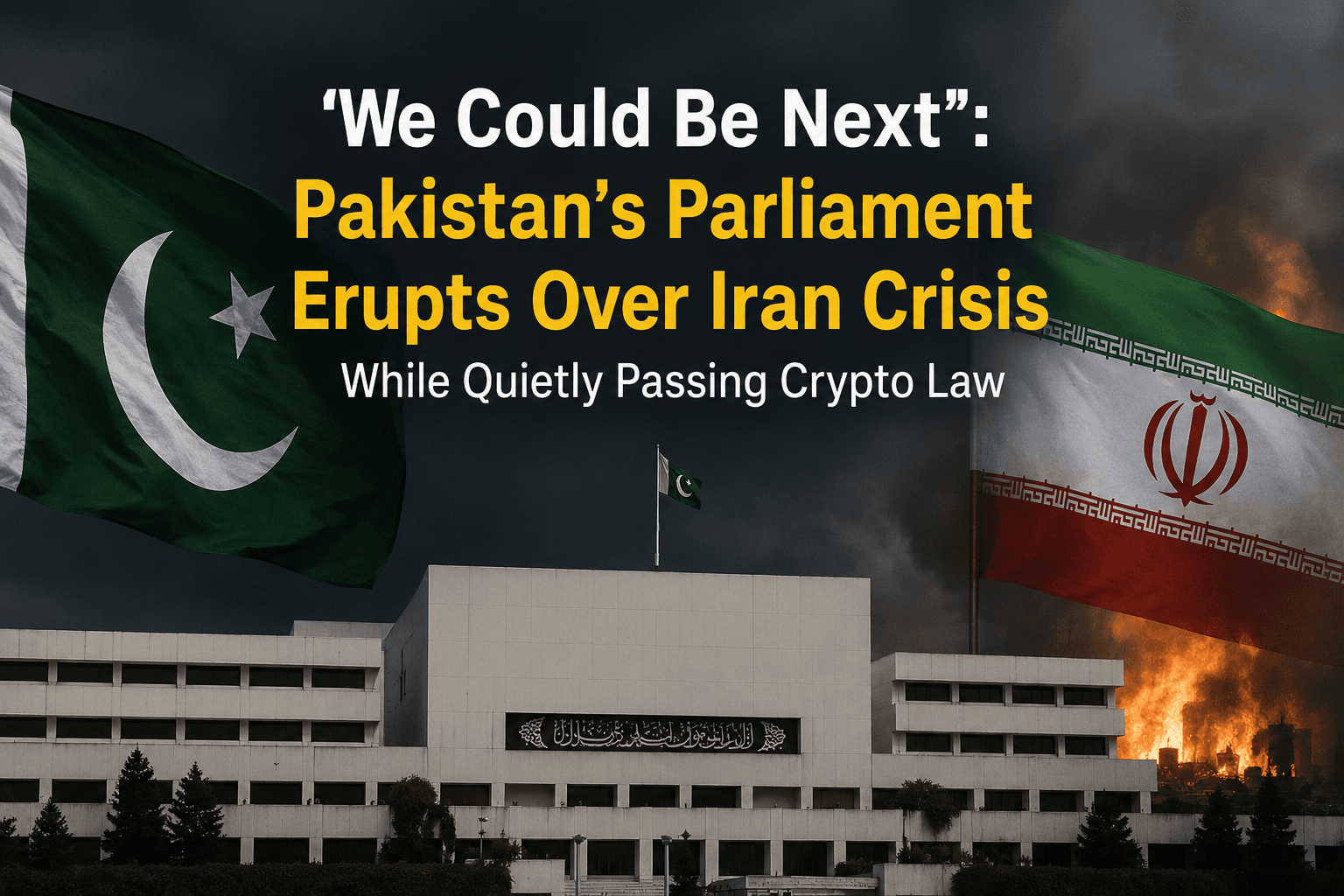
"We Could Be Next": Pakistan's Parliament Erupts Over Iran Crisis While Quietly Passing Crypto Law
By ISN Global News Desk | Islamabad, March 4, 2026
Pakistan's National Assembly held an extraordinary session on Tuesday that combined swift legislative action with some of the most emotionally charged speeches heard in the chamber in recent memory.
Before any general debate could begin, the government moved quickly to pass the Virtual Assets Bill 2026 — a landmark piece of legislation that creates a dedicated federal authority to regulate cryptocurrencies and other digital assets in Pakistan. Minister for Parliamentary Affairs Dr Tariq Fazal Chaudhry used procedural rules to temporarily set aside the regular private members' agenda, allowing the bill to be introduced and approved through a supplementary agenda. Despite some dissenting voices in the house, Speaker Ayaz Sadiq allowed the process to proceed. The bill, which had already cleared the Senate and been reviewed by parliamentary committees, was passed through a voice vote in a matter of minutes, with Finance Minister Muhammad Aurangzeb's team presenting it to the floor.
Once the legislative business concluded, the session shifted into an intense national security debate focused on the US-Israeli military strikes against Iran and the death of Iranian Supreme Leader Ali Khamenei. The lower house collectively described Khamenei as a martyr of the Muslim world, with members lining up to denounce American foreign policy and express solidarity with Iran.
PPP leader Syeda Shehla Raza delivered a composed but deeply emotional address, arguing that external forces would not succeed in engineering regime change in Iran. She framed the ongoing conflict as a systematic campaign against Muslim-majority nations, warning that no country would be spared and urging resilience in the face of aggression.
Her party colleague Abdul Qadir Patel took a more confrontational tone, directly challenging the government's response to the crisis. He questioned what concrete steps Pakistan's leadership was taking for the people of Gaza, Kashmir, and now Iran, warning that the instability spreading across the region was moving dangerously close to Pakistan's own borders.
PTI members also weighed in, criticising Prime Minister Shehbaz Sharif for previously nominating US President Donald Trump for the Nobel Peace Prize — a stance they described as incompatible with the current reality of American military involvement in the region.
Barrister Gohar Ali Khan argued that the Israeli strikes on Iran had no legal justification under international law. He pointed to earlier diplomatic signals — including a statement from Oman's foreign minister indicating that Iran had agreed to limit its nuclear activities — suggesting that a peaceful resolution had been within reach before the attacks were launched. He noted that the strikes had resulted in civilian casualties, including children.
MQM's Aasia Ishaq broadened the debate to Pakistan's western border, alleging that Afghanistan's Taliban-led government was operating in coordination with India against Pakistani interests. She called on the government not to ease pressure on Kabul until the Taliban demonstrated a genuine shift in policy, and warned that the combination of Indian, Israeli, and Afghan hostility represented a serious strategic threat to Pakistan.
Several other lawmakers, including Aniqa Mehdi and Hameed Hussain, also addressed the house, echoing concerns about a perceived India-Israel axis and what they described as a deliberate strategy to destabilise Muslim nations one by one.


 Admin
Admin