



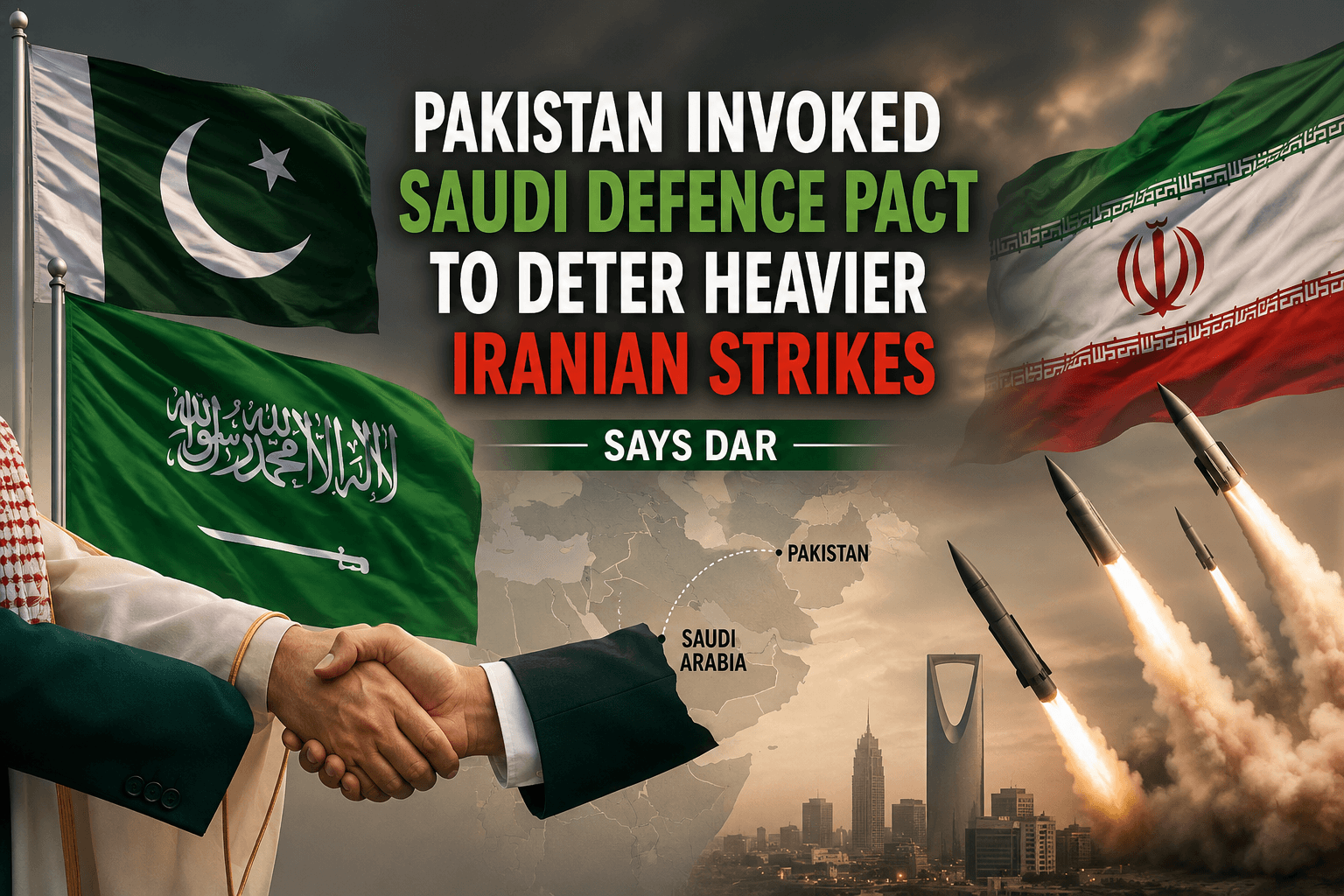
Pakistan Invoked Saudi Defence Pact to Deter Heavier Iranian Strikes, Says Dar
ISN Global News Desk | Islamabad, March 4, 2026
Deputy Prime Minister and Foreign Minister Ishaq Dar has revealed that Pakistan played a quiet but significant behind-the-scenes role in preventing a more devastating Iranian missile campaign against Saudi Arabia during the ongoing regional conflict. Speaking at a press briefing at the Foreign Office in Islamabad on Tuesday — and separately in the Senate — Dar disclosed that he personally intervened with Iranian leadership by invoking the bilateral defence agreement Pakistan signed with Riyadh last year.
The Saudi-Pakistan Defence Card
Dar confirmed that Pakistan holds a Strategic Mutual Defence Agreement with Saudi Arabia, formalised in September last year. Under the terms of that agreement, an armed attack against either country is treated as an attack against both, and the two nations are bound to respond jointly. Dar said he used this framework as leverage during his visit to Saudi Arabia, directly communicating to Iranian leadership that any strikes on Saudi soil would carry serious consequences for Iran's relationship with Islamabad.
Iranian officials, according to Dar, were primarily concerned about whether Saudi territory was being used as a launchpad for attacks against Iran. Dar said he engaged in shuttle diplomacy between the two sides, securing assurances from the Saudis that their soil would not be used for offensive operations against Tehran. He credited this diplomatic back-channel with keeping Saudi Arabia largely shielded from the worst of the regional fallout.
"Unlike almost every other country in the region, Saudi Arabia faced the fewest attacks — apart from Oman, which was serving as a mediator," Dar noted.
Iran's Missile Accuracy Under Scrutiny
Dar also cast doubt on Iranian claims of precision targeting, stating that while Tehran insisted its missiles were aimed at American military installations, the actual impact sites told a different story. Strikes reportedly hit airports, hotels, and residential neighbourhoods rather than exclusively military infrastructure — raising questions about either the accuracy of Iran's weapons or the truthfulness of its official statements.
Pakistani Diaspora in the Gulf: One Dead, Thousands Stranded
With an estimated four to five million Pakistani nationals living and working across the Gulf and Middle East, the escalating conflict has created a humanitarian emergency for Islamabad. Dar confirmed that one Pakistani citizen lost his life in Abu Dhabi as a direct result of the hostilities, though he provided no further details.
He outlined the current situation across affected countries:
Saudi Arabia remains home to the largest concentration of Pakistani expatriates in the world, with roughly 2.5 million nationals residing there. Qatar hosts around 350,000 Pakistanis, and an additional 1,400 short-term visitors and tourists are currently stranded due to widespread flight cancellations and airport closures. Pakistani missions are coordinating with Qatari authorities to assist those seeking to return home.
In Iraq, approximately 40,000 Pakistanis are present, including around 3,500 religious pilgrims visiting Shia holy sites. Roughly 500 nationals based in the Kurdistan region have expressed a wish to return to Pakistan, and repatriation arrangements are being worked out. Kuwait has around 101,000 Pakistani residents, with 27 short-term visitors currently unable to travel home. Bahrain hosts 134,000 Pakistanis, none of whom are reported stranded. Jordan, with approximately 18,000 Pakistani residents, is also reporting no stranded nationals.
Dar said Pakistani diplomatic missions across the region are in active contact with affected communities and working to facilitate safe returns where needed.
Nobel Nomination Clarification
On the controversy surrounding Pakistan's nomination of US President Donald Trump for the Nobel Peace Prize — which drew sharp criticism in parliament — Dar clarified that the nomination was made in the context of Trump's role in brokering a ceasefire during last year's India-Pakistan military confrontation, and was not a blanket endorsement of American foreign policy in the Middle East.


 Admin
Admin