



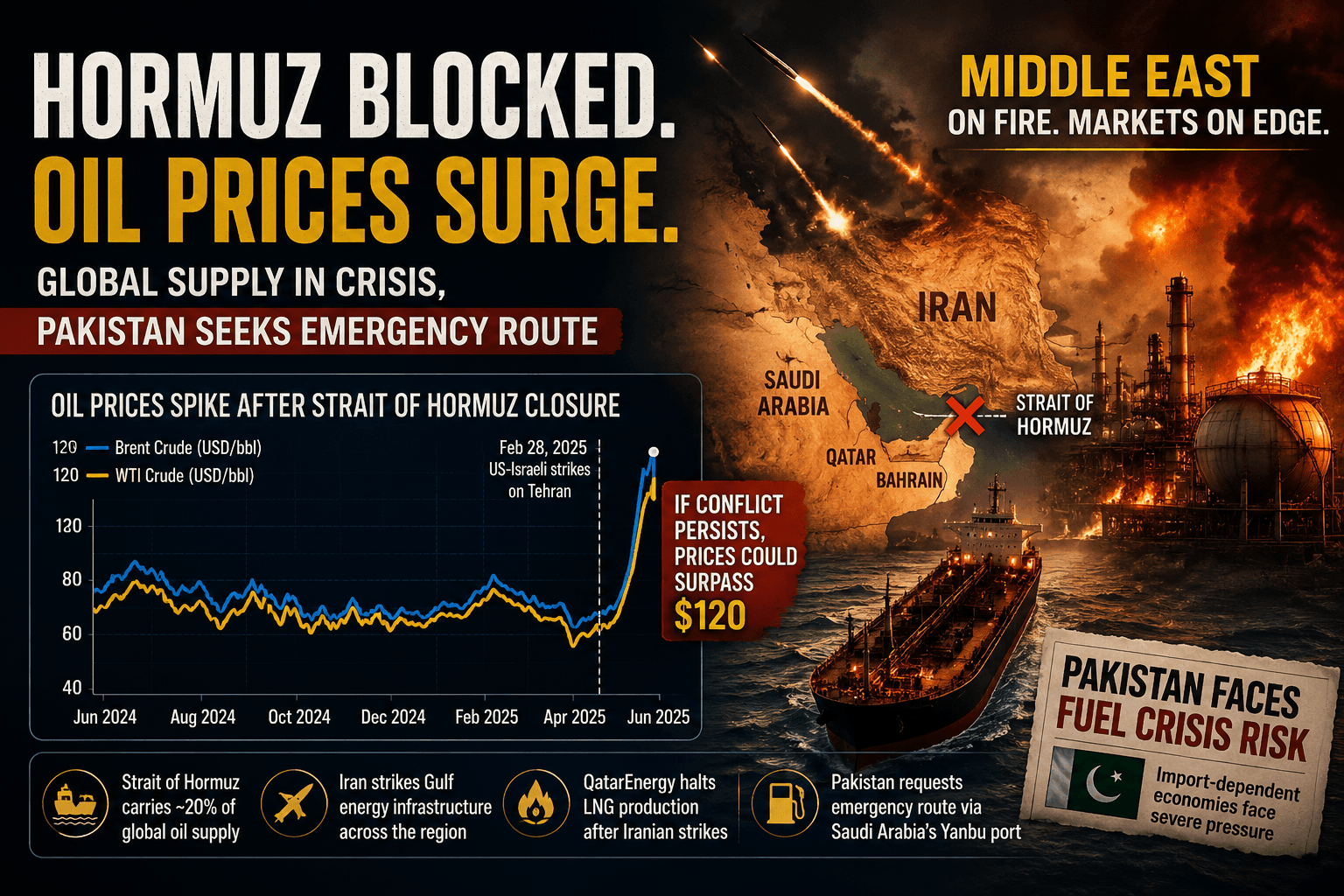
LONDON/ISLAMABAD — Global oil prices surged toward the $100-per-barrel threshold on Monday as the escalating US-Israel war on Iran rattled energy markets worldwide, with Brent crude climbing to $99.77 and WTI reaching $94.37 — levels not seen since Russia's invasion of Ukraine in 2022.
The dramatic spike, which saw both benchmarks nearly double from their pre-conflict lows, was triggered by Iran's closure of the Strait of Hormuz following the February 28 US-Israeli strikes on Tehran. The strait serves as the transit corridor for roughly a fifth of the world's daily oil supply, and its blockage has sent shockwaves through commodity markets from London to Singapore.
Iran's retaliatory missile and drone campaign has compounded the supply panic, with strikes targeting Gulf energy infrastructure including Saudi Arabia's Shaybah oil field and a drone attack on a Bahraini oil refinery. QatarEnergy, the world's largest LNG producer, separately halted production after Iranian strikes, further squeezing global supply.
For Pakistan, the consequences are immediate and severe. Islamabad has already formally requested an emergency oil supply route through Saudi Arabia's Yanbu port to bypass the Hormuz blockade, as the country faces a potential fuel crisis. Analysts warn that if the conflict does not de-escalate quickly, prices could push past the $120 mark — a threshold that would place enormous pressure on import-dependent economies across South Asia.
<iframe src="https://isn-media.s3.ap-southeast-1.amazonaws.com/oil-price-chart.html" width="100%" height="460" frameborder="0" style="border:none;">
</iframe>

 ISN MEDIA